 Add to Chrome
 Add to Firefox
 Add to Edge
Doeblin Curves
Jun 18, 2026
Recent research on Doeblin coefficients has shed light on their usefulness as a multi-way generalization of the Dobrushin contraction coefficient for TV distance, in a separate vein from their classic role in the theory of Markov chain ergodicity. However, strong conditions, such as being bounded away from 0, are typically necessary for Doeblin coefficients to establish the existence of information contraction. Building on recently formulated concepts of nonlinear information contraction, we aim to propose a finer-grained Doeblin-based characterization of multi-way contraction behavior which yields non-vacuous contraction guarantees even for channels whose Doeblin coefficient is 0. To this end, we introduce the notion of a Doeblin curve -- a nonlinear function which quantifies the contraction behavior of a Markov kernel on collections of input distributions at specific levels of divergence and power. Through the course of our analysis, we develop a new variational characterization of Doeblin coefficients, present several properties of Doeblin curves, define several versions of power-constrained Doeblin curves, and derive upper and lower bounds using our aforementioned variational characterization. We then utilize these results in diverse areas, including generalization bounds for noisy iterative optimization, error bounds for reliable computation with noisy circuits, and differential privacy guarantees for online iterative algorithms. In particular, we extend results in these areas to broader domains or group settings, leveraging Doeblin curves to reveal finer-grained contraction phenomena than Doeblin coefficients.
* 42 pages, 2 figures

Entrywise Error Bounds for Spectral Ranking with Semi-Random Adversaries
May 22, 2026Bradley-Terry-Luce (BTL) model estimation is a well-established strategy to rank a collection of items given a dataset of pairwise comparisons. Although the theoretical performance of BTL estimation methods, such as spectral and maximum likelihood estimation, is well studied in the regime of uniformly sampled graphs, generalizing such results to a wider class of random graphs has proved challenging. In this work, we investigate the entry-wise error of spectral algorithms against a semi-random adversary that can arbitrarily boost the sampling probabilities of certain edges. We find that the performance of the unweighted spectral method is heavily dependent on the spectral properties of the generated graph. Furthermore, we show that asymptotic performance approaching that of uniformly sampled graphs can be recovered by appropriately reweighting the observed edges to counteract the adversary and restore the spectral gap. Finally, we provide numerical simulations that support our theoretical findings.
Minimax Hypothesis Testing for the Bradley-Terry-Luce Model
Oct 10, 2024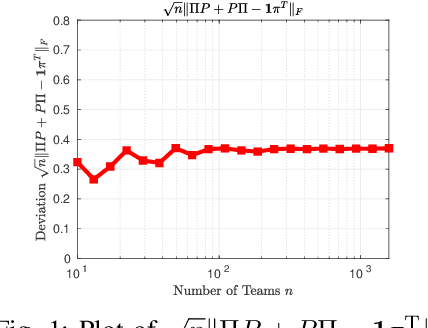
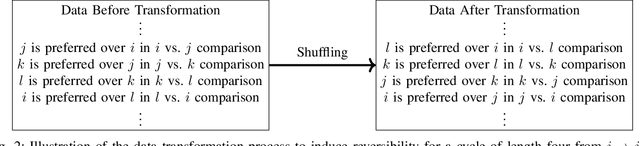
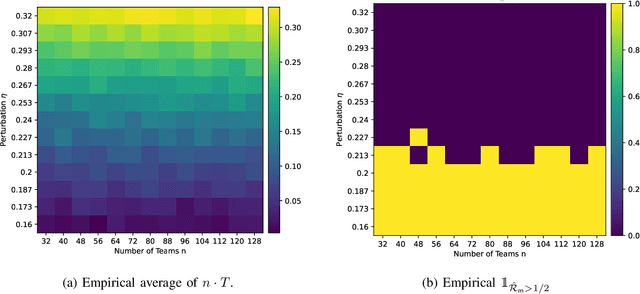
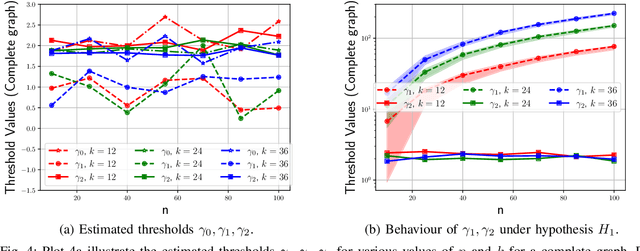
The Bradley-Terry-Luce (BTL) model is one of the most widely used models for ranking a collection of items or agents based on pairwise comparisons among them. Given $n$ agents, the BTL model endows each agent $i$ with a latent skill score $\alpha_i > 0$ and posits that the probability that agent $i$ is preferred over agent $j$ is $\alpha_i/(\alpha_i + \alpha_j)$. In this work, our objective is to formulate a hypothesis test that determines whether a given pairwise comparison dataset, with $k$ comparisons per pair of agents, originates from an underlying BTL model. We formalize this testing problem in the minimax sense and define the critical threshold of the problem. We then establish upper bounds on the critical threshold for general induced observation graphs (satisfying mild assumptions) and develop lower bounds for complete induced graphs. Our bounds demonstrate that for complete induced graphs, the critical threshold scales as $\Theta((nk)^{-1/2})$ in a minimax sense. In particular, our test statistic for the upper bounds is based on a new approximation we derive for the separation distance between general pairwise comparison models and the class of BTL models. To further assess the performance of our statistical test, we prove upper bounds on the type I and type II probabilities of error. Much of our analysis is conducted within the context of a fixed observation graph structure, where the graph possesses certain ``nice'' properties, such as expansion and bounded principal ratio. Additionally, we derive several auxiliary results, such as bounds on principal ratios of graphs, $\ell^2$-bounds on BTL parameter estimation under model mismatch, stability of rankings under the BTL model, etc. We validate our theoretical results through experiments on synthetic and real-world datasets and propose a data-driven permutation testing approach to determine test thresholds.