 Add to Chrome
 Add to Firefox
 Add to Edge
HAPEns: Hardware-Aware Post-Hoc Ensembling for Tabular Data
Mar 11, 2026
Ensembling is commonly used in machine learning on tabular data to boost predictive performance and robustness, but larger ensembles often lead to increased hardware demand. We introduce HAPEns, a post-hoc ensembling method that explicitly balances accuracy against hardware efficiency. Inspired by multi-objective and quality diversity optimization, HAPEns constructs a diverse set of ensembles along the Pareto front of predictive performance and resource usage. Existing hardware-aware post-hoc ensembling baselines are not available, highlighting the novelty of our approach. Experiments on 83 tabular classification datasets show that HAPEns significantly outperforms baselines, finding superior trade-offs for ensemble performance and deployment cost. Ablation studies also reveal that memory usage is a particularly effective objective metric. Further, we show that even a greedy ensembling algorithm can be significantly improved in this task with a static multi-objective weighting scheme.

Hardware Aware Ensemble Selection for Balancing Predictive Accuracy and Cost
Aug 05, 2024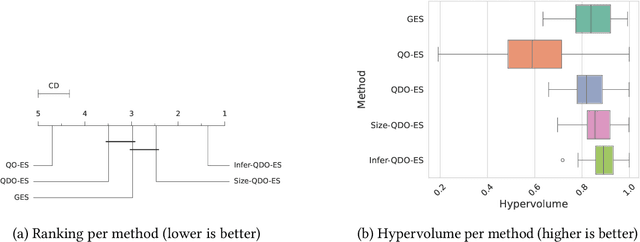
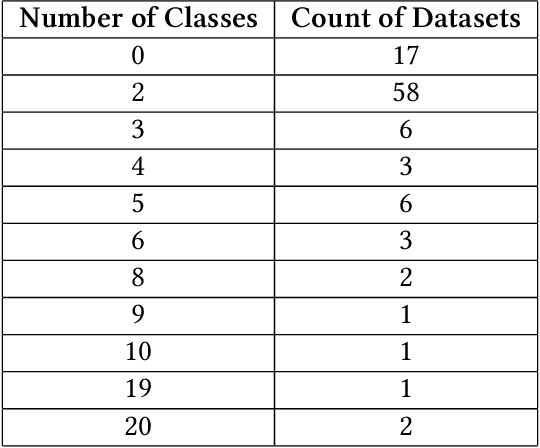
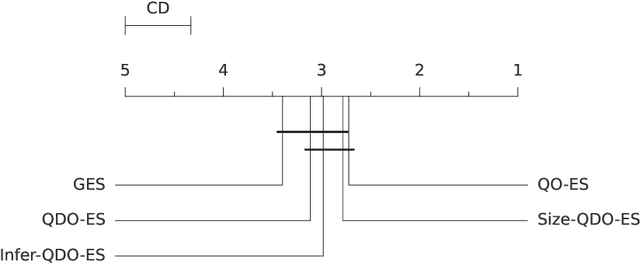
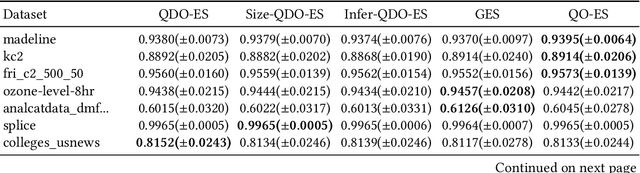
Automated Machine Learning (AutoML) significantly simplifies the deployment of machine learning models by automating tasks from data preprocessing to model selection to ensembling. AutoML systems for tabular data often employ post hoc ensembling, where multiple models are combined to improve predictive accuracy. This typically results in longer inference times, a major limitation in practical deployments. Addressing this, we introduce a hardware-aware ensemble selection approach that integrates inference time into post hoc ensembling. By leveraging an existing framework for ensemble selection with quality diversity optimization, our method evaluates ensemble candidates for their predictive accuracy and hardware efficiency. This dual focus allows for a balanced consideration of accuracy and operational efficiency. Thus, our approach enables practitioners to choose from a Pareto front of accurate and efficient ensembles. Our evaluation using 83 classification datasets shows that our approach sustains competitive accuracy and can significantly improve ensembles' operational efficiency. The results of this study provide a foundation for extending these principles to additional hardware constraints, setting the stage for the development of more resource-efficient AutoML systems.