 Add to Chrome
 Add to Firefox
 Add to Edge
Ensembles at Any Cost? Accuracy-Energy Trade-offs in Recommender Systems
Apr 09, 2026
Ensemble methods are frequently used in recommender systems to improve accuracy by combining multiple models. Recent work reports sizable performance gains, but most studies still optimize primarily for accuracy and robustness rather than for energy efficiency. This paper measures accuracy energy trade offs of ensemble techniques relative to strong single models. We run 93 controlled experiments in two pipelines: 1. explicit rating prediction with Surprise (RMSE) and 2. implicit feedback ranking with LensKit (NDCG@10). We evaluate four datasets ranging from 100,000 to 7.8 million interactions (MovieLens 100K, MovieLens 1M, ModCloth, Anime). We compare four ensemble strategies (Average, Weighted, Stacking or Rank Fusion, Top Performers) against baselines and optimized single models. Whole system energy is measured with EMERS using a smart plug and converted to CO2 equivalents. Across settings, ensembles improve accuracy by 0.3% to 5.7% while increasing energy by 19% to 2,549%. On MovieLens 1M, a Top Performers ensemble improves RMSE by 0.96% at an 18.8% energy overhead over SVD++. On MovieLens 100K, an averaging ensemble improves NDCG@10 by 5.7% with 103% additional energy. On Anime, a Surprise Top Performers ensemble improves RMSE by 1.2% but consumes 2,005% more energy (0.21 vs. 0.01 Wh), increasing emissions from 2.6 to 53.8 mg CO2 equivalents, and LensKit ensembles fail due to memory limits. Overall, selective ensembles are more energy efficient than exhaustive averaging,

The Environmental Impact of Ensemble Techniques in Recommender Systems
Nov 10, 2025Ensemble techniques in recommender systems have demonstrated accuracy improvements of 10-30%, yet their environmental impact remains unmeasured. While deep learning recommendation algorithms can generate up to 3,297 kg CO2 per paper, ensemble methods have not been sufficiently evaluated for energy consumption. This thesis investigates how ensemble techniques influence environmental impact compared to single optimized models. We conducted 93 experiments across two frameworks (Surprise for rating prediction, LensKit for ranking) on four datasets spanning 100,000 to 7.8 million interactions. We evaluated four ensemble strategies (Average, Weighted, Stacking/Rank Fusion, Top Performers) against simple baselines and optimized single models, measuring energy consumption with a smart plug. Results revealed a non-linear accuracy-energy relationship. Ensemble methods achieved 0.3-5.7% accuracy improvements while consuming 19-2,549% more energy depending on dataset size and strategy. The Top Performers ensemble showed best efficiency: 0.96% RMSE improvement with 18.8% energy overhead on MovieLens-1M, and 5.7% NDCG improvement with 103% overhead on MovieLens-100K. Exhaustive averaging strategies consumed 88-270% more energy for comparable gains. On the largest dataset (Anime, 7.8M interactions), the Surprise ensemble consumed 2,005% more energy (0.21 Wh vs. 0.01 Wh) for 1.2% accuracy improvement, producing 53.8 mg CO2 versus 2.6 mg CO2 for the single model. This research provides one of the first systematic measurements of energy and carbon footprint for ensemble recommender systems, demonstrates that selective strategies offer superior efficiency over exhaustive averaging, and identifies scalability limitations at industrial scale. These findings enable informed decisions about sustainable algorithm selection in recommender systems.
Evaluating the performance-deviation of itemKNN in RecBole and LensKit
Jul 18, 2024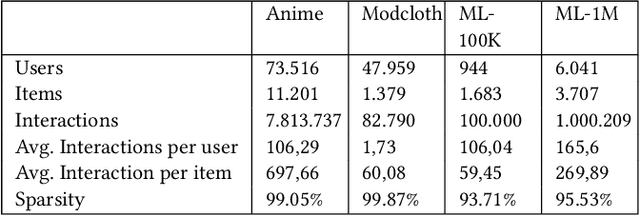
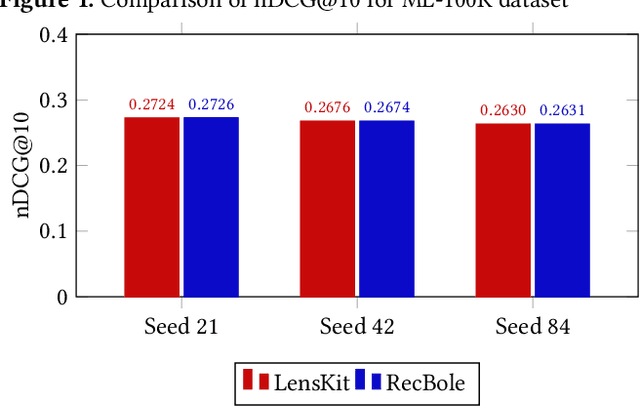
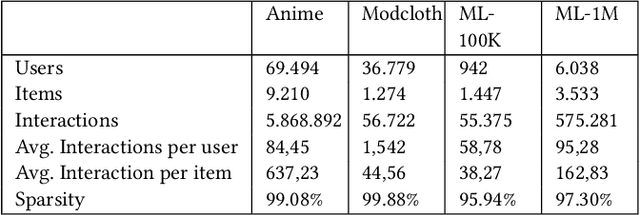
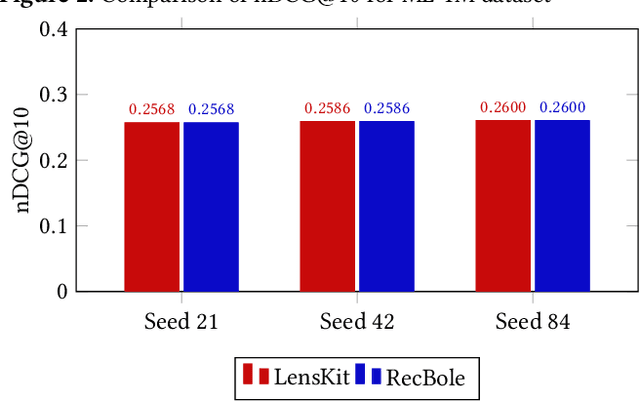
This study examines the performance of item-based k-Nearest Neighbors (ItemKNN) algorithms in the RecBole and LensKit recommender system libraries. Using four data sets (Anime, Modcloth, ML-100K, and ML-1M), we assess each library's efficiency, accuracy, and scalability, focusing primarily on normalized discounted cumulative gain (nDCG). Our results show that RecBole outperforms LensKit on two of three metrics on the ML-100K data set: it achieved an 18% higher nDCG, 14% higher precision, and 35% lower recall. To ensure a fair comparison, we adjusted LensKit's nDCG calculation to match RecBole's method. This alignment made the performance more comparable, with LensKit achieving an nDCG of 0.2540 and RecBole 0.2674. Differences in similarity matrix calculations were identified as the main cause of performance deviations. After modifying LensKit to retain only the top K similar items, both libraries showed nearly identical nDCG values across all data sets. For instance, both achieved an nDCG of 0.2586 on the ML-1M data set with the same random seed. Initially, LensKit's original implementation only surpassed RecBole in the ModCloth dataset.