 Add to Chrome
 Add to Firefox
 Add to Edge
Estimating Individual Tree Height and Species from UAV Imagery
Mar 24, 2026
Accurate estimation of forest biomass, a major carbon sink, relies heavily on tree-level traits such as height and species. Unoccupied Aerial Vehicles (UAVs) capturing high-resolution imagery from a single RGB camera offer a cost-effective and scalable approach for mapping and measuring individual trees. We introduce BIRCH-Trees, the first benchmark for individual tree height and species estimation from tree-centered UAV images, spanning three datasets: temperate forests, tropical forests, and boreal plantations. We also present DINOvTree, a unified approach using a Vision Foundation Model (VFM) backbone with task-specific heads for simultaneous height and species prediction. Through extensive evaluations on BIRCH-Trees, we compare DINOvTree against commonly used vision methods, including VFMs, as well as biological allometric equations. We find that DINOvTree achieves top overall results with accurate height predictions and competitive classification accuracy while using only 54% to 58% of the parameters of the second-best approach.

Boosting Omnidirectional Stereo Matching with a Pre-trained Depth Foundation Model
Mar 30, 2025Omnidirectional depth perception is essential for mobile robotics applications that require scene understanding across a full 360{\deg} field of view. Camera-based setups offer a cost-effective option by using stereo depth estimation to generate dense, high-resolution depth maps without relying on expensive active sensing. However, existing omnidirectional stereo matching approaches achieve only limited depth accuracy across diverse environments, depth ranges, and lighting conditions, due to the scarcity of real-world data. We present DFI-OmniStereo, a novel omnidirectional stereo matching method that leverages a large-scale pre-trained foundation model for relative monocular depth estimation within an iterative optimization-based stereo matching architecture. We introduce a dedicated two-stage training strategy to utilize the relative monocular depth features for our omnidirectional stereo matching before scale-invariant fine-tuning. DFI-OmniStereo achieves state-of-the-art results on the real-world Helvipad dataset, reducing disparity MAE by approximately 16% compared to the previous best omnidirectional stereo method.
Helvipad: A Real-World Dataset for Omnidirectional Stereo Depth Estimation
Nov 27, 2024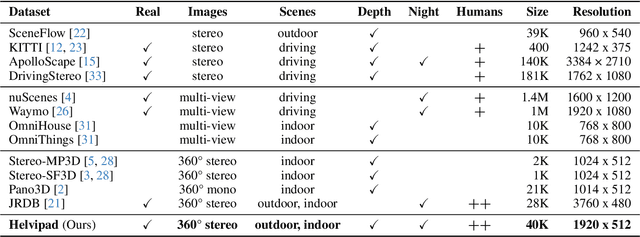
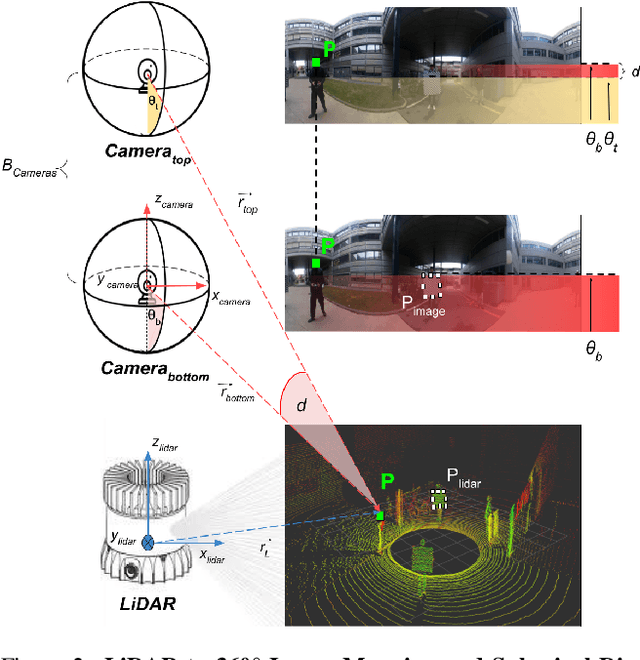

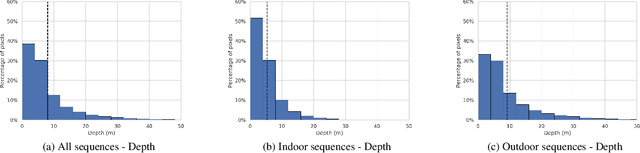
Despite considerable progress in stereo depth estimation, omnidirectional imaging remains underexplored, mainly due to the lack of appropriate data. We introduce Helvipad, a real-world dataset for omnidirectional stereo depth estimation, consisting of 40K frames from video sequences across diverse environments, including crowded indoor and outdoor scenes with diverse lighting conditions. Collected using two 360{\deg} cameras in a top-bottom setup and a LiDAR sensor, the dataset includes accurate depth and disparity labels by projecting 3D point clouds onto equirectangular images. Additionally, we provide an augmented training set with a significantly increased label density by using depth completion. We benchmark leading stereo depth estimation models for both standard and omnidirectional images. The results show that while recent stereo methods perform decently, a significant challenge persists in accurately estimating depth in omnidirectional imaging. To address this, we introduce necessary adaptations to stereo models, achieving improved performance.