 Add to Chrome
 Add to Firefox
 Add to Edge
HIDVAS: A Hearing Instrument Dataset in Various Acoustical Scenarios for Algorithm Evaluation and Training
Jun 12, 2026
To evaluate the performance of audio signal processing algorithms and to train data-driven algorithms, e.g., as applied in hearing instruments, either simulated or recorded data can be used. While large batches of simulated data can be generated using mathematical models, recorded data provide a more adequate representation of real-life scenarios. Therefore, in this paper, the Hearing Instrument Dataset in Various Acoustical Scenarios (HIDVAS) is introduced. This dataset consists of both impulse responses and audio recordings using eight external loudspeakers, two external microphones, and a dummy head. On this dummy head behind-the-ear (BTE) hearing instrument shells with two microphones per shell are mounted, and in the dummy head's ears receiver-in-canal (RIC) hearing instrument loudspeakers are inserted. The dummy head also contains microphones located at its eardrum. The impulse responses have been computed from a swept-sine recording for each microphone-loudspeaker pair, and the audio recordings have been obtained by playing back audio (male and female speech, speech shaped noise, singing voice, stringed instrument, wind instrument, and percussion instrument) through each individual loudspeaker and recording simultaneously using all microphones. These recordings have been repeated for four hearing instrument domes (open, semi-open, closed, and no-RIC) in three reverberation conditions in one room (T30 = 0.09 s, T30 = 0.47 s, and T30 = 0.73 s), and in one reverberation condition in a different room (T30 = 1.48 s). The usage of the dataset as a `hearing instrument in a box' is exemplified with three example use cases.

Integrated Minimum Mean Squared Error Algorithms for Combined Acoustic Echo Cancellation and Noise Reduction
Dec 05, 2024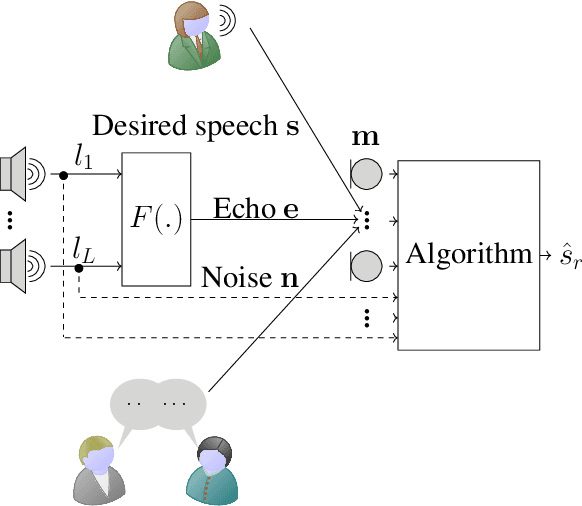
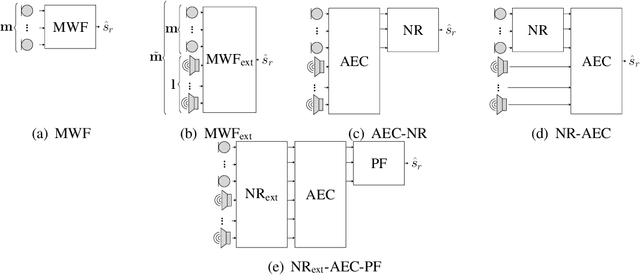
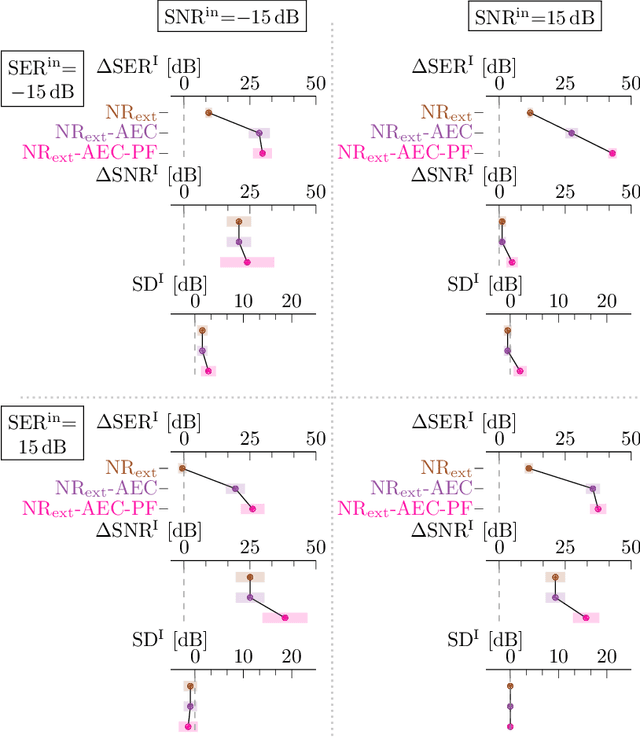
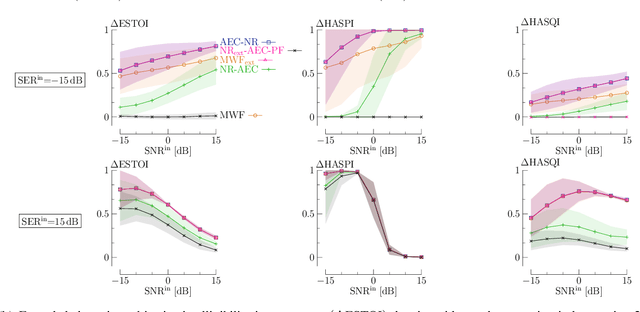
In many speech recording applications, noise and acoustic echo corrupt the desired speech. Consequently, combined noise reduction (NR) and acoustic echo cancellation (AEC) is required. Generally, a cascade approach is followed, i.e., the AEC and NR are designed in isolation by selecting a separate signal model, formulating a separate cost function, and using a separate solution strategy. The AEC and NR are then cascaded one after the other, not accounting for their interaction. In this paper, however, an integrated approach is proposed to consider this interaction in a general multi-microphone/multi-loudspeaker setup. Therefore, a single signal model of either the microphone signal vector or the extended signal vector, obtained by stacking microphone and loudspeaker signals, is selected, a single mean squared error cost function is formulated, and a common solution strategy is used. Using this microphone signal model, a multi channel Wiener filter (MWF) is derived. Using the extended signal model, an extended MWF (MWFext) is derived, and several equivalent expressions are found, which nevertheless are interpretable as cascade algorithms. Specifically, the MWFext is shown to be equivalent to algorithms where the AEC precedes the NR (AEC NR), the NR precedes the AEC (NR-AEC), and the extended NR (NRext) precedes the AEC and post-filter (PF) (NRext-AECPF). Under rank-deficiency conditions the MWFext is non-unique, such that this equivalence amounts to the expressions being specific, not necessarily minimum-norm solutions for this MWFext. The practical performances nonetheless differ due to non-stationarities and imperfect correlation matrix estimation, resulting in the AEC-NR and NRext-AEC-PF attaining best overall performance.