 Add to Chrome
 Add to Firefox
 Add to Edge
Improving the Efficiency and Effectiveness of LLM Knowledge Distillation for Conversational Search
Jun 03, 2026
Conversational Search (CS) considers retrieval of relevant documents based on conversational context. Large Language Models (LLMs) have significantly enhanced CS by enabling effective query rewriting. However, employing LLMs during inference poses efficiency challenges. A method to balance effectiveness and efficiency is the use of knowledge distillation from LLM-based query rewriting. Recent work applies the Kullback-Leibler Divergence (KLD) for distillation, relaxing the alignment with the teacher signal compared to previous methods. Despite these gains, several aspects of KLD-based distillation for conversational search remain understudied, and we investigate them in this work. Prior work in related fields suggests that adding a contrastive loss to the KLD objective can improve performance; we confirm this and observe significant gains in precision-oriented ranking metrics. We also find that contrastive sampling strategies for the KLD loss have a non-trivial impact and must be chosen carefully. Although theory suggests that more samples improve the KLD estimate, experiments show diminishing returns on the number of used samples. Finally, we address the phenomenon of decreased sparsity in longer conversations, which limits computational efficiency across sparse retrieval methods. We find that the representations from the model distilled with the KLD loss can be strongly regularized with a regularization loss, substantially improving sparsity and inference efficiency without significantly harming retrieval effectiveness. We achieve a $2\times$ decrease in FLOPS on TopiOCQA with negligible loss in effectiveness, corresponding to a $\leq 2%$ drop in Recall@100. Our results provide insights into distillation objectives for learned sparse conversational retrievers and offer practical guidelines for improving effectiveness and efficiency in first-stage retrieval.

Autoencoder-based General Purpose Representation Learning for Customer Embedding
Feb 28, 2024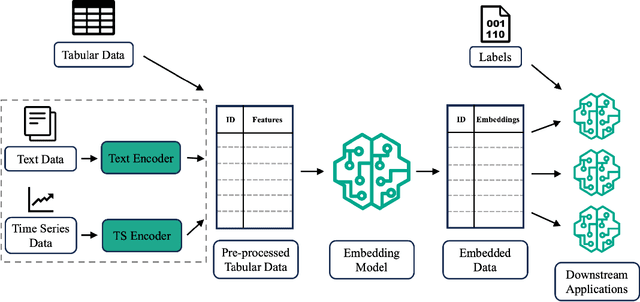


In recent years, exploiting the domain-specific underlying structure of data and its generative factors for representation learning has shown success in various use-case agnostic applications. However, the diversity and complexity of tabular data have made it challenging to represent these structures in a latent space through multi-dimensional vectors. We design an autoencoder-based framework for building general purpose embeddings, we assess the performance of different autoencoder architectures, and show simpler models outperform complex ones in embedding highly complex tabular data. We apply our framework to produce plug-and-play, rich, and anonymized embeddings representing AWS customers for usage in any model, saving up to 45% of development time, and observe significant improvements in downstream models. Moreover, we propose a significant improvement to the calculation of reconstruction loss for multi-layer contractive autoencoders (CAE) by calculating the Jacobian of the entire encoder leading to a 15% improvement in reconstruction quality when compared to a stacked CAE.