 Add to Chrome
 Add to Firefox
 Add to Edge
The role of spatial context and multitask learning in the detection of organic and conventional farming systems based on Sentinel-2 time series
Mar 25, 2026
Organic farming is a key element in achieving more sustainable agriculture. For a better understanding of the development and impact of organic farming, comprehensive, spatially explicit information is needed. This study presents an approach for the discrimination of organic and conventional farming systems using intra-annual Sentinel-2 time series. In addition, it examines two factors influencing this discrimination: the joint learning of crop type information in a concurrent task and the role of spatial context. A Vision Transformer model based on the Temporo-Spatial Vision Transformer (TSViT) architecture was used to construct a classification model for the two farming systems. The model was extended for simultaneous learning of the crop type, creating a multitask learning setting. By varying the patch size presented to the model, we tested the influence of spatial context on the classification accuracy of both tasks. We show that discrimination between organic and conventional farming systems using multispectral remote sensing data is feasible. However, classification performance varies substantially across crop types. For several crops, such as winter rye, winter wheat, and winter oat, F1 scores of 0.8 or higher can be achieved. In contrast, other agricultural land use classes, such as permanent grassland, orchards, grapevines, and hops, cannot be reliably distinguished, with F1 scores for the organic management class of 0.4 or lower. Joint learning of farming system and crop type provides only limited additional benefits over single-task learning. In contrast, incorporating wider spatial context improves the performance of both farming system and crop type classification. Overall, we demonstrate that a classification of agricultural farming systems is possible in a diverse agricultural region using multispectral remote sensing data.

Multi-Modal Vision Transformers for Crop Mapping from Satellite Image Time Series
Jun 24, 2024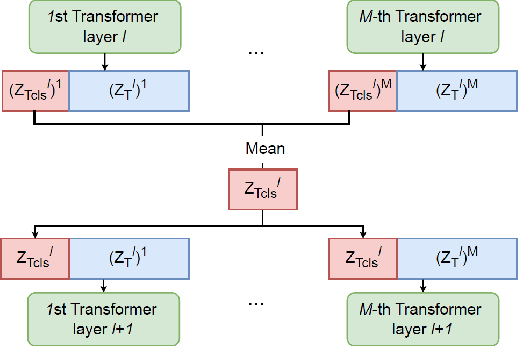
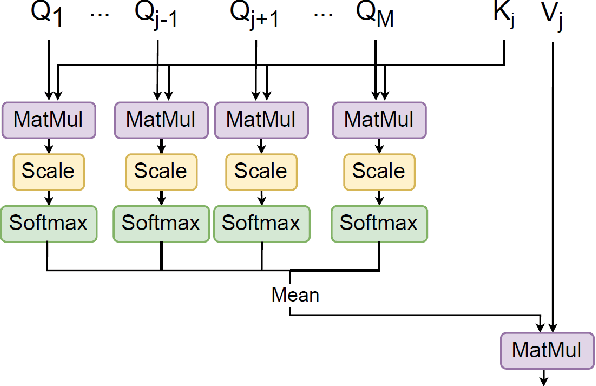
Using images acquired by different satellite sensors has shown to improve classification performance in the framework of crop mapping from satellite image time series (SITS). Existing state-of-the-art architectures use self-attention mechanisms to process the temporal dimension and convolutions for the spatial dimension of SITS. Motivated by the success of purely attention-based architectures in crop mapping from single-modal SITS, we introduce several multi-modal multi-temporal transformer-based architectures. Specifically, we investigate the effectiveness of Early Fusion, Cross Attention Fusion and Synchronized Class Token Fusion within the Temporo-Spatial Vision Transformer (TSViT). Experimental results demonstrate significant improvements over state-of-the-art architectures with both convolutional and self-attention components.
Taking it further: leveraging pseudo labels for field delineation across label-scarce smallholder regions
Dec 12, 2023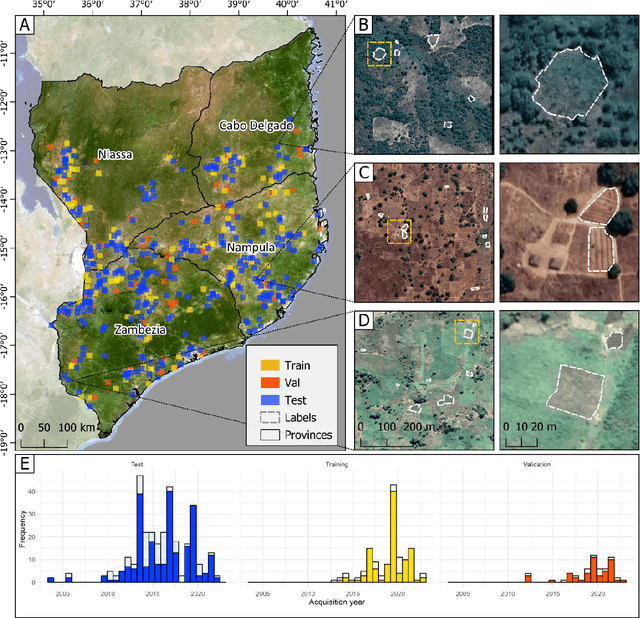
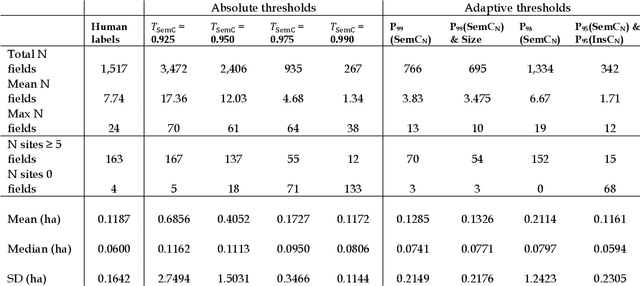

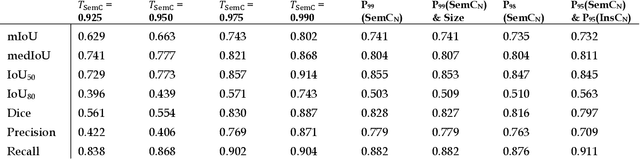
Transfer learning allows for resource-efficient geographic transfer of pre-trained field delineation models. However, the scarcity of labeled data for complex and dynamic smallholder landscapes, particularly in Sub-Saharan Africa, remains a major bottleneck for large-area field delineation. This study explores opportunities of using sparse field delineation pseudo labels for fine-tuning models across geographies and sensor characteristics. We build on a FracTAL ResUNet trained for crop field delineation in India (median field size of 0.24 ha) and use this pre-trained model to generate pseudo labels in Mozambique (median field size of 0.06 ha). We designed multiple pseudo label selection strategies and compared the quantities, area properties, seasonal distribution, and spatial agreement of the pseudo labels against human-annotated training labels (n = 1,512). We then used the human-annotated labels and the pseudo labels for model fine-tuning and compared predictions against human field annotations (n = 2,199). Our results indicate i) a good baseline performance of the pre-trained model in both field delineation and field size estimation, and ii) the added value of regional fine-tuning with performance improvements in nearly all experiments. Moreover, we found iii) substantial performance increases when using only pseudo labels (up to 77% of the IoU increases and 68% of the RMSE decreases obtained by human labels), and iv) additional performance increases when complementing human annotations with pseudo labels. Pseudo labels can be efficiently generated at scale and thus facilitate domain adaptation in label-scarce settings. The workflow presented here is a stepping stone for overcoming the persisting data gaps in heterogeneous smallholder agriculture of Sub-Saharan Africa, where labels are commonly scarce.