 Add to Chrome
 Add to Firefox
 Add to Edge
Probabilistic Wind Power Forecasting with Tree-Based Machine Learning and Weather Ensembles
Feb 13, 2026
Accurate production forecasts are essential to continue facilitating the integration of renewable energy sources into the power grid. This paper illustrates how to obtain probabilistic day-ahead forecasts of wind power generation via gradient boosting trees using an ensemble of weather forecasts. To this end, we perform a comparative analysis across three state-of-the-art probabilistic prediction methods-conformalised quantile regression, natural gradient boosting and conditional diffusion models-all of which can be combined with tree-based machine learning. The methods are validated using four years of data for all wind farms present within the Belgian offshore zone. Additionally, the point forecasts are benchmarked against deterministic engineering methods, using either the power curve or an advanced approach incorporating a calibrated analytical wake model. The experimental results show that the machine learning methods improve the mean absolute error by up to 53% and 33% compared to the power curve and the calibrated wake model. Considering the three probabilistic prediction methods, the conditional diffusion model is found to yield the best overall probabilistic and point estimate of wind power generation. Moreover, the findings suggest that the use of an ensemble of weather forecasts can improve point forecast accuracy by up to 23%.

Scalable Optimization for Wind Farm Control using Coordination Graphs
Jan 19, 2021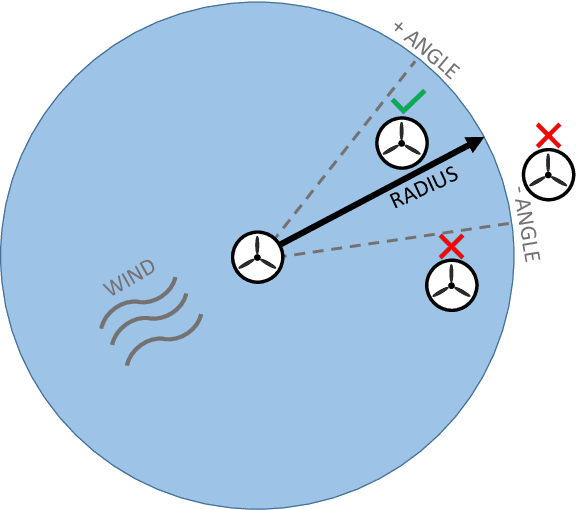
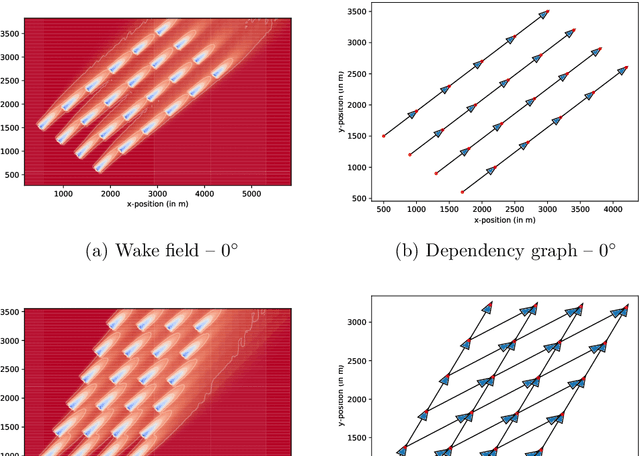
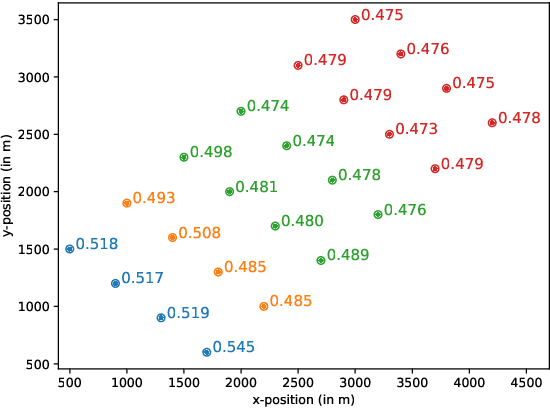
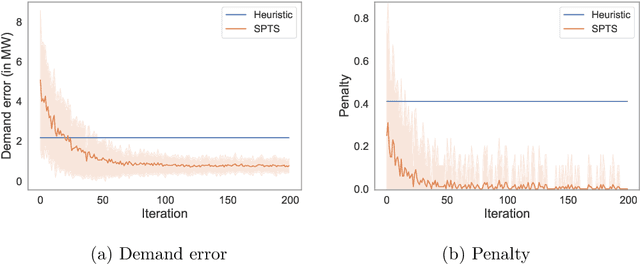
Wind farms are a crucial driver toward the generation of ecological and renewable energy. Due to their rapid increase in capacity, contemporary wind farms need to adhere to strict constraints on power output to ensure stability of the electricity grid. Specifically, a wind farm controller is required to match the farm's power production with a power demand imposed by the grid operator. This is a non-trivial optimization problem, as complex dependencies exist between the wind turbines. State-of-the-art wind farm control typically relies on physics-based heuristics that fail to capture the full load spectrum that defines a turbine's health status. When this is not taken into account, the long-term viability of the farm's turbines is put at risk. Given the complex dependencies that determine a turbine's lifetime, learning a flexible and optimal control strategy requires a data-driven approach. However, as wind farms are large-scale multi-agent systems, optimizing control strategies over the full joint action space is intractable. We propose a new learning method for wind farm control that leverages the sparse wind farm structure to factorize the optimization problem. Using a Bayesian approach, based on multi-agent Thompson sampling, we explore the factored joint action space for configurations that match the demand, while considering the lifetime of turbines. We apply our method to a grid-like wind farm layout, and evaluate configurations using a state-of-the-art wind flow simulator. Our results are competitive with a physics-based heuristic approach in terms of demand error, while, contrary to the heuristic, our method prolongs the lifetime of high-risk turbines.