 Add to Chrome
 Add to Firefox
 Add to Edge
Causal Discovery with Mixed Latent Confounding via Precision Decomposition
Dec 31, 2025
We study causal discovery from observational data in linear Gaussian systems affected by \emph{mixed latent confounding}, where some unobserved factors act broadly across many variables while others influence only small subsets. This setting is common in practice and poses a challenge for existing methods: differentiable and score-based DAG learners can misinterpret global latent effects as causal edges, while latent-variable graphical models recover only undirected structure. We propose \textsc{DCL-DECOR}, a modular, precision-led pipeline that separates these roles. The method first isolates pervasive latent effects by decomposing the observed precision matrix into a structured component and a low-rank component. The structured component corresponds to the conditional distribution after accounting for pervasive confounders and retains only local dependence induced by the causal graph and localized confounding. A correlated-noise DAG learner is then applied to this deconfounded representation to recover directed edges while modeling remaining structured error correlations, followed by a simple reconciliation step to enforce bow-freeness. We provide identifiability results that characterize the recoverable causal target under mixed confounding and show how the overall problem reduces to well-studied subproblems with modular guarantees. Synthetic experiments that vary the strength and dimensionality of pervasive confounding demonstrate consistent improvements in directed edge recovery over applying correlated-noise DAG learning directly to the confounded data.

DAG DECORation: Continuous Optimization for Structure Learning under Hidden Confounding
Oct 02, 2025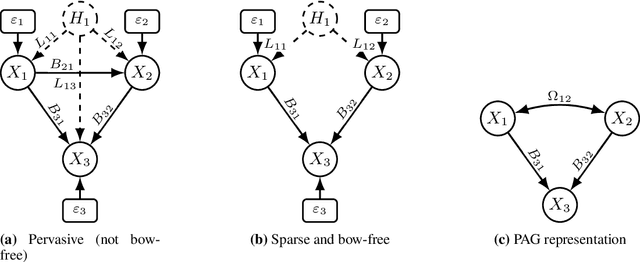
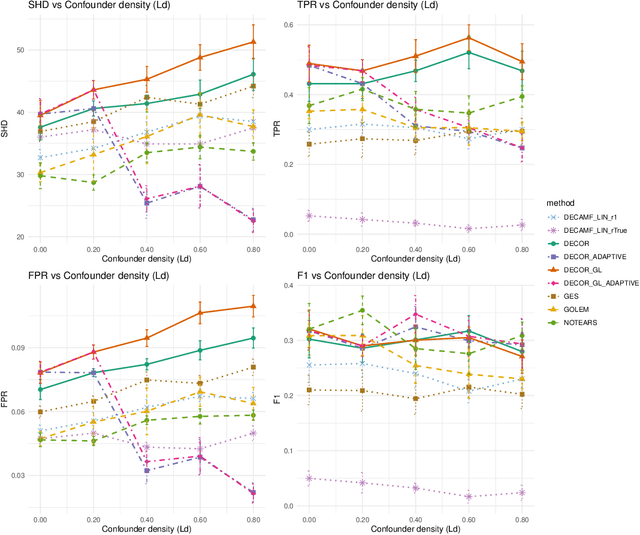
We study structure learning for linear Gaussian SEMs in the presence of latent confounding. Existing continuous methods excel when errors are independent, while deconfounding-first pipelines rely on pervasive factor structure or nonlinearity. We propose \textsc{DECOR}, a single likelihood-based and fully differentiable estimator that jointly learns a DAG and a correlated noise model. Our theory gives simple sufficient conditions for global parameter identifiability: if the mixed graph is bow free and the noise covariance has a uniform eigenvalue margin, then the map from $(\B,\OmegaMat)$ to the observational covariance is injective, so both the directed structure and the noise are uniquely determined. The estimator alternates a smooth-acyclic graph update with a convex noise update and can include a light bow complementarity penalty or a post hoc reconciliation step. On synthetic benchmarks that vary confounding density, graph density, latent rank, and dimension with $n<p$, \textsc{DECOR} matches or outperforms strong baselines and is especially robust when confounding is non-pervasive, while remaining competitive under pervasiveness.