 Add to Chrome
 Add to Firefox
 Add to Edge
RealSynCol: a high-fidelity synthetic colon dataset for 3D reconstruction applications
Feb 09, 2026
Deep learning has the potential to improve colonoscopy by enabling 3D reconstruction of the colon, providing a comprehensive view of mucosal surfaces and lesions, and facilitating the identification of unexplored areas. However, the development of robust methods is limited by the scarcity of large-scale ground truth data. We propose RealSynCol, a highly realistic synthetic dataset designed to replicate the endoscopic environment. Colon geometries extracted from 10 CT scans were imported into a virtual environment that closely mimics intraoperative conditions and rendered with realistic vascular textures. The resulting dataset comprises 28\,130 frames, paired with ground truth depth maps, optical flow, 3D meshes, and camera trajectories. A benchmark study was conducted to evaluate the available synthetic colon datasets for the tasks of depth and pose estimation. Results demonstrate that the high realism and variability of RealSynCol significantly enhance generalization performance on clinical images, proving it to be a powerful tool for developing deep learning algorithms to support endoscopic diagnosis.

Towards Actionable Pedagogical Feedback: A Multi-Perspective Analysis of Mathematics Teaching and Tutoring Dialogue
May 12, 2025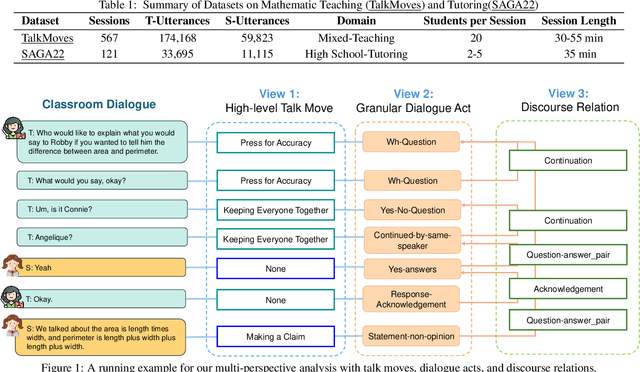
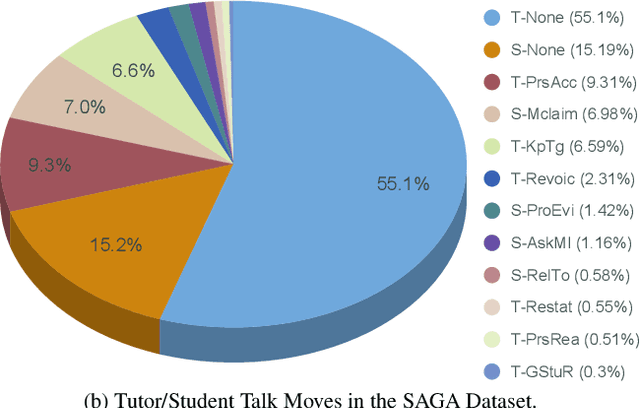

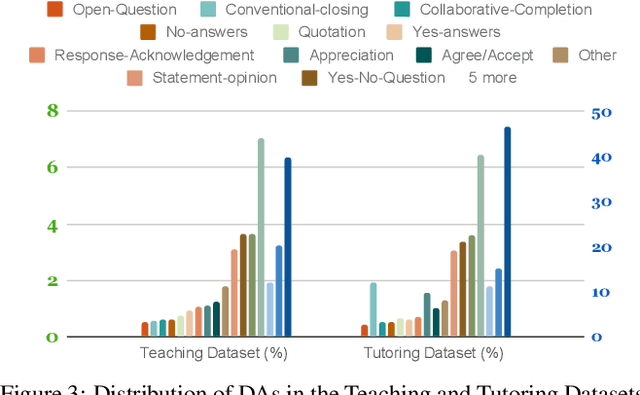
Effective feedback is essential for refining instructional practices in mathematics education, and researchers often turn to advanced natural language processing (NLP) models to analyze classroom dialogues from multiple perspectives. However, utterance-level discourse analysis encounters two primary challenges: (1) multifunctionality, where a single utterance may serve multiple purposes that a single tag cannot capture, and (2) the exclusion of many utterances from domain-specific discourse move classifications, leading to their omission in feedback. To address these challenges, we proposed a multi-perspective discourse analysis that integrates domain-specific talk moves with dialogue act (using the flattened multi-functional SWBD-MASL schema with 43 tags) and discourse relation (applying Segmented Discourse Representation Theory with 16 relations). Our top-down analysis framework enables a comprehensive understanding of utterances that contain talk moves, as well as utterances that do not contain talk moves. This is applied to two mathematics education datasets: TalkMoves (teaching) and SAGA22 (tutoring). Through distributional unigram analysis, sequential talk move analysis, and multi-view deep dive, we discovered meaningful discourse patterns, and revealed the vital role of utterances without talk moves, demonstrating that these utterances, far from being mere fillers, serve crucial functions in guiding, acknowledging, and structuring classroom discourse. These insights underscore the importance of incorporating discourse relations and dialogue acts into AI-assisted education systems to enhance feedback and create more responsive learning environments. Our framework may prove helpful for providing human educator feedback, but also aiding in the development of AI agents that can effectively emulate the roles of both educators and students.