 Add to Chrome
 Add to Firefox
 Add to Edge
Mixed Magnification Aggregation for Generalizable Region-Level Representations in Computational Pathology
Feb 25, 2026
In recent years, a standard computational pathology workflow has emerged where whole slide images are cropped into tiles, these tiles are processed using a foundation model, and task-specific models are built using the resulting representations. At least 15 different foundation models have been proposed, and the vast majority are trained exclusively with tiles using the 20$\times$ magnification. However, it is well known that certain histologic features can only be discerned with larger context windows and requires a pathologist to zoom in and out when analyzing a whole slide image. Furthermore, creating 224$\times$224 pixel crops at 20$\times$ leads to a large number of tiles per slide, which can be gigapixel in size. To more accurately capture multi-resolution features and investigate the possibility of reducing the number of representations per slide, we propose a region-level mixing encoder. Our approach jointly fuses image tile representations of a mixed magnification foundation model using a masked embedding modeling pretraining step. We explore a design space for pretraining the proposed mixed-magnification region aggregators and evaluate our models on transfer to biomarker prediction tasks representing various cancer types. Results demonstrate cancer dependent improvements in predictive performance, highlighting the importance of spatial context and understanding.

Tag-LLM: Repurposing General-Purpose LLMs for Specialized Domains
Feb 06, 2024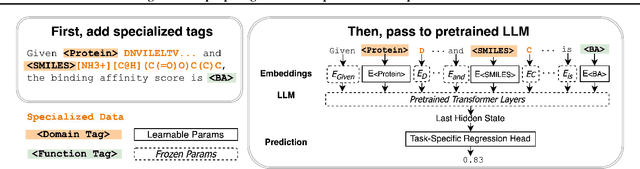
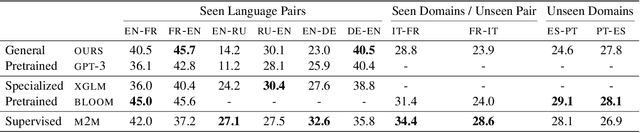

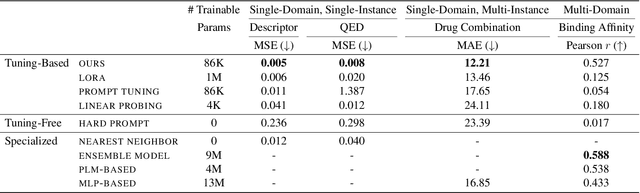
Large Language Models (LLMs) have demonstrated remarkable proficiency in understanding and generating natural language. However, their capabilities wane in highly specialized domains underrepresented in the pretraining corpus, such as physical and biomedical sciences. This work explores how to repurpose general LLMs into effective task solvers for specialized domains. We introduce a novel, model-agnostic framework for learning custom input tags, which are parameterized as continuous vectors appended to the LLM's embedding layer, to condition the LLM. We design two types of input tags: domain tags are used to delimit specialized representations (e.g., chemical formulas) and provide domain-relevant context; function tags are used to represent specific functions (e.g., predicting molecular properties) and compress function-solving instructions. We develop a three-stage protocol to learn these tags using auxiliary data and domain knowledge. By explicitly disentangling task domains from task functions, our method enables zero-shot generalization to unseen problems through diverse combinations of the input tags. It also boosts LLM's performance in various specialized domains, such as predicting protein or chemical properties and modeling drug-target interactions, outperforming expert models tailored to these tasks.