 Add to Chrome
 Add to Firefox
 Add to Edge
MotionPhysics: Learnable Motion Distillation for Text-Guided Simulation
Jan 01, 2026
Accurately simulating existing 3D objects and a wide variety of materials often demands expert knowledge and time-consuming physical parameter tuning to achieve the desired dynamic behavior. We introduce MotionPhysics, an end-to-end differentiable framework that infers plausible physical parameters from a user-provided natural language prompt for a chosen 3D scene of interest, removing the need for guidance from ground-truth trajectories or annotated videos. Our approach first utilizes a multimodal large language model to estimate material parameter values, which are constrained to lie within plausible ranges. We further propose a learnable motion distillation loss that extracts robust motion priors from pretrained video diffusion models while minimizing appearance and geometry inductive biases to guide the simulation. We evaluate MotionPhysics across more than thirty scenarios, including real-world, human-designed, and AI-generated 3D objects, spanning a wide range of materials such as elastic solids, metals, foams, sand, and both Newtonian and non-Newtonian fluids. We demonstrate that MotionPhysics produces visually realistic dynamic simulations guided by natural language, surpassing the state of the art while automatically determining physically plausible parameters. The code and project page are available at: https://wangmiaowei.github.io/MotionPhysics.github.io/.

HumMorph: Generalized Dynamic Human Neural Fields from Few Views
Apr 27, 2025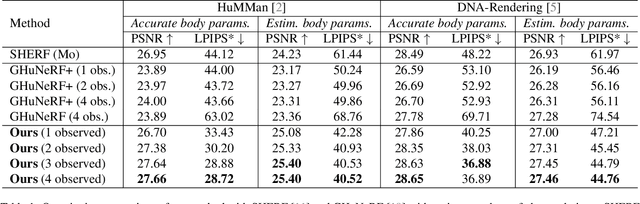
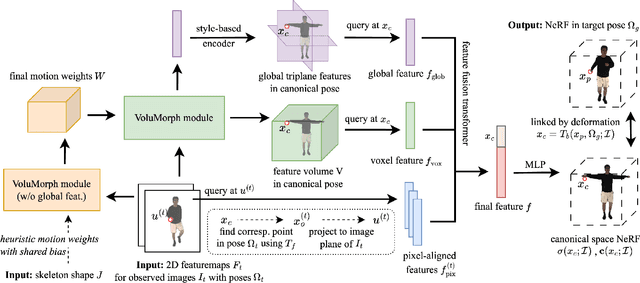
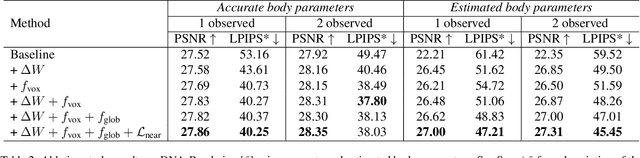
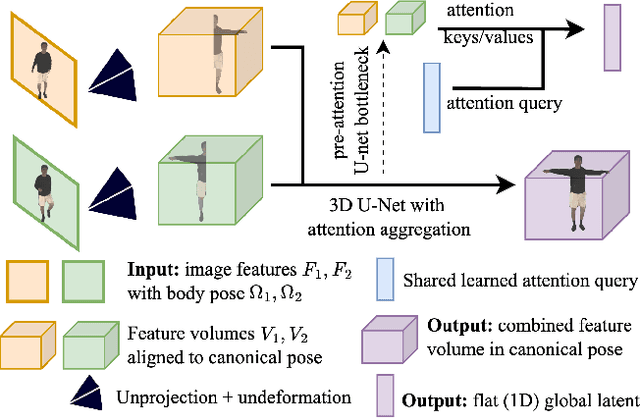
We introduce HumMorph, a novel generalized approach to free-viewpoint rendering of dynamic human bodies with explicit pose control. HumMorph renders a human actor in any specified pose given a few observed views (starting from just one) in arbitrary poses. Our method enables fast inference as it relies only on feed-forward passes through the model. We first construct a coarse representation of the actor in the canonical T-pose, which combines visual features from individual partial observations and fills missing information using learned prior knowledge. The coarse representation is complemented by fine-grained pixel-aligned features extracted directly from the observed views, which provide high-resolution appearance information. We show that HumMorph is competitive with the state-of-the-art when only a single input view is available, however, we achieve results with significantly better visual quality given just 2 monocular observations. Moreover, previous generalized methods assume access to accurate body shape and pose parameters obtained using synchronized multi-camera setups. In contrast, we consider a more practical scenario where these body parameters are noisily estimated directly from the observed views. Our experimental results demonstrate that our architecture is more robust to errors in the noisy parameters and clearly outperforms the state of the art in this setting.