 Add to Chrome
 Add to Firefox
 Add to Edge
Hierarchical Question Answering for Long Documents
Feb 08, 2017
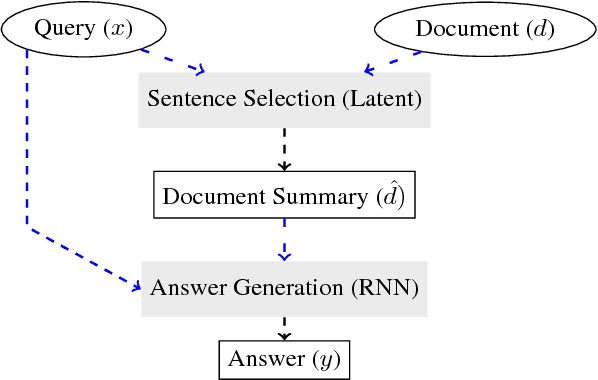
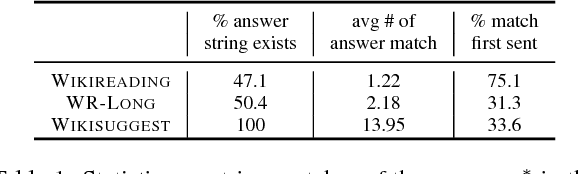
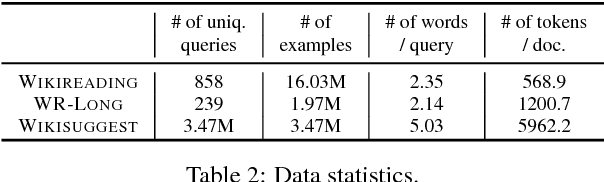
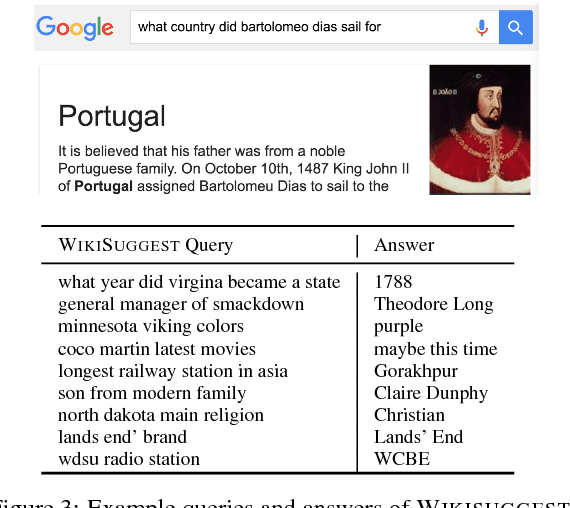
We present a framework for question answering that can efficiently scale to longer documents while maintaining or even improving performance of state-of-the-art models. While most successful approaches for reading comprehension rely on recurrent neural networks (RNNs), running them over long documents is prohibitively slow because it is difficult to parallelize over sequences. Inspired by how people first skim the document, identify relevant parts, and carefully read these parts to produce an answer, we combine a coarse, fast model for selecting relevant sentences and a more expensive RNN for producing the answer from those sentences. We treat sentence selection as a latent variable trained jointly from the answer only using reinforcement learning. Experiments demonstrate the state of the art performance on a challenging subset of the Wikireading and on a new dataset, while speeding up the model by 3.5x-6.7x.

A Decomposable Attention Model for Natural Language Inference
Sep 25, 2016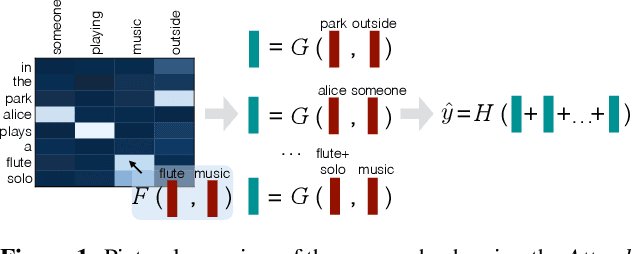
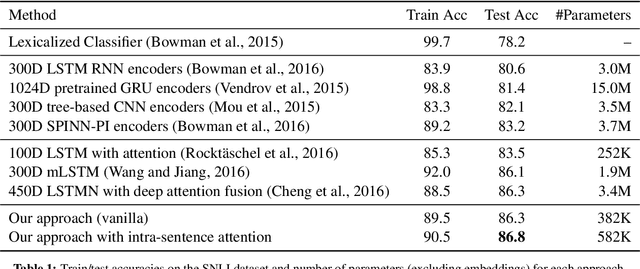
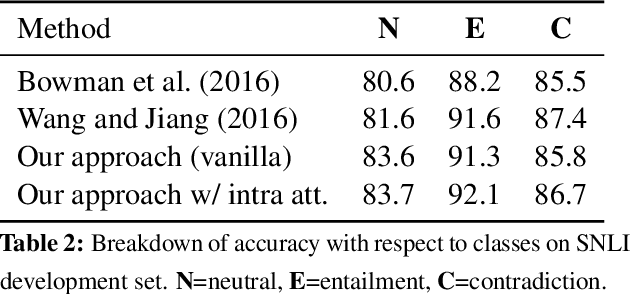
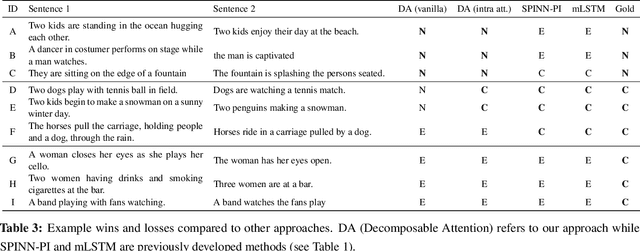
We propose a simple neural architecture for natural language inference. Our approach uses attention to decompose the problem into subproblems that can be solved separately, thus making it trivially parallelizable. On the Stanford Natural Language Inference (SNLI) dataset, we obtain state-of-the-art results with almost an order of magnitude fewer parameters than previous work and without relying on any word-order information. Adding intra-sentence attention that takes a minimum amount of order into account yields further improvements.