 Add to Chrome
 Add to Firefox
 Add to Edge
Temperature Scaling Attack Disrupting Model Confidence in Federated Learning
Feb 09, 2026
Predictive confidence serves as a foundational control signal in mission-critical systems, directly governing risk-aware logic such as escalation, abstention, and conservative fallback. While prior federated learning attacks predominantly target accuracy or implant backdoors, we identify confidence calibration as a distinct attack objective. We present the Temperature Scaling Attack (TSA), a training-time attack that degrades calibration while preserving accuracy. By injecting temperature scaling with learning rate-temperature coupling during local training, malicious updates maintain benign-like optimization behavior, evading accuracy-based monitoring and similarity-based detection. We provide a convergence analysis under non-IID settings, showing that this coupling preserves standard convergence bounds while systematically distorting confidence. Across three benchmarks, TSA substantially shifts calibration (e.g., 145% error increase on CIFAR-100) with <2 accuracy change, and remains effective under robust aggregation and post-hoc calibration defenses. Case studies further show that confidence manipulation can cause up to 7.2x increases in missed critical cases (healthcare) or false alarms (autonomous driving), even when accuracy is unchanged. Overall, our results establish calibration integrity as a critical attack surface in federated learning.

Tazza: Shuffling Neural Network Parameters for Secure and Private Federated Learning
Dec 10, 2024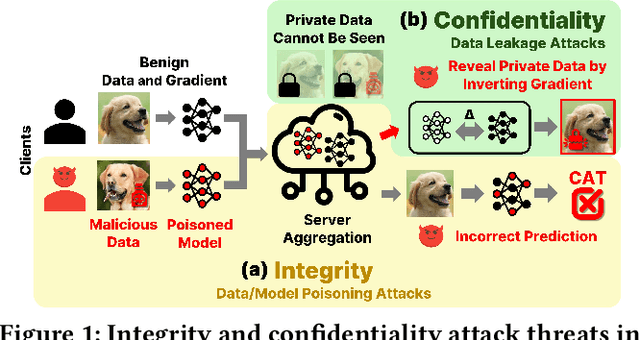
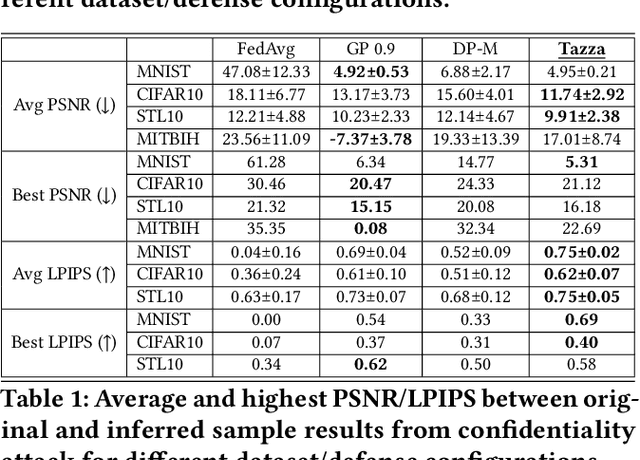
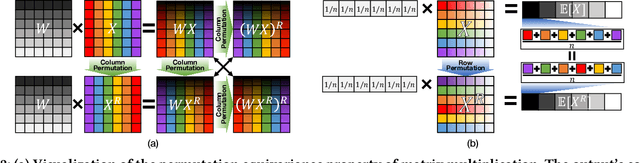
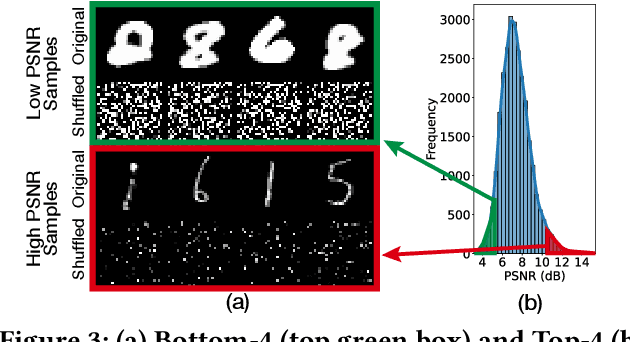
Federated learning enables decentralized model training without sharing raw data, preserving data privacy. However, its vulnerability towards critical security threats, such as gradient inversion and model poisoning by malicious clients, remain unresolved. Existing solutions often address these issues separately, sacrificing either system robustness or model accuracy. This work introduces Tazza, a secure and efficient federated learning framework that simultaneously addresses both challenges. By leveraging the permutation equivariance and invariance properties of neural networks via weight shuffling and shuffled model validation, Tazza enhances resilience against diverse poisoning attacks, while ensuring data confidentiality and high model accuracy. Comprehensive evaluations on various datasets and embedded platforms show that Tazza achieves robust defense with up to 6.7x improved computational efficiency compared to alternative schemes, without compromising performance.