 Add to Chrome
 Add to Firefox
 Add to Edge
Communication-Aware Multi-Agent Reinforcement Learning for Decentralized Cooperative UAV Deployment
Mar 17, 2026
Autonomous Unmanned Aerial Vehicle (UAV) swarms are increasingly used as rapidly deployable aerial relays and sensing platforms, yet practical deployments must operate under partial observability and intermittent peer-to-peer links. We present a graph-based multi-agent reinforcement learning framework trained under centralized training with decentralized execution (CTDE): a centralized critic and global state are available only during training, while each UAV executes a shared policy using local observations and messages from nearby neighbors. Our architecture encodes local agent state and nearby entities with an agent-entity attention module, and aggregates inter-UAV messages with neighbor self-attention over a distance-limited communication graph. We evaluate primarily on a cooperative relay deployment task (DroneConnect) and secondarily on an adversarial engagement task (DroneCombat). In DroneConnect, the proposed method achieves high coverage under restricted communication and partial observation (e.g. 74% coverage with M = 5 UAVs and N = 10 nodes) while remaining competitive with a mixed-integer linear programming (MILP) optimization-based offline upper bound, and it generalizes to unseen team sizes without fine-tuning. In the adversarial setting, the same framework transfers without architectural changes and improves win rate over non-communicating baselines.

DeepMPR: Enhancing Opportunistic Routing in Wireless Networks through Multi-Agent Deep Reinforcement Learning
Jun 16, 2023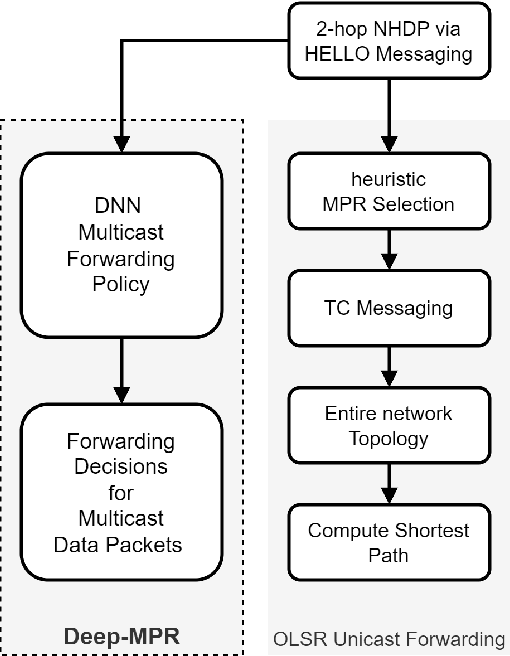
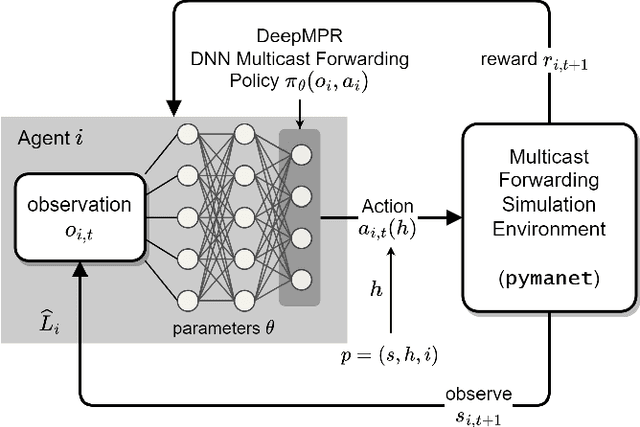
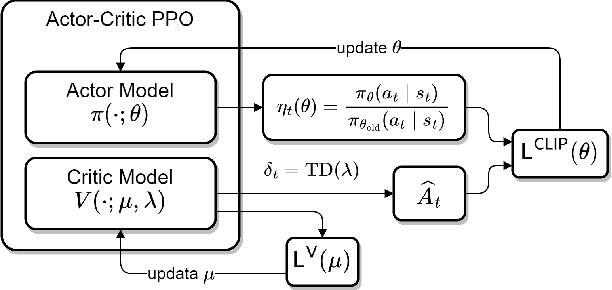
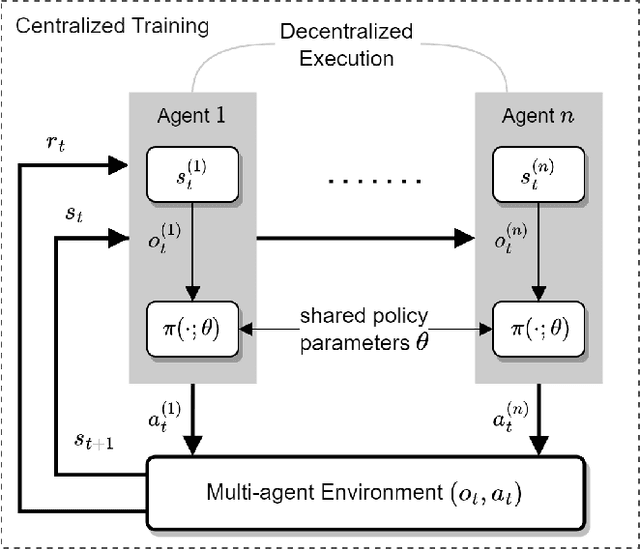
Opportunistic routing relies on the broadcast capability of wireless networks. It brings higher reliability and robustness in highly dynamic and/or severe environments such as mobile or vehicular ad-hoc networks (MANETs/VANETs). To reduce the cost of broadcast, multicast routing schemes use the connected dominating set (CDS) or multi-point relaying (MPR) set to decrease the network overhead and hence, their selection algorithms are critical. Common MPR selection algorithms are heuristic, rely on coordination between nodes, need high computational power for large networks, and are difficult to tune for network uncertainties. In this paper, we use multi-agent deep reinforcement learning to design a novel MPR multicast routing technique, DeepMPR, which is outperforming the OLSR MPR selection algorithm while it does not require MPR announcement messages from the neighbors. Our evaluation results demonstrate the performance gains of our trained DeepMPR multicast forwarding policy compared to other popular techniques.