 Add to Chrome
 Add to Firefox
 Add to Edge
Robust Silicone Pour Casting and Sensor Embedding Procedures for Soft Robotic Actuators
Jul 16, 2026
Soft robots are well-suited for applications such as rehabilitation and surgery that require adaptable and safe interaction with their environment. However, the challenges of reproducible and scalable fabrication of soft robots limit their real-world deployment. Various fabrication methods have been introduced, but many are labor-intensive and prone to human error. Therefore, traditional two-part pour casting remains an attractive option. This paper presents procedures for robust, repeatable, and scalable fabrication of soft pneumatic actuators using two-part pour casting. The presented methods prevent internal cavity clogging and ensure air-tight sealing. Additionally, a robust sensor embedding procedure for thin-film flex sensors is presented, which allows for accurate and repeatable data acquisition. Finite Element Modeling (FEM) of the soft actuator is performed to analyze stress and deformation from internal pressure loadings. Pneumatic actuation experiments with PID pressure control are performed. Automated image processing is used to calibrate the embedded flex sensor to bending angle measurements. Staircase and sinusoidal profile actuation experiments validate the performance of the fabricated actuator. Angle response experiments for the staircase input show repeatable performance, and the sinusoidal input shows a small amount of hysteresis consistent with viscoelastic response to pneumatic actuation of soft actuators. Simulated and real-world bending angles show comparable response. These methods provide a repeatable and robust fabrication procedure, validated across two operators and 24 successful fabrications, along with benchmark simulations and experimental testing. These benchmarks will enable more widespread adoption of soft robotics.

Towards Soft Robotic Exogloves for Musculoskeletal Manipulation to Reduce Pain and Spasticity
Jul 08, 2026Hand spasticity and resulting pain affect 12 million people worldwide, including stroke survivors, arthritis patients, and those with other muscle and nerve deficiencies. Soft robotic exogloves are being introduced to help patients enhance mobility or manage pain; however, there are no current solutions that address both pain and mobility. We present preliminary development of a soft robotic exoglove that both aids in mobility and administers massage-like compression to relax spastic muscles. The glove consists of soft pneumatic actuators that are personalized to an individual's hand topology and kinematics, allowing for optimal conformability and targeted mobility. Novel soft actuators were designed, analyzed, fabricated, assembled into an exoglove, and experimentally tested. Actuators were 3D modeled and analyzed with finite element modeling under pressures of 100 and 200 kPa. Geometries were optimized to minimize stress before fabrication and testing. A dorsal finger actuator was successfully customized to a participant's hand topology, providing full conformal contact and maximal force distribution. A ventral finger actuator was successfully fabricated that can be drastically compressed in size to fit into the tight space of a hyperflexed spastic finger. A palmar actuator was successfully printed with stereolithography, showing potential for 3D-printed soft actuators with more complex geometries. The glove was assembled and successfully worn by a pilot user to validate initial findings in comfort and effectiveness.
Soft Robotic Exogloves for Dexterous Mobility -- Towards Personalized Rehabilitation
Jul 08, 2026Soft robotic exogloves can provide hand rehabilitation and assistance. Fitting these gloves often relies on standardized measurements not tailored to the individual, limiting their effectiveness, especially for fine articulation necessary for dexterous manipulation. We present the design, fabrication, modeling, and testing of a personalized pneumatically-actuated soft robotic exoglove. The glove was fit to a user's hand with topological scans and fabricated with silicone mold casting. Finite element analysis (FEA) was performed to evaluate actuator bending and forces from physical human-robot interaction (pHRI) between an actuator and a simplified personalized biomechanical finger model. Pneumatic pressure control experiments were conducted to flex the user's finger with static and dynamic references. Fabrication results show that topological scans enable precise tailoring to hand anatomy. Simulations showed that anatomical personalization enables analysis of pHRI contact forces, and results indicate sufficient joint mobilization with non-ideal compression on the proximal phalanx. Pneumatic testing indicates that pressure control allows accurate and targeted mobility of the metacarpophalangeal (MCP) and proximal interphalangeal (PIP) joints with intrinsic stiffness. Testing of multiple designs showed that relaxing the strain-limiting layer improves actuator-to-finger joint alignment during actuation. This work presents personalization to the human hand in structural conformability, joint topology, modeling of pHRI contact, and time-dependent actuation-deformation profiles. This lays a groundwork for informing exoglove design optimization to enable assistance in dexterous manipulation and neuromuscular rehabilitation of fine motor skills.
How Does the Inner Geometry of Soft Actuators Modulate the Dynamic and Hysteretic Response?
Aug 09, 2023
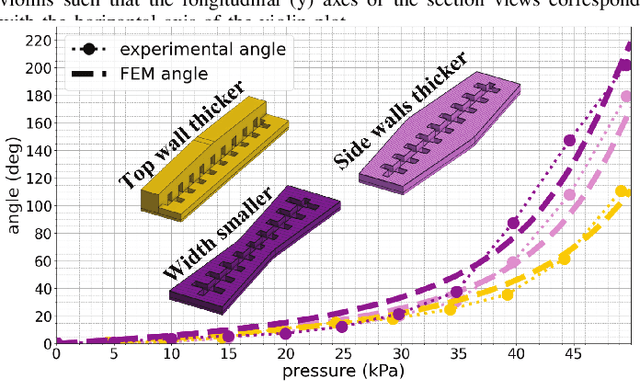


This paper investigates the influence of the internal geometrical structure of soft pneu-nets on the dynamic response and hysteresis of the actuators. The research findings indicate that by strategically manipulating the stress distribution within soft robots, it is possible to enhance the dynamic response while reducing hysteresis. The study utilizes the Finite Element Method (FEM) and includes experimental validation through markerless motion tracking of the soft robot. In particular, the study examines actuator bending angles up to 500% strain while achieving 95% accuracy in predicting the bending angle. The results demonstrate that the particular design with the minimum air chamber width in the center significantly improves both high- and low-frequency hysteresis behavior by 21.5% while also enhancing dynamic response by 60% to 112% across various frequencies and peak-to-peak pressures. Consequently, the paper evaluates the effectiveness of "mechanically programming" stress distribution and distributed energy storage within soft robots to maximize their dynamic performance, offering direct benefits for control.
What Happens When Pneu-Net Soft Robotic Actuators Get Fatigued?
Dec 07, 2022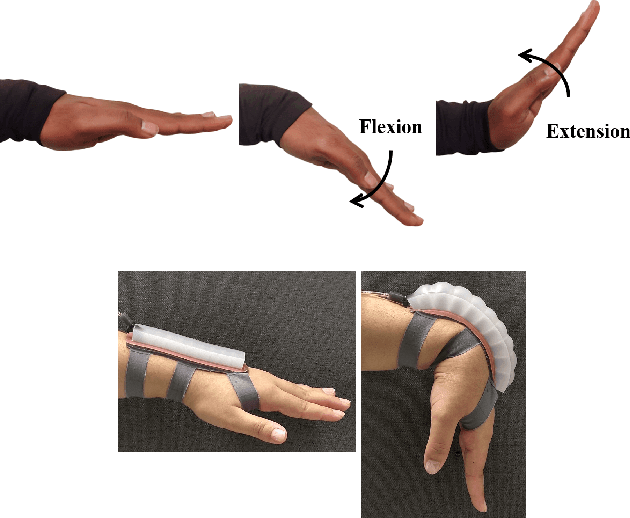
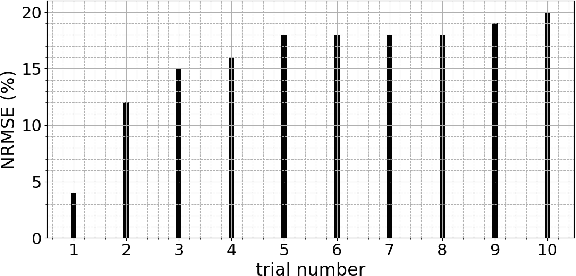
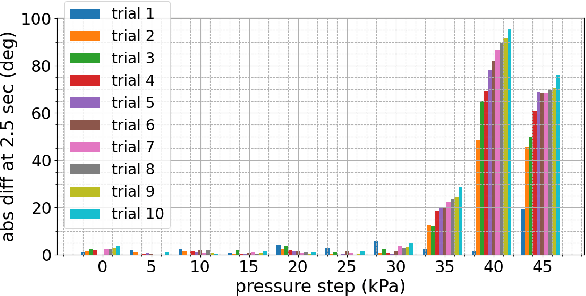
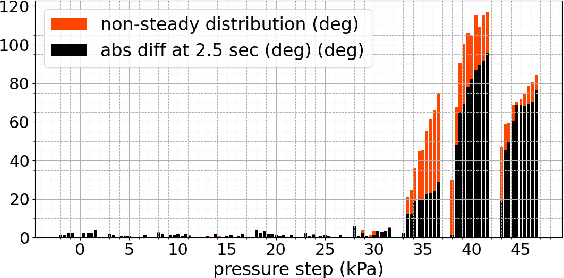
Soft actuators have attracted a great deal of interest in the context of rehabilitative and assistive robots for increasing safety and lowering costs as compared to rigid-body robotic systems. During actuation, soft actuators experience high levels of deformation, which can lead to microscale fractures in their elastomeric structure, which fatigues the system over time and eventually leads to macroscale damages and eventually failure. This paper reports finite element modeling (FEM) of pneu-nets at high angles, along with repetitive experimentation at high deformation rates, in order to study the effect and behavior of fatigue in soft robotic actuators, which would result in deviation from the ideal behavior. Comparing the FEM model and experimental data, we show that FEM can model the performance of the actuator before fatigue to a bending angle of 167 degrees with ~96% accuracy. We also show that the FEM model performance will drop to 80% due to fatigue after repetitive high-angle bending. The results of this paper objectively highlight the emergence of fatigue over cyclic activation of the system and the resulting deviation from the computational FEM model. Such behavior can be considered in future controllers to adapt the system with time-variable and non-autonomous response dynamics of soft robots.