 Add to Chrome
 Add to Firefox
 Add to Edge
Temperature transferable Machine Learned Coarse Grained model for proteins
Jun 12, 2026
Coarse-grained (CG) molecular simulations offer an efficient alternative to atomistic molecular dynamics to study large and complex biological systems. The accuracy of CG simulations has been increased dramatically by the introduction of machine-learned coarse-grained (MLCG) models. However, these models are typically designed to be used at a single thermodynamic point, lack temperature transferability, and can not be used to predict temperature dependent quantities like the heat capacity. Here we introduce a thermodynamically informed, temperature-transferable MLCG framework for proteins that explicitly decomposes the CG potential of mean force (PMF) into its energetic and entropic components. The model architecture enforces an exact thermodynamic relation between the energetic and entropic components of the PMF and guarantees physically consistent extrapolation and interpolation across temperature regimes. We validate this framework on an extensive dataset spanning a total of 250 $μ$s of molecular dynamics simulations across five temperatures between 300 K and 400 K for the Chignolin protein, and demonstrate that it reproduces the temperature dependency of the reference atomistic free energy surfaces, correcting the temperature-unaware baselines. Furthermore, we show that it is possible to apply an inexpensive, post-hoc temperature-dependent correction that does not require retraining the MLCG potential, accurately recovering the atomistic heat capacity at different temperatures. Overall, this work provides a physically grounded pathway toward thermodynamically transferable MLCG simulations of complex biomolecular systems.

Navigating protein landscapes with a machine-learned transferable coarse-grained model
Oct 27, 2023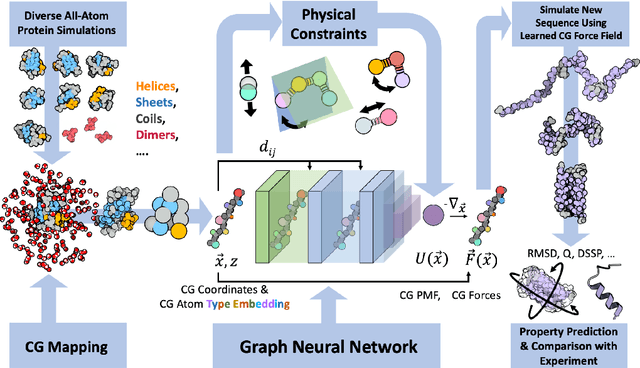
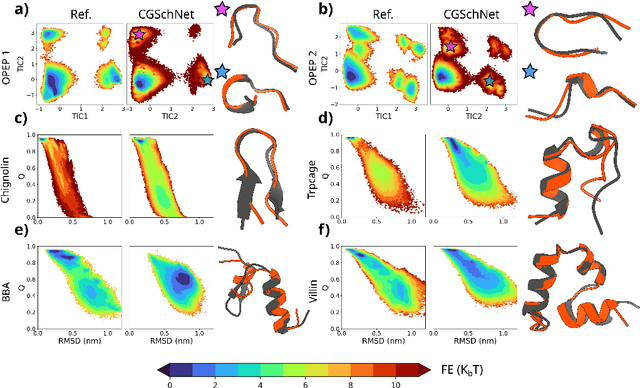
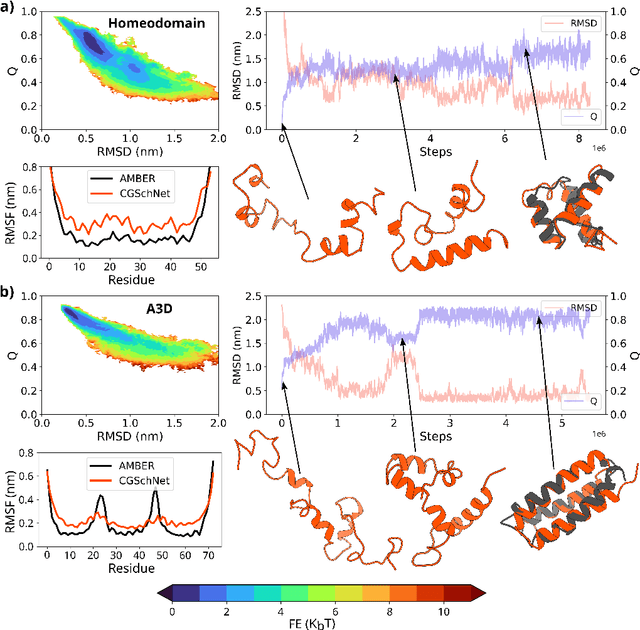
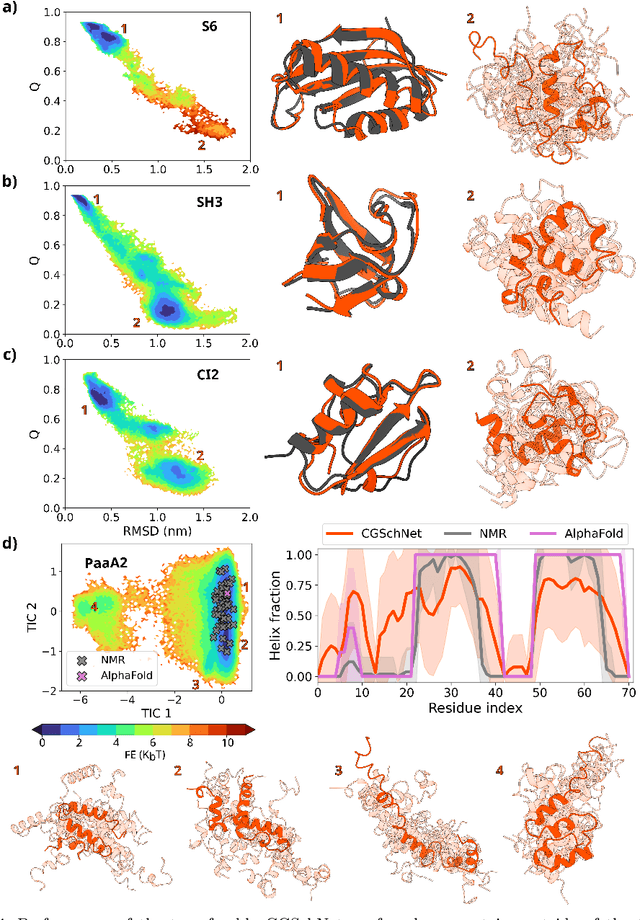
The most popular and universally predictive protein simulation models employ all-atom molecular dynamics (MD), but they come at extreme computational cost. The development of a universal, computationally efficient coarse-grained (CG) model with similar prediction performance has been a long-standing challenge. By combining recent deep learning methods with a large and diverse training set of all-atom protein simulations, we here develop a bottom-up CG force field with chemical transferability, which can be used for extrapolative molecular dynamics on new sequences not used during model parametrization. We demonstrate that the model successfully predicts folded structures, intermediates, metastable folded and unfolded basins, and the fluctuations of intrinsically disordered proteins while it is several orders of magnitude faster than an all-atom model. This showcases the feasibility of a universal and computationally efficient machine-learned CG model for proteins.