 Add to Chrome
 Add to Firefox
 Add to Edge
Diffusion Representations for Fine-Grained Image Classification: A Marine Plankton Case Study
Jan 19, 2026
Diffusion models have emerged as state-of-the-art generative methods for image synthesis, yet their potential as general-purpose feature encoders remains underexplored. Trained for denoising and generation without labels, they can be interpreted as self-supervised learners that capture both low- and high-level structure. We show that a frozen diffusion backbone enables strong fine-grained recognition by probing intermediate denoising features across layers and timesteps and training a linear classifier for each pair. We evaluate this in a real-world plankton-monitoring setting with practical impact, using controlled and comparable training setups against established supervised and self-supervised baselines. Frozen diffusion features are competitive with supervised baselines and outperform other self-supervised methods in both balanced and naturally long-tailed settings. Out-of-distribution evaluations on temporally and geographically shifted plankton datasets further show that frozen diffusion features maintain strong accuracy and Macro F1 under substantial distribution shift.

Probabilistic orientation estimation with matrix Fisher distributions
Jun 17, 2020

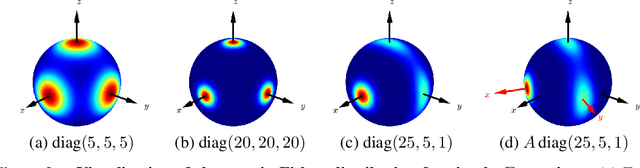

This paper focuses on estimating probability distributions over the set of 3D rotations ($SO(3)$) using deep neural networks. Learning to regress models to the set of rotations is inherently difficult due to differences in topology between $\mathbb{R}^N$ and $SO(3)$. We overcome this issue by using a neural network to output the parameters for a matrix Fisher distribution since these parameters are homeomorphic to $\mathbb{R}^9$. By using a negative log likelihood loss for this distribution we get a loss which is convex with respect to the network outputs. By optimizing this loss we improve state-of-the-art on several challenging applicable datasets, namely Pascal3D+, ModelNet10-$SO(3)$ and UPNA head pose.