 Add to Chrome
 Add to Firefox
 Add to Edge
Tensor Decompositions for Online Grid-Based Terrain-Aided Navigation
Jan 12, 2026
This paper presents a practical and scalable grid-based state estimation method for high-dimensional models with invertible linear dynamics and with highly non-linear measurements, such as the nearly constant velocity model with measurements of e.g. altitude, bearing, and/or range. Unlike previous tensor decomposition-based approaches, which have largely remained at the proof-of-concept stage, the proposed method delivers an efficient and practical solution by exploiting decomposable model structure-specifically, block-diagonal dynamics and sparsely coupled measurement dimensions. The algorithm integrates a Lagrangian formulation for the time update and leverages low-rank tensor decompositions to compactly represent and effectively propagate state densities. This enables real-time estimation for models with large state dimension, significantly extending the practical reach of grid-based filters beyond their traditional low-dimensional use. Although demonstrated in the context of terrain-aided navigation, the method is applicable to a wide range of models with decomposable structure. The computational complexity and estimation accuracy depend on the specific structure of the model. All experiments are fully reproducible, with source code provided alongside this paper (GitHub link: https://github.com/pesslovany/Matlab-LagrangianPMF).

Tensor Train Discrete Grid-Based Filters: Breaking the Curse of Dimensionality
Jan 14, 2025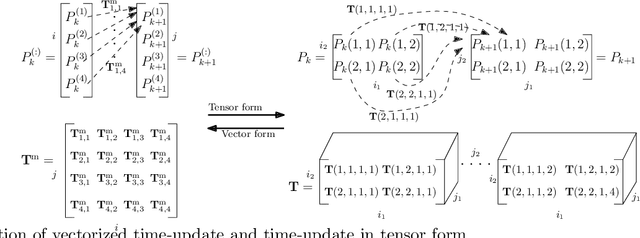
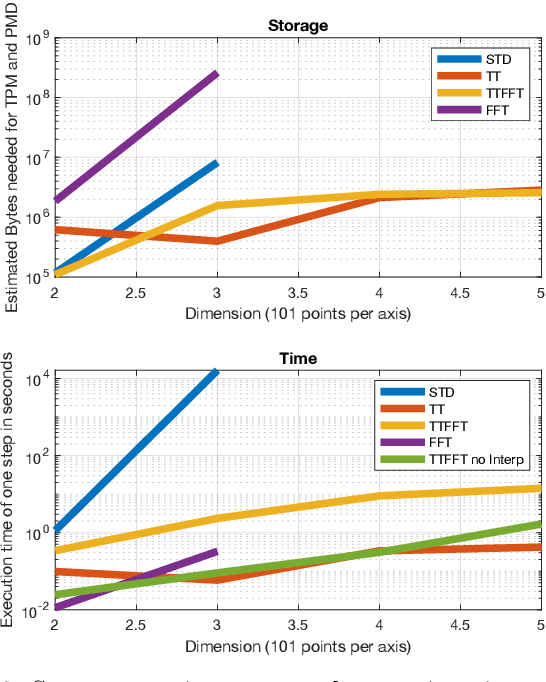

This paper deals with the state estimation of stochastic systems and examines the possible employment of tensor decompositions in grid-based filtering routines, in particular, the tensor-train decomposition. The aim is to show that these techniques can lead to a massive reduction in both the computational and storage complexity of grid-based filtering algorithms without considerable tradeoffs in accuracy. This claim is supported by an algorithm descriptions and numerical illustrations.
Design of Efficient Point-Mass Filter with Application in Terrain Aided Navigation
Mar 09, 2023This paper deals with state estimation of stochastic models with linear state dynamics, continuous or discrete in time. The emphasis is laid on a numerical solution to the state prediction by the time-update step of the grid-point-based point-mass filter (PMF), which is the most computationally demanding part of the PMF algorithm. A novel efficient PMF (ePMF) estimator is proposed, designed, and discussed. By numerical illustrations, it is shown, that the proposed ePMF can lead to a time complexity reduction that exceeds 99.9% without compromising accuracy. The MATLAB code of the ePMF is released with this paper.