 Add to Chrome
 Add to Firefox
 Add to Edge
Multi-vision-based Picking Point Localisation of Target Fruit for Harvesting Robots
Feb 18, 2025
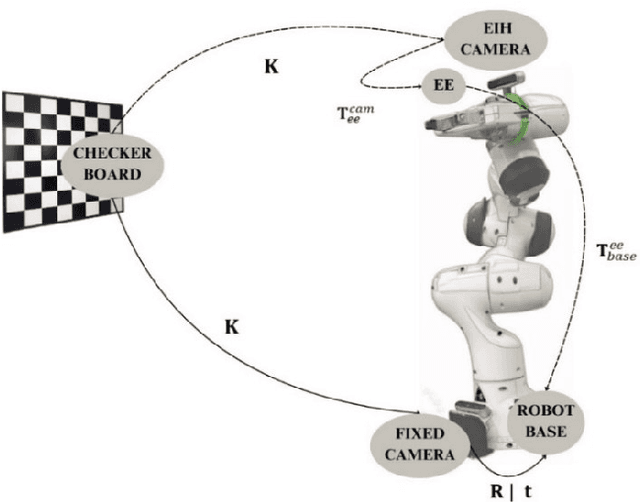
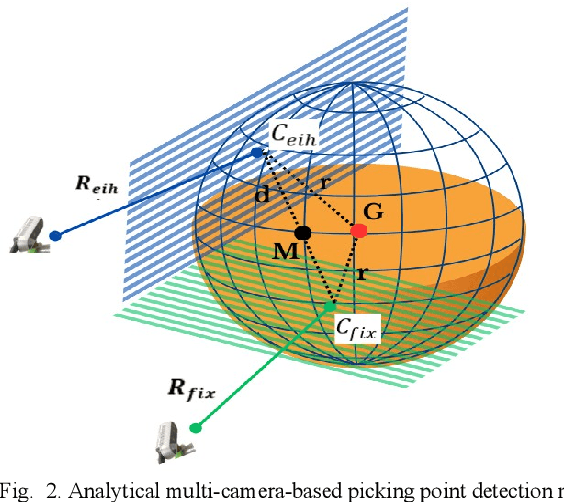
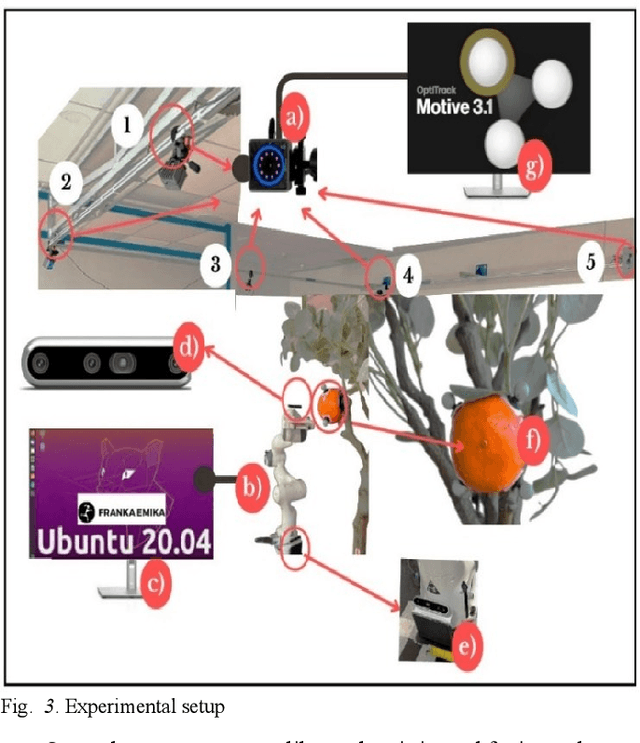
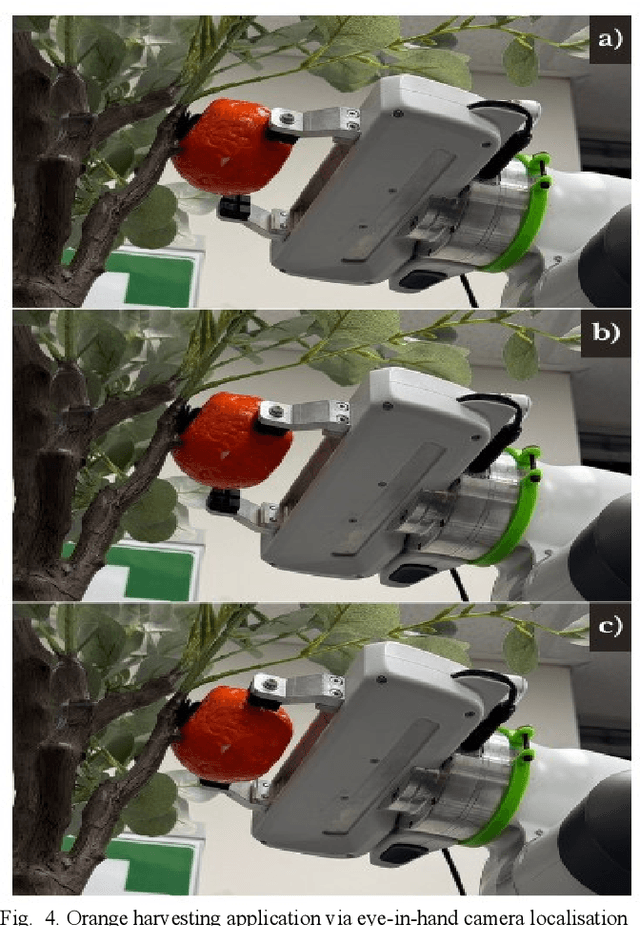
This paper presents multi-vision-based localisation strategies for harvesting robots. Identifying picking points accurately is essential for robotic harvesting because insecure grasping can lead to economic loss through fruit damage and dropping. In this study, two multi-vision-based localisation methods, namely the analytical approach and model-based algorithms, were employed. The actual geometric centre points of fruits were collected using a motion capture system (mocap), and two different surface points Cfix and Ceih were extracted using two Red-Green-Blue-Depth (RGB-D) cameras. First, the picking points of the target fruit were detected using analytical methods. Second, various primary and ensemble learning methods were employed to predict the geometric centre of target fruits by taking surface points as input. Adaboost regression, the most successful model-based localisation algorithm, achieved 88.8% harvesting accuracy with a Mean Euclidean Distance (MED) of 4.40 mm, while the analytical approach reached 81.4% picking success with a MED of 14.25 mm, both demonstrating better performance than the single-camera, which had a picking success rate of 77.7% with a MED of 24.02 mm. To evaluate the effect of picking point accuracy in collecting fruits, a series of robotic harvesting experiments were performed utilising a collaborative robot (cobot). It is shown that multi-vision systems can improve picking point localisation, resulting in higher success rates of picking in robotic harvesting.

Sensing-based Robustness Challenges in Agricultural Robotic Harvesting
Feb 18, 2025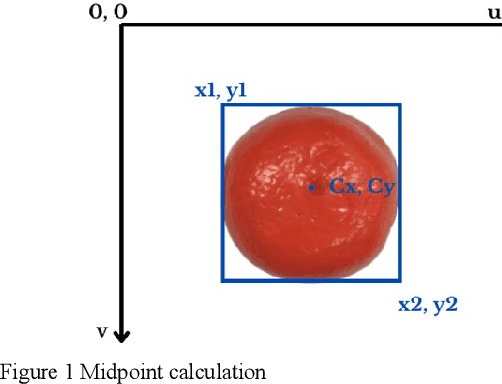
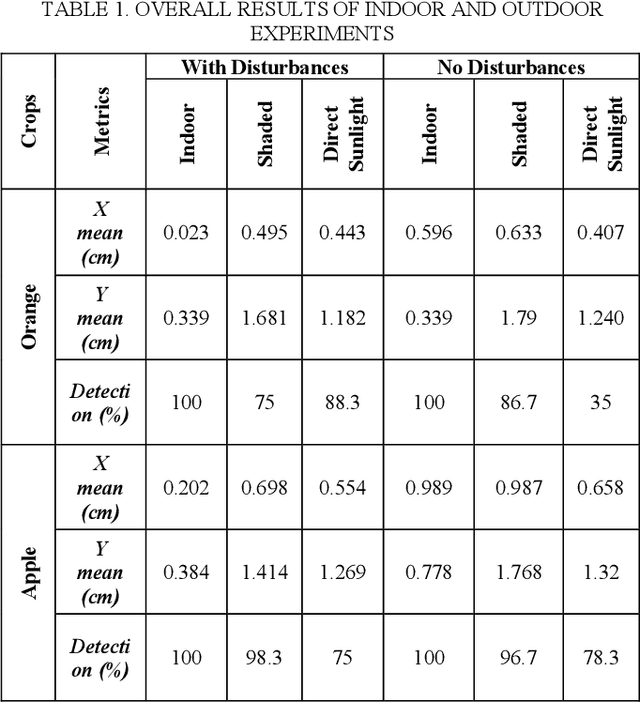
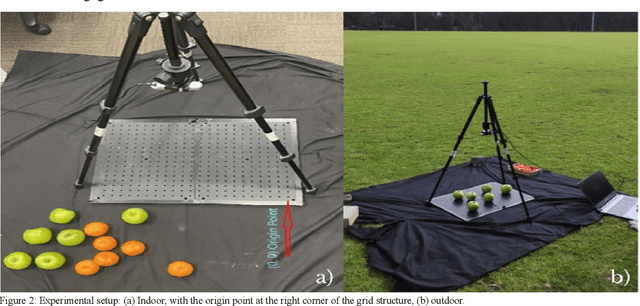
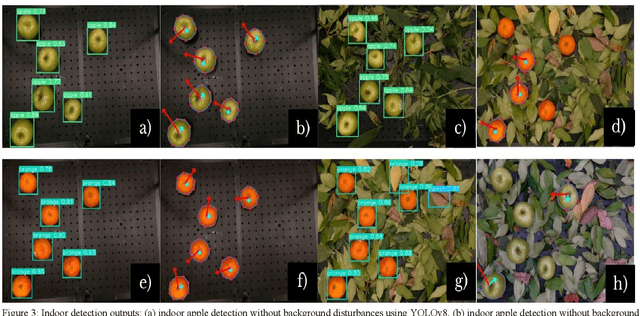
This paper presents the challenges agricultural robotic harvesters face in detecting and localising fruits under various environmental disturbances. In controlled laboratory settings, both the traditional HSV (Hue Saturation Value) transformation and the YOLOv8 (You Only Look Once) deep learning model were employed. However, only YOLOv8 was utilised in outdoor experiments, as the HSV transformation was not capable of accurately drawing fruit contours. Experiments include ten distinct fruit patterns with six apples and six oranges. A grid structure for homography (perspective) transformation was employed to convert detected midpoints into 3D world coordinates. The experiments evaluated detection and localisation under varying lighting and background disturbances, revealing accurate performance indoors, but significant challenges outdoors. Our results show that indoor experiments using YOLOv8 achieved 100% detection accuracy, while outdoor conditions decreased performance, with an average accuracy of 69.15% for YOLOv8 under direct sunlight. The study demonstrates that real-world applications reveal significant limitations due to changing lighting, background disturbances, and colour and shape variability. These findings underscore the need for further refinement of algorithms and sensors to enhance the robustness of robotic harvesters for agricultural use.
AI-assisted Optimization of the ECCE Tracking System at the Electron Ion Collider
May 20, 2022The Electron-Ion Collider (EIC) is a cutting-edge accelerator facility that will study the nature of the "glue" that binds the building blocks of the visible matter in the universe. The proposed experiment will be realized at Brookhaven National Laboratory in approximately 10 years from now, with detector design and R&D currently ongoing. Notably, EIC is one of the first large-scale facilities to leverage Artificial Intelligence (AI) already starting from the design and R&D phases. The EIC Comprehensive Chromodynamics Experiment (ECCE) is a consortium that proposed a detector design based on a 1.5T solenoid. The EIC detector proposal review concluded that the ECCE design will serve as the reference design for an EIC detector. Herein we describe a comprehensive optimization of the ECCE tracker using AI. The work required a complex parametrization of the simulated detector system. Our approach dealt with an optimization problem in a multidimensional design space driven by multiple objectives that encode the detector performance, while satisfying several mechanical constraints. We describe our strategy and show results obtained for the ECCE tracking system. The AI-assisted design is agnostic to the simulation framework and can be extended to other sub-detectors or to a system of sub-detectors to further optimize the performance of the EIC detector.