 Add to Chrome
 Add to Firefox
 Add to Edge
When Remembering and Planning are Worth it: Navigating under Change
Feb 17, 2026
We explore how different types and uses of memory can aid spatial navigation in changing uncertain environments. In the simple foraging task we study, every day, our agent has to find its way from its home, through barriers, to food. Moreover, the world is non-stationary: from day to day, the location of the barriers and food may change, and the agent's sensing such as its location information is uncertain and very limited. Any model construction, such as a map, and use, such as planning, needs to be robust against these challenges, and if any learning is to be useful, it needs to be adequately fast. We look at a range of strategies, from simple to sophisticated, with various uses of memory and learning. We find that an architecture that can incorporate multiple strategies is required to handle (sub)tasks of a different nature, in particular for exploration and search, when food location is not known, and for planning a good path to a remembered (likely) food location. An agent that utilizes non-stationary probability learning techniques to keep updating its (episodic) memories and that uses those memories to build maps and plan on the fly (imperfect maps, i.e. noisy and limited to the agent's experience) can be increasingly and substantially more efficient than the simpler (minimal-memory) agents, as the task difficulties such as distance to goal are raised, as long as the uncertainty, from localization and change, is not too large.

Sensor Control for Information Gain in Dynamic, Sparse and Partially Observed Environments
Nov 03, 2022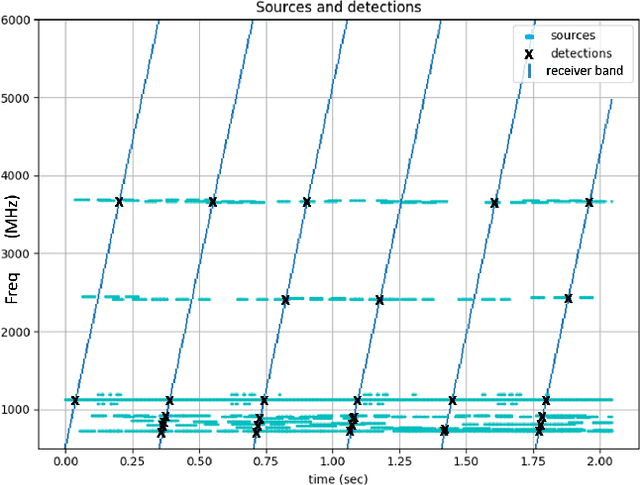
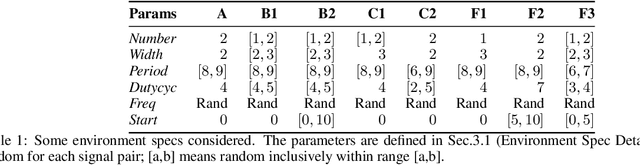

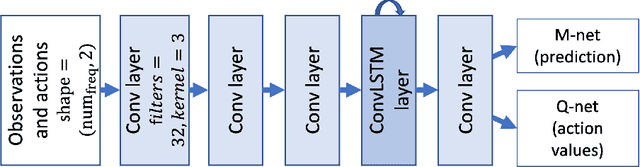
We present an approach for autonomous sensor control for information gathering under partially observable, dynamic and sparsely sampled environments. We consider the problem of controlling a sensor that makes partial observations in some space of interest such that it maximizes information about entities present in that space. We describe our approach for the task of Radio-Frequency (RF) spectrum monitoring, where the goal is to search for and track unknown, dynamic signals in the environment. To this end, we develop and demonstrate enhancements of the Deep Anticipatory Network (DAN) Reinforcement Learning (RL) framework that uses prediction and information-gain rewards to learn information-maximization policies in reward-sparse environments. We also extend this problem to situations in which taking samples from the actual RF spectrum/field is limited and expensive, and propose a model-based version of the original RL algorithm that fine-tunes the controller using a model of the environment that is iteratively improved from limited samples taken from the RF field. Our approach was thoroughly validated by testing against baseline expert-designed controllers in simulated RF environments of different complexity, using different rewards schemes and evaluation metrics. The results show that our system outperforms the standard DAN architecture and is more flexible and robust than several hand-coded agents. We also show that our approach is adaptable to non-stationary environments where the agent has to learn to adapt to changes from the emitting sources.