 Add to Chrome
 Add to Firefox
 Add to Edge
Differential Morphological Profile Neural Networks for Semantic Segmentation
Sep 04, 2025
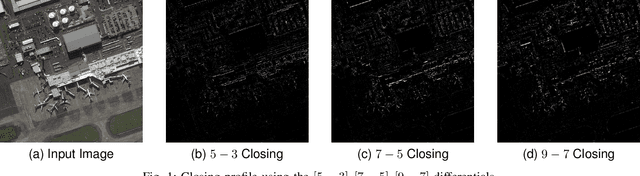
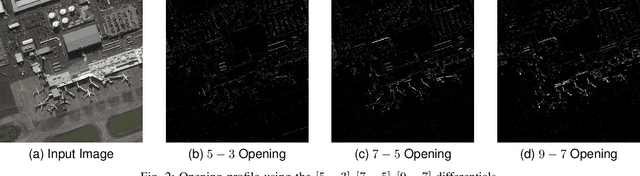
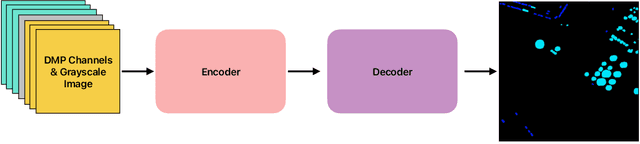
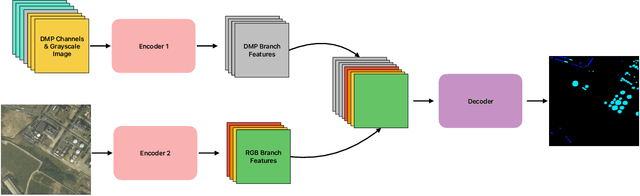
Semantic segmentation of overhead remote sensing imagery enables applications in mapping, urban planning, and disaster response. State-of-the-art segmentation networks are typically developed and tuned on ground-perspective photographs and do not directly address remote sensing challenges such as extreme scale variation, foreground-background imbalance, and large image sizes. We explore the incorporation of the differential morphological profile (DMP), a multi-scale shape extraction method based on grayscale morphology, into modern segmentation networks. Prior studies have shown that the DMP can provide critical shape information to Deep Neural Networks to enable superior detection and classification performance in overhead imagery. In this work, we extend prior DMPNet work beyond classification and object detection by integrating DMP features into three state-of-the-art convolutional and transformer semantic segmentation architectures. We utilize both direct input, which adapts the input stem of feature extraction architectures to accept DMP channels, and hybrid architectures, a dual-stream design that fuses RGB and DMP encoders. Using the iSAID benchmark dataset, we evaluate a variety of DMP differentials and structuring element shapes to more effectively provide shape information to the model. Our results show that while non-DMP models generally outperform the direct-input variants, hybrid DMP consistently outperforms direct-input and is capable of surpassing a non-DMP model on mIoU, F1, and Recall.

Scaling Deep Learning Research with Kubernetes on the NRP Nautilus HyperCluster
Nov 18, 2024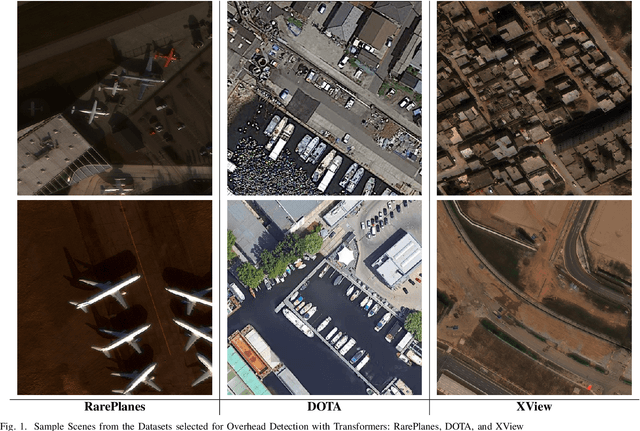
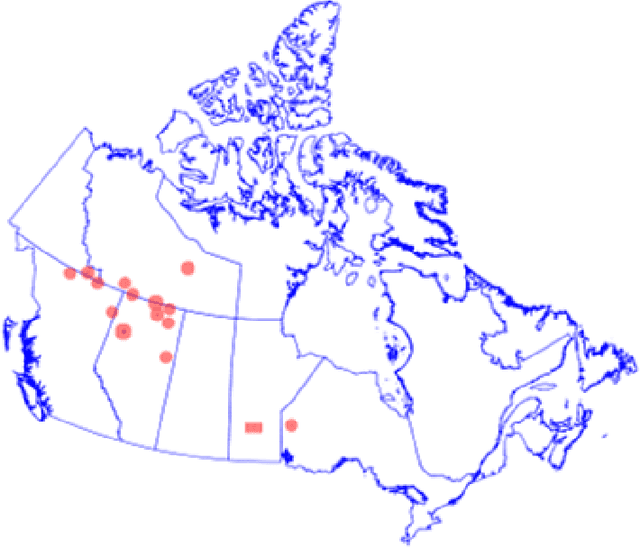
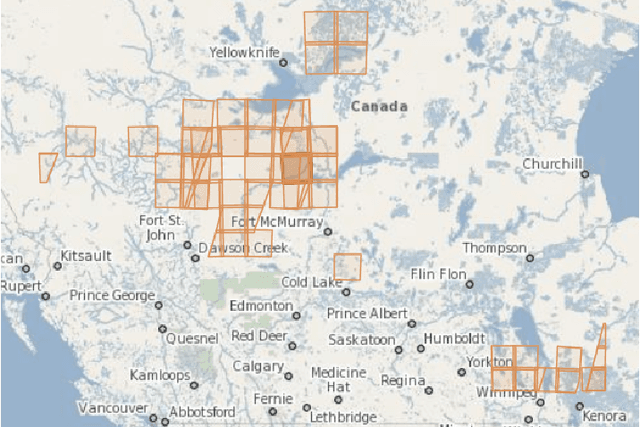
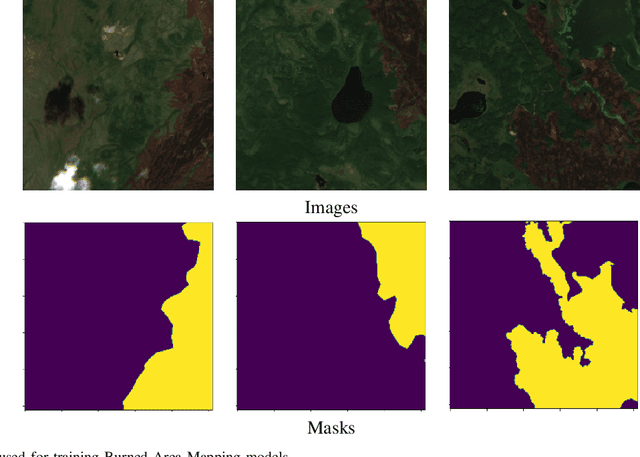
Throughout the scientific computing space, deep learning algorithms have shown excellent performance in a wide range of applications. As these deep neural networks (DNNs) continue to mature, the necessary compute required to train them has continued to grow. Today, modern DNNs require millions of FLOPs and days to weeks of training to generate a well-trained model. The training times required for DNNs are oftentimes a bottleneck in DNN research for a variety of deep learning applications, and as such, accelerating and scaling DNN training enables more robust and accelerated research. To that end, in this work, we explore utilizing the NRP Nautilus HyperCluster to automate and scale deep learning model training for three separate applications of DNNs, including overhead object detection, burned area segmentation, and deforestation detection. In total, 234 deep neural models are trained on Nautilus, for a total time of 4,040 hours