 Add to Chrome
 Add to Firefox
 Add to Edge
DeepForestSound: a multi-species automatic detector for passive acoustic monitoring in African tropical forests, a case study in Kibale National Park
Apr 09, 2026
Passive Acoustic Monitoring (PAM) is widely used for biodiversity assessment. Its application in African tropical forests is limited by scarce annotated data, reducing the performance of general-purpose ecoacoustic models on underrepresented taxa. In this study, we introduce DeepForestSound (DFS), a multi-species automatic detection model designed for PAM in African tropical forests. DFS relies on a semi-supervised pipeline combining clustering of unannotated recordings with manual validation, followed by supervised fine-tuning of an Audio Spectrogram Transformer (AST) using low-rank adaptation, which is compared to a frozen-backbone linear baseline (DFS-Linear). The framework supports the detection of multiple taxonomic groups, including birds, primates, and elephants, from long-term acoustic recordings. DFS was trained on acoustic data collected in the Sebitoli area, in Kibale National Park, Uganda, and evaluated on an independent dataset recorded two years later at different locations within the same forest. This evaluation therefore assesses generalization across time and recording sites within a single tropical forest ecosystem. Across 8 out of 12 taxons, DFS outperforms existing automatic detection tools, particularly for non-avian taxa, achieving average AP values of 0.964 for primates and 0.961 for elephants. Results further show that LoRA-based fine-tuning substantially outperforms linear probing across taxa. Overall, these results demonstrate that task-oriented, region-specific training substantially improves detection performance in acoustically complex tropical environments, and highlight the potential of DFS as a practical tool for biodiversity monitoring and conservation in African rainforests.

ECOSoundSet: a finely annotated dataset for the automated acoustic identification of Orthoptera and Cicadidae in North, Central and temperate Western Europe
Apr 29, 2025Currently available tools for the automated acoustic recognition of European insects in natural soundscapes are limited in scope. Large and ecologically heterogeneous acoustic datasets are currently needed for these algorithms to cross-contextually recognize the subtle and complex acoustic signatures produced by each species, thus making the availability of such datasets a key requisite for their development. Here we present ECOSoundSet (European Cicadidae and Orthoptera Sound dataSet), a dataset containing 10,653 recordings of 200 orthopteran and 24 cicada species (217 and 26 respective taxa when including subspecies) present in North, Central, and temperate Western Europe (Andorra, Belgium, Denmark, mainland France and Corsica, Germany, Ireland, Luxembourg, Monaco, Netherlands, United Kingdom, Switzerland), collected partly through targeted fieldwork in South France and Catalonia and partly through contributions from various European entomologists. The dataset is composed of a combination of coarsely labeled recordings, for which we can only infer the presence, at some point, of their target species (weak labeling), and finely annotated recordings, for which we know the specific time and frequency range of each insect sound present in the recording (strong labeling). We also provide a train/validation/test split of the strongly labeled recordings, with respective approximate proportions of 0.8, 0.1 and 0.1, in order to facilitate their incorporation in the training and evaluation of deep learning algorithms. This dataset could serve as a meaningful complement to recordings already available online for the training of deep learning algorithms for the acoustic classification of orthopterans and cicadas in North, Central, and temperate Western Europe.
Unsupervised classification to improve the quality of a bird song recording dataset
Feb 15, 2023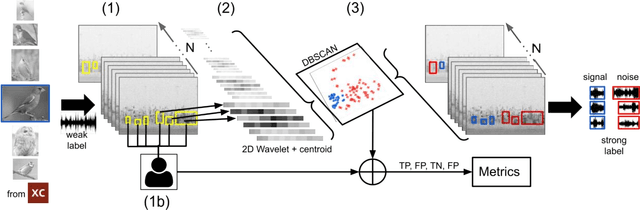
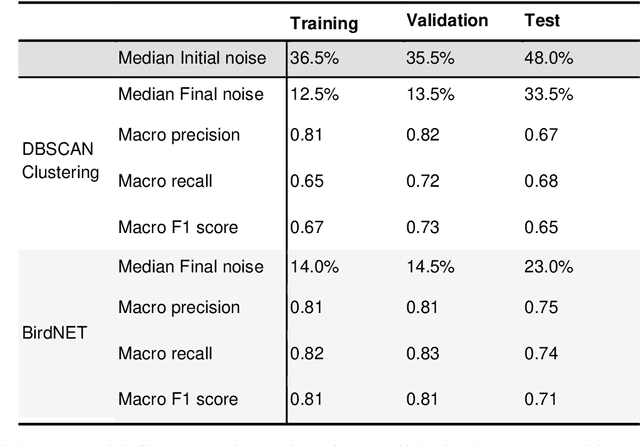
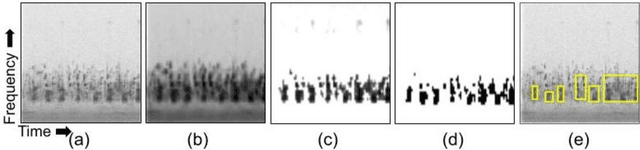
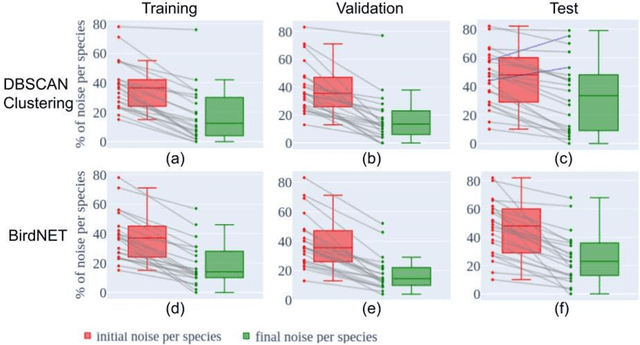
Open audio databases such as Xeno-Canto are widely used to build datasets to explore bird song repertoire or to train models for automatic bird sound classification by deep learning algorithms. However, such databases suffer from the fact that bird sounds are weakly labelled: a species name is attributed to each audio recording without timestamps that provide the temporal localization of the bird song of interest. Manual annotations can solve this issue, but they are time consuming, expert-dependent, and cannot run on large datasets. Another solution consists in using a labelling function that automatically segments audio recordings before assigning a label to each segmented audio sample. Although labelling functions were introduced to expedite strong label assignment, their classification performance remains mostly unknown. To address this issue and reduce label noise (wrong label assignment) in large bird song datasets, we introduce a data-centric novel labelling function composed of three successive steps: 1) time-frequency sound unit segmentation, 2) feature computation for each sound unit, and 3) classification of each sound unit as bird song or noise with either an unsupervised DBSCAN algorithm or the supervised BirdNET neural network. The labelling function was optimized, validated, and tested on the songs of 44 West-Palearctic common bird species. We first showed that the segmentation of bird songs alone aggregated from 10% to 83% of label noise depending on the species. We also demonstrated that our labelling function was able to significantly reduce the initial label noise present in the dataset by up to a factor of three. Finally, we discuss different opportunities to design suitable labelling functions to build high-quality animal vocalizations with minimum expert annotation effort.