 Add to Chrome
 Add to Firefox
 Add to Edge
Technical Report -- A Context-Sensitive Multi-Level Similarity Framework for First-Order Logic Arguments: An Axiomatic Study
Apr 14, 2026
Similarity in formal argumentation has recently gained attention due to its significance in problems such as argument aggregation in semantics and enthymeme decoding. While existing approaches focus on propositional logic, we address the richer setting of First-Order Logic (FOL), where similarity must account for structured content. We introduce a comprehensive framework for FOL argument similarity, built upon: (1) an extended axiomatic foundation; (2) a four-level parametric model covering predicates, literals, clauses, and formulae similarity; (3) two model families, one syntax-sensitive via language models, both integrating contextual weights for nuanced and explainable similarity; and (4) formal constraints enforcing desirable properties.

Impact Measures for Gradual Argumentation Semantics
Jul 11, 2024Argumentation is a formalism allowing to reason with contradictory information by modeling arguments and their interactions. There are now an increasing number of gradual semantics and impact measures that have emerged to facilitate the interpretation of their outcomes. An impact measure assesses, for each argument, the impact of other arguments on its score. In this paper, we refine an existing impact measure from Delobelle and Villata and introduce a new impact measure rooted in Shapley values. We introduce several principles to evaluate those two impact measures w.r.t. some well-known gradual semantics. This comprehensive analysis provides deeper insights into their functionality and desirability.
A note on the uniqueness of models in social abstract argumentation
May 09, 2017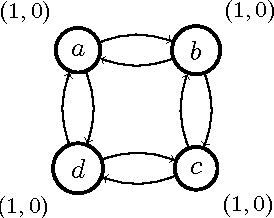

Social abstract argumentation is a principled way to assign values to conflicting (weighted) arguments. In this note we discuss the important property of the uniqueness of the model.
A Comparative Study of Ranking-based Semantics for Abstract Argumentation
Feb 02, 2016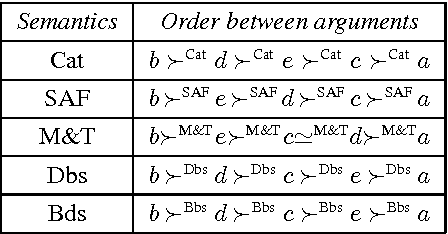
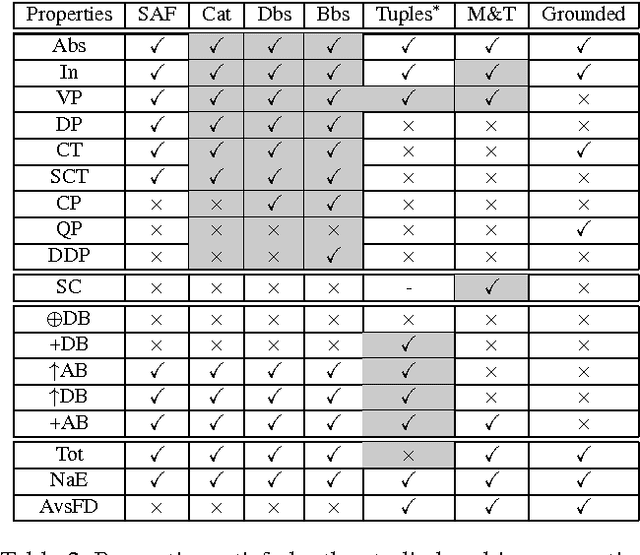
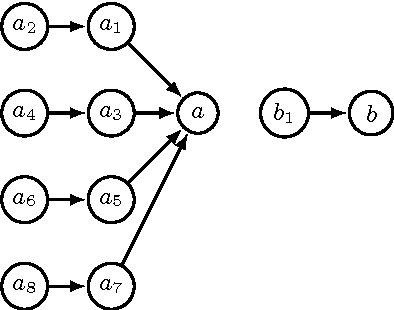
Argumentation is a process of evaluating and comparing a set of arguments. A way to compare them consists in using a ranking-based semantics which rank-order arguments from the most to the least acceptable ones. Recently, a number of such semantics have been proposed independently, often associated with some desirable properties. However, there is no comparative study which takes a broader perspective. This is what we propose in this work. We provide a general comparison of all these semantics with respect to the proposed properties. That allows to underline the differences of behavior between the existing semantics.