 Add to Chrome
 Add to Firefox
 Add to Edge
An explicit operator explains end-to-end computation in the modern neural networks used for sequence and language modeling
Apr 22, 2026
We establish a mathematical correspondence between state space models, a state-of-the-art architecture for capturing long-range dependencies in data, and an exactly solvable nonlinear oscillator network. As a specific example of this general correspondence, we analyze the diagonal linear time-invariant implementation of the Structured State Space Sequence model (S4). The correspondence embeds S4D, a specific implementation of S4, into a ring network topology, in which recent inputs are encoded, as waves of activity traveling over the one-dimensional spatial layout of the network. We then derive an exact operator expression for the full forward pass of S4D, yielding an analytical characterization of its complete input-output map. This expression reveals that the nonlinear decoder in the system induces interactions between these information-carrying waves that enable classifying real-world sequences. These results generalize across modern SSM architectures, and show that they admit an exact mathematical description with a clear physical interpretation. These insights enable a new level of interpretability for these systems in terms of nonlinear oscillator networks.

An exact mathematical description of computation with transient spatiotemporal dynamics in a complex-valued neural network
Nov 28, 2023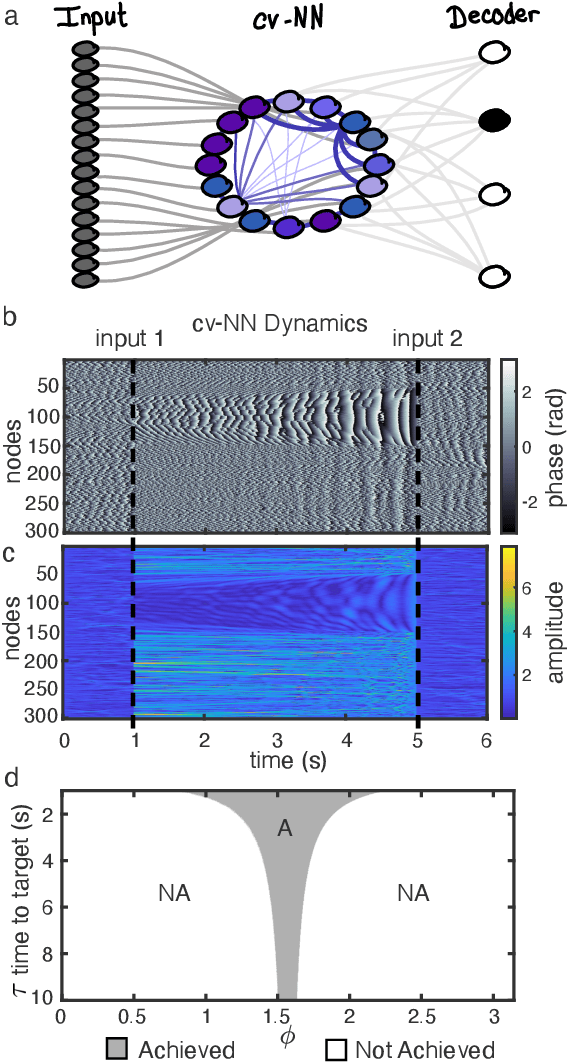
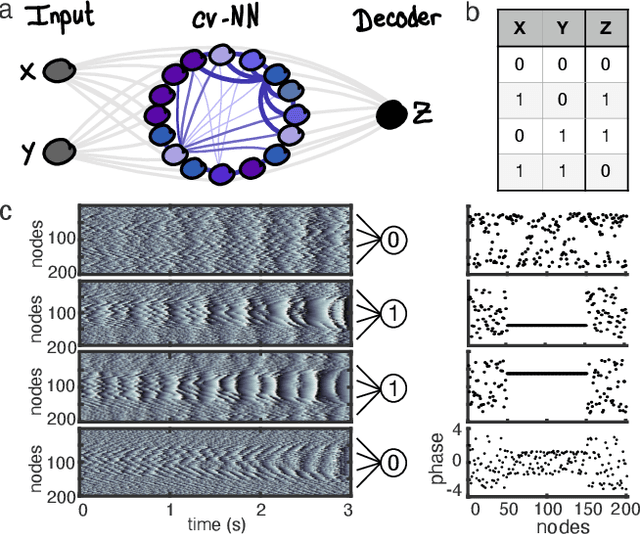
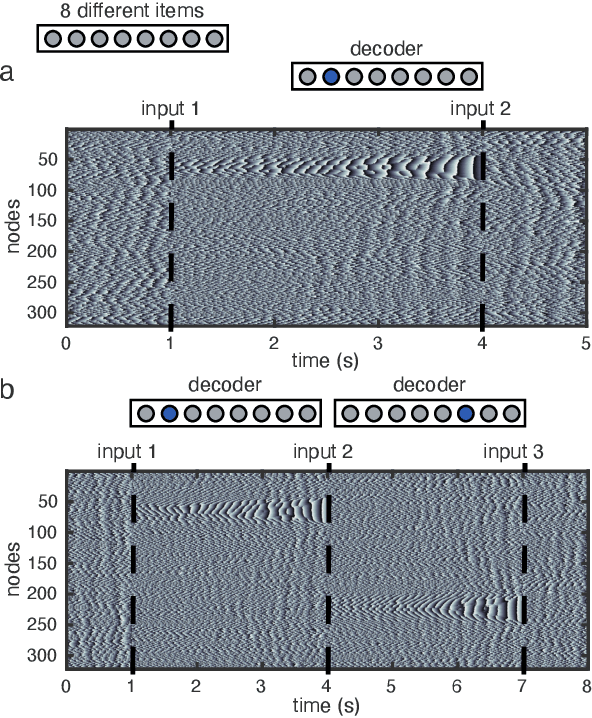
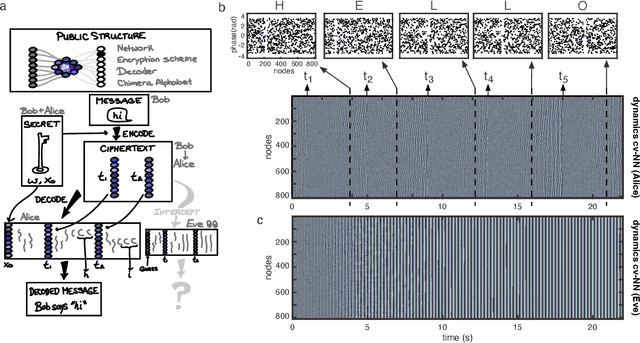
We study a complex-valued neural network (cv-NN) with linear, time-delayed interactions. We report the cv-NN displays sophisticated spatiotemporal dynamics, including partially synchronized ``chimera'' states. We then use these spatiotemporal dynamics, in combination with a nonlinear readout, for computation. The cv-NN can instantiate dynamics-based logic gates, encode short-term memories, and mediate secure message passing through a combination of interactions and time delays. The computations in this system can be fully described in an exact, closed-form mathematical expression. Finally, using direct intracellular recordings of neurons in slices from neocortex, we demonstrate that computations in the cv-NN are decodable by living biological neurons. These results demonstrate that complex-valued linear systems can perform sophisticated computations, while also being exactly solvable. Taken together, these results open future avenues for design of highly adaptable, bio-hybrid computing systems that can interface seamlessly with other neural networks.