 Add to Chrome
 Add to Firefox
 Add to Edge
Orthogonal machine learning for conditional odds and risk ratios
Apr 12, 2026
Conditional effects are commonly used measures for understanding how treatment effects vary across different groups, and are often used to target treatments/interventions to groups who benefit most. In this work we review existing methods and propose novel ones, focusing on the odds ratio (OR) and the risk ratio (RR). While estimation of the conditional average treatment effect (ATE) has been widely studied, estimators for the OR and RR lag behind, and cutting edge estimators such as those based on doubly robust transformations or orthogonal risk functions have not been generalized to these parameters. We propose such a generalization here, focusing on the DR-learner and the R-learner. We derive orthogonal risk functions for the OR and RR and show that the associated pseudo-outcomes satisfy second-order conditional-mean remainder properties analogous to the ATE case. We also evaluate estimators for the conditional ATE, OR, and RR in a comprehensive nonparametric Monte Carlo simulation study to compare them with common alternatives under hundreds of different data-generating distributions. Our numerical studies provide empirical guidance for choosing an estimator. For instance, they show that while parametric models are useful in very simple settings, the proposed nonparametric estimators significantly reduce bias and mean squared error in the more complex settings expected in the real world. We illustrate the methods in the analysis of physical activity and sleep trouble in U.S. adults using data from the National Health and Nutrition Examination Survey (NHANES). The results demonstrate that our estimators uncover substantial treatment effect heterogeneity that is obscured by traditional regression approaches and lead to improved treatment decision rules, highlighting the importance of data-adaptive methods for advancing precision health research.

Non-parametric efficient estimation of marginal structural models with multi-valued time-varying treatments
Sep 27, 2024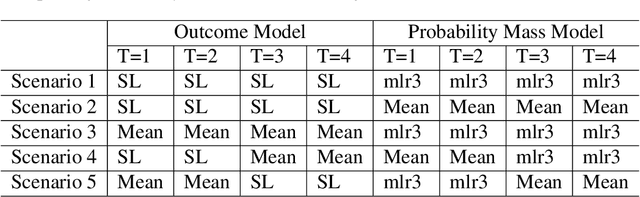
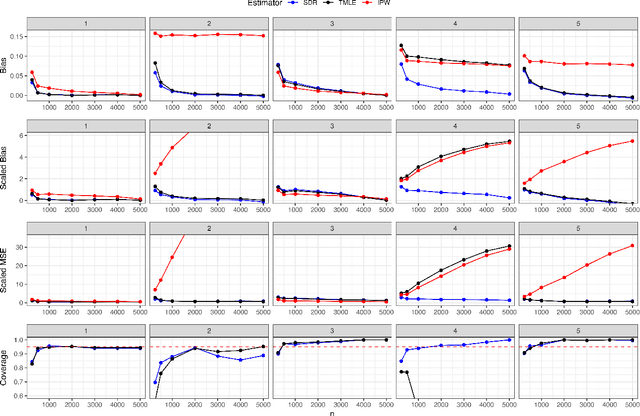

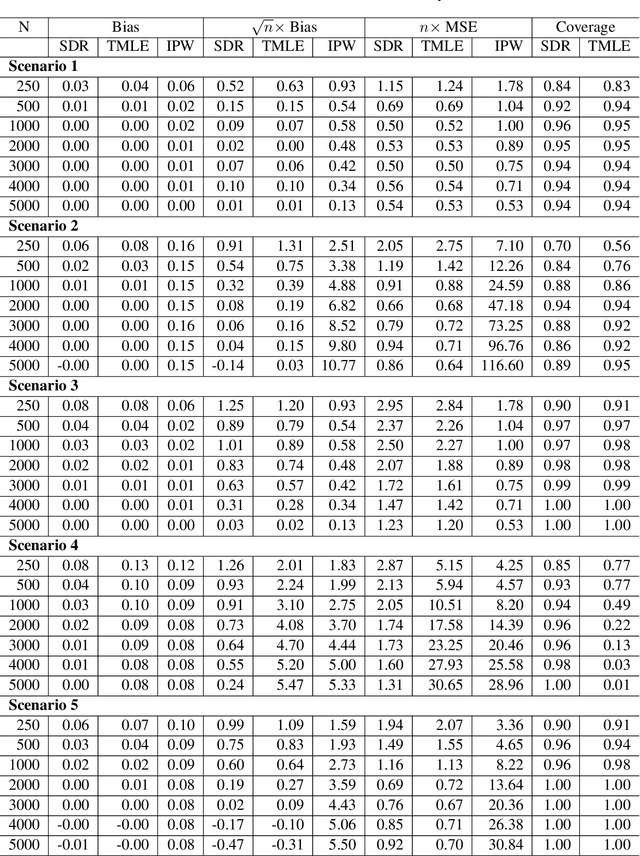
Marginal structural models are a popular method for estimating causal effects in the presence of time-varying exposures. In spite of their popularity, no scalable non-parametric estimator exist for marginal structural models with multi-valued and time-varying treatments. In this paper, we use machine learning together with recent developments in semiparametric efficiency theory for longitudinal studies to propose such an estimator. The proposed estimator is based on a study of the non-parametric identifying functional, including first order von-Mises expansions as well as the efficient influence function and the efficiency bound. We show conditions under which the proposed estimator is efficient, asymptotically normal, and sequentially doubly robust in the sense that it is consistent if, for each time point, either the outcome or the treatment mechanism is consistently estimated. We perform a simulation study to illustrate the properties of the estimators, and present the results of our motivating study on a COVID-19 dataset studying the impact of mobility on the cumulative number of observed cases.
General targeted machine learning for modern causal mediation analysis
Aug 26, 2024Causal mediation analyses investigate the mechanisms through which causes exert their effects, and are therefore central to scientific progress. The literature on the non-parametric definition and identification of mediational effects in rigourous causal models has grown significantly in recent years, and there has been important progress to address challenges in the interpretation and identification of such effects. Despite great progress in the causal inference front, statistical methodology for non-parametric estimation has lagged behind, with few or no methods available for tackling non-parametric estimation in the presence of multiple, continuous, or high-dimensional mediators. In this paper we show that the identification formulas for six popular non-parametric approaches to mediation analysis proposed in recent years can be recovered from just two statistical estimands. We leverage this finding to propose an all-purpose one-step estimation algorithm that can be coupled with machine learning in any mediation study that uses any of these six definitions of mediation. The estimators have desirable properties, such as $\sqrt{n}$-convergence and asymptotic normality. Estimating the first-order correction for the one-step estimator requires estimation of complex density ratios on the potentially high-dimensional mediators, a challenge that is solved using recent advancements in so-called Riesz learning. We illustrate the properties of our methods in a simulation study and illustrate its use on real data to estimate the extent to which pain management practices mediate the total effect of having a chronic pain disorder on opioid use disorder.