 Add to Chrome
 Add to Firefox
 Add to Edge
Local and Global Regimes of Geometric Complexity in Language Model Representations
Aug 14, 2026
Intrinsic dimensionality (ID) is widely used to probe the representational complexity of language models, but it remains unclear whether ID differences reflect properties of language itself or artefacts of how the underlying dataset was constructed. In this paper, we focus specifically on how lexical diversity, the number of unique last-token items present in a dataset, affects ID estimates of that dataset. We find a scale-dependent transition between two regimes: at low lexical diversity, conditions with fewer unique final words produce higher ID, while at high lexical diversity, this ordering reverses, and conditions with more unique words produce higher ID. We derive an exact, parameter-free formula for the point at which this reversal occurs, which matches the observed transition point at every scale tested. On the one hand, our results highlight how care must be taken when interpreting the intrinsic dimensionality of a set of representations as a straightforward cue of their complexity. On the other hand, our discovery of the two ID regimes reveals a general principle of organisation of linguistic data in LLMs that sheds new light on their inner manifold structures.

On The Effectiveness-Fluency Trade-Off In LLM Conditioning: A Systematic Study
Jun 10, 2026Controlling the output of Large Language Models (LLMs) is a central challenge for their reliable deployment, yet a clear understanding of the involved trade-offs remains elusive. Current approaches to conditioning are often evaluated with a narrow focus on their effectiveness at injecting or removing a target concept, neglecting generation quality. We systematically investigate a range of conditioning methods in both injection and removal scenarios. We find that efficient steering methods frequently achieve conditioning at a steep cost to fluency. Furthermore, we identify a critical yet previously overlooked interaction with the training paradigm: activation steering methods are far less effective on instruction-tuned models than on their base counterparts. Simple prompting and full-fledged supervised fine-tuning, on the other hand, are viable options for concept injection, but are not as good at concept removal. Finally, cheaply computed textual metrics highly correlate to costly LLM-as-judge scores, and provide insights on the behavior of conditioning methods.
Tracing Computation Density in LLMs
May 26, 2026Transformer-based large language models (LLMs) are comprised of billions of parameters arranged in deep and wide computational graphs, but it is not clear that they exploit their full capacity for all inputs. We introduce the s-Trace method to efficiently estimate the subgraph of size s that best approximates a full model output. With this method, we find the computation in a variety of LLMs to be organized in two distinct phases. A small subgraph mostly composed of early-layer nodes can reconstruct the head of the full model output distribution. Adding further nodes, mostly located in later layers and increasingly consisting of attention heads, leads to incremental refinements in approximating the full output distribution. We find moreover that the amount of necessary computation per input correlates with model uncertainty, and that sparser subgraphs encode shallow statistics, such as unigram frequency. Overall, our results suggest a consistent modular organization in effective LLM computation, with a sparse early-layer core providing a rough prediction that is further refined through denser computations in later layers.
Outlier dimensions favor frequent tokens in language model
Mar 27, 2025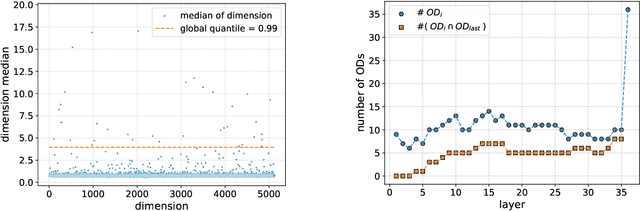
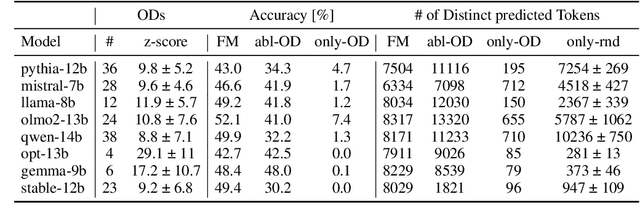
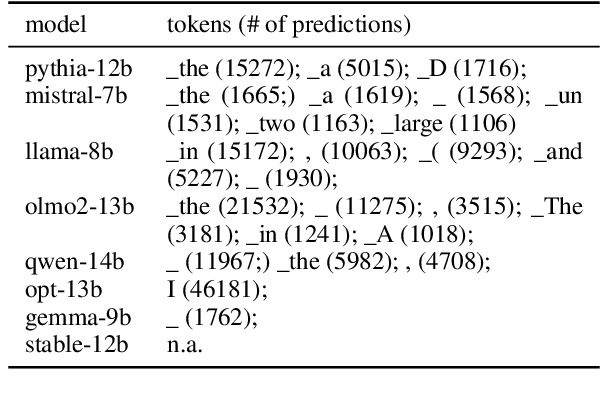
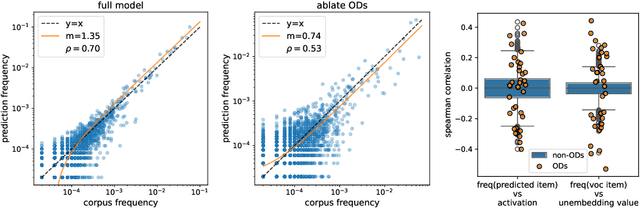
We study last-layer outlier dimensions, i.e.dimensions that display extreme activations for the majority of inputs. We show that outlier dimensions arise in many different modern language models, and trace their function back to the heuristic of constantly predicting frequent words. We further show how a model can block this heuristic when it is not contextually appropriate, by assigning a counterbalancing weight mass to the remaining dimensions, and we investigate which model parameters boost outlier dimensions and when they arise during training. We conclude that outlier dimensions are a specialized mechanism discovered by many distinct models to implement a useful token prediction heuristic.
Emergence of a High-Dimensional Abstraction Phase in Language Transformers
May 24, 2024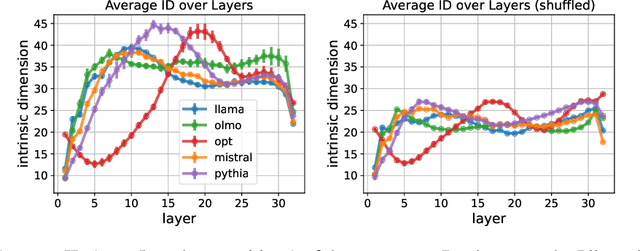
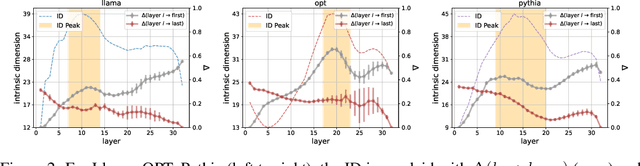
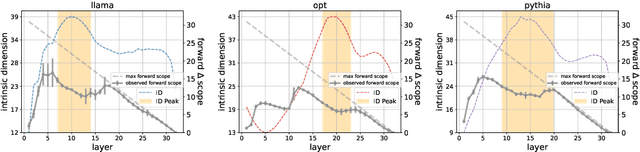
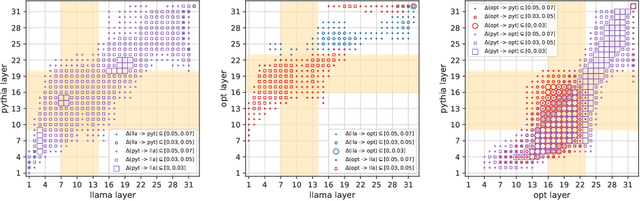
A language model (LM) is a mapping from a linguistic context to an output token. However, much remains to be known about this mapping, including how its geometric properties relate to its function. We take a high-level geometric approach to its analysis, observing, across five pre-trained transformer-based LMs and three input datasets, a distinct phase characterized by high intrinsic dimensionality. During this phase, representations (1) correspond to the first full linguistic abstraction of the input; (2) are the first to viably transfer to downstream tasks; (3) predict each other across different LMs. Moreover, we find that an earlier onset of the phase strongly predicts better language modelling performance. In short, our results suggest that a central high-dimensionality phase underlies core linguistic processing in many common LM architectures.
Beyond the noise: intrinsic dimension estimation with optimal neighbourhood identification
May 24, 2024

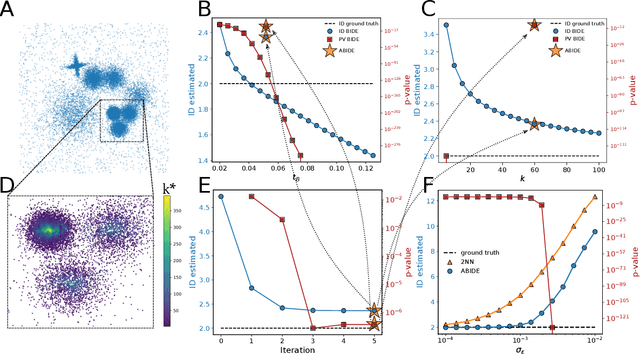
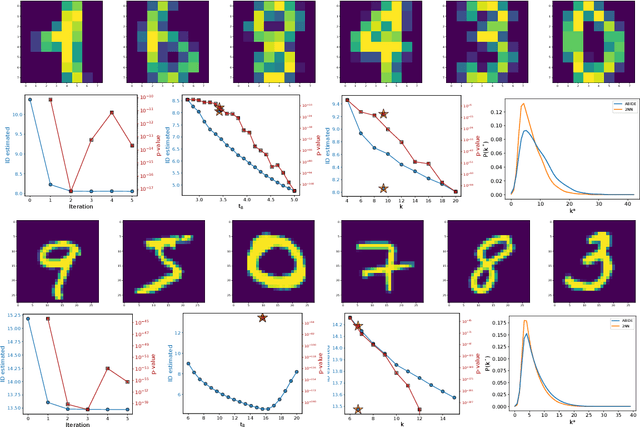
The Intrinsic Dimension (ID) is a key concept in unsupervised learning and feature selection, as it is a lower bound to the number of variables which are necessary to describe a system. However, in almost any real-world dataset the ID depends on the scale at which the data are analysed. Quite typically at a small scale, the ID is very large, as the data are affected by measurement errors. At large scale, the ID can also be erroneously large, due to the curvature and the topology of the manifold containing the data. In this work, we introduce an automatic protocol to select the sweet spot, namely the correct range of scales in which the ID is meaningful and useful. This protocol is based on imposing that for distances smaller than the correct scale the density of the data is constant. Since to estimate the density it is necessary to know the ID, this condition is imposed self-consistently. We illustrate the usefulness and robustness of this procedure by benchmarks on artificial and real-world datasets.
Intrinsic dimension estimation for discrete metrics
Jul 20, 2022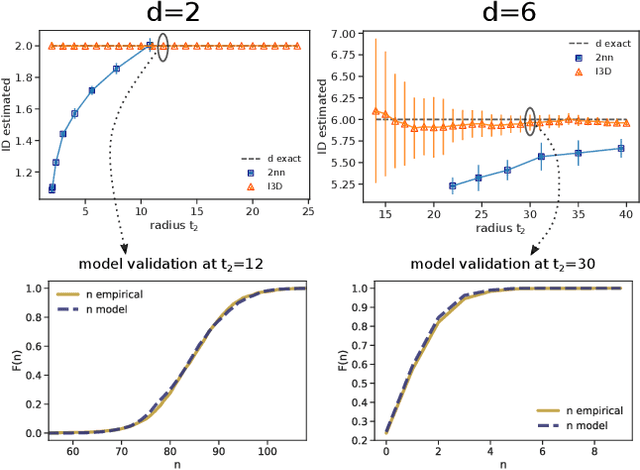
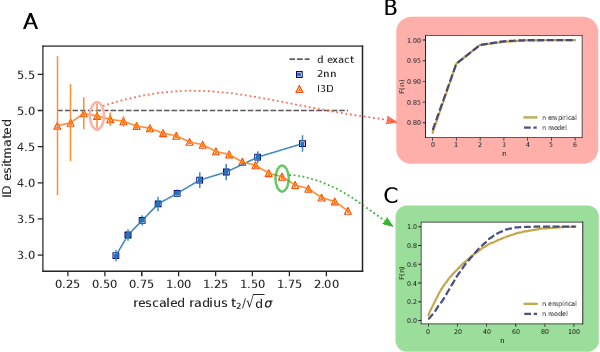
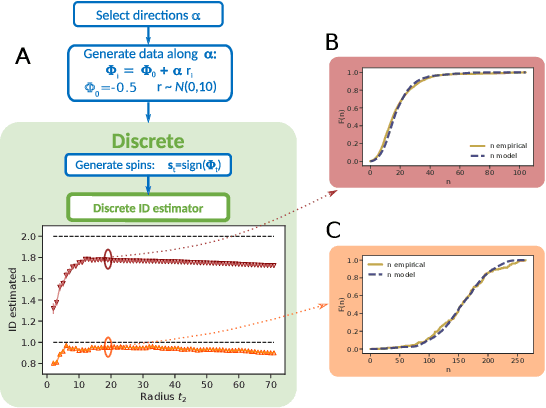
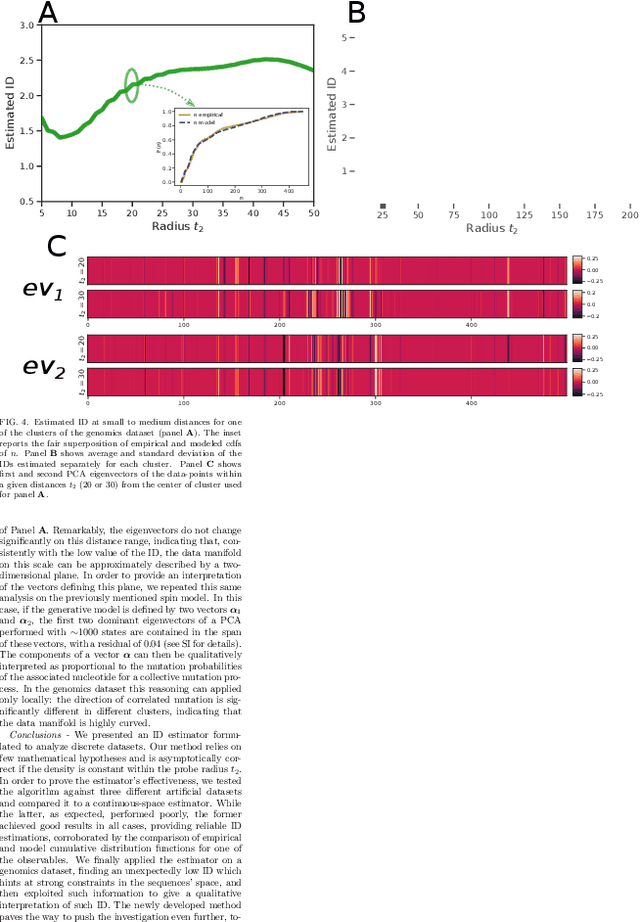
Real world-datasets characterized by discrete features are ubiquitous: from categorical surveys to clinical questionnaires, from unweighted networks to DNA sequences. Nevertheless, the most common unsupervised dimensional reduction methods are designed for continuous spaces, and their use for discrete spaces can lead to errors and biases. In this letter we introduce an algorithm to infer the intrinsic dimension (ID) of datasets embedded in discrete spaces. We demonstrate its accuracy on benchmark datasets, and we apply it to analyze a metagenomic dataset for species fingerprinting, finding a surprisingly small ID, of order 2. This suggests that evolutive pressure acts on a low-dimensional manifold despite the high-dimensionality of sequences' space.
DADApy: Distance-based Analysis of DAta-manifolds in Python
May 04, 2022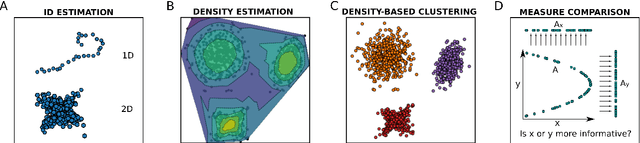
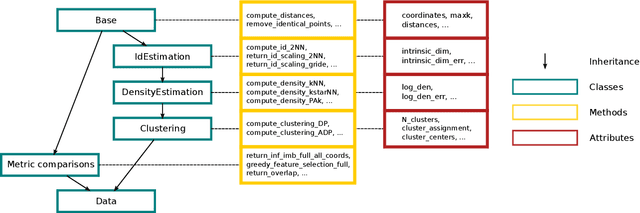
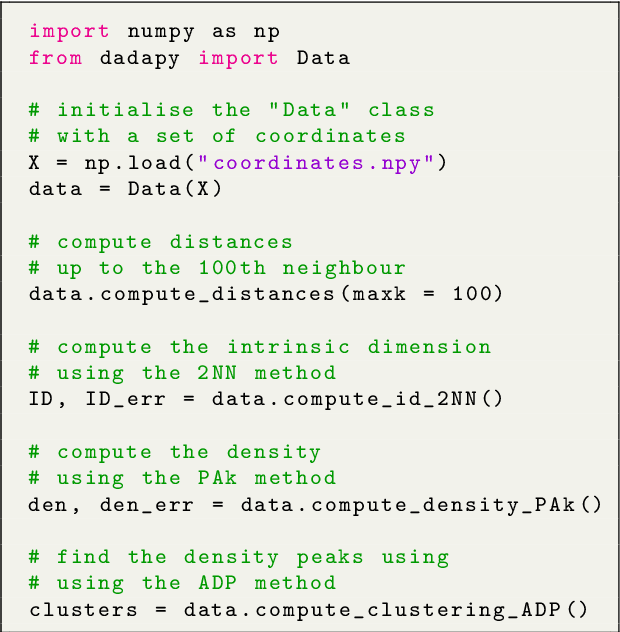
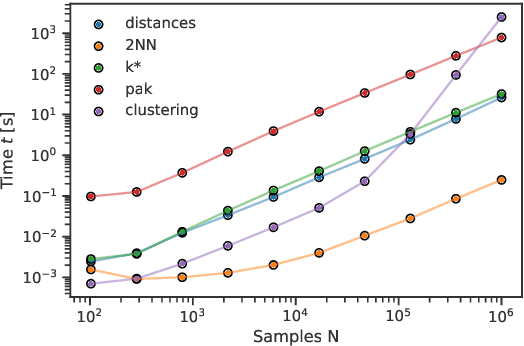
DADApy is a python software package for analysing and characterising high-dimensional data manifolds. It provides methods for estimating the intrinsic dimension and the probability density, for performing density-based clustering and for comparing different distance metrics. We review the main functionalities of the package and exemplify its usage in toy cases and in a real-world application. The package is freely available under the open-source Apache 2.0 license and can be downloaded from the Github page https://github.com/sissa-data-science/DADApy.