 Add to Chrome
 Add to Firefox
 Add to Edge
Spherical Harmonic Optimal Transport: Application to Climate Models Comparisons
May 19, 2026
Optimal transport provides a powerful framework for comparing measures while respecting the geometry of their support, but comes with an expensive computational cost, hindering its potential application to real world use cases. On manifolds, convolutional algorithms based on the heat kernel have been proposed to alleviate this cost, but their theoretical properties remain largely unexplored. We establish that the heat kernel cost converges to the optimal transport cost as time vanishes in the balanced and unbalanced cases. In the specific case of the 2-sphere $\mathbb{S}^2$, we ensure that the associated Sinkhorn divergences retains the desirable geometric and analytic properties of classical optimal transport discrepancies. Moreover, we leverage the harmonic structure of the sphere to derive a fast Sinkhorn algorithm, requiring only $\mathcal{O}(n)$ memory and $\mathcal{O}(n^{3/2})$ time per iteration, with fully dense GPU-friendly operations. We validate its computational efficiency on synthetic data, and discuss its potential use in the evaluation of global climate models, providing both spatial and seasonal insights into models performances.

Asymptotic convergence rates for averaging strategies
Aug 10, 2021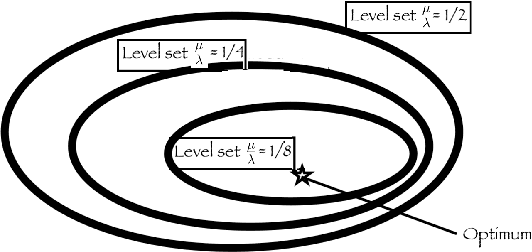
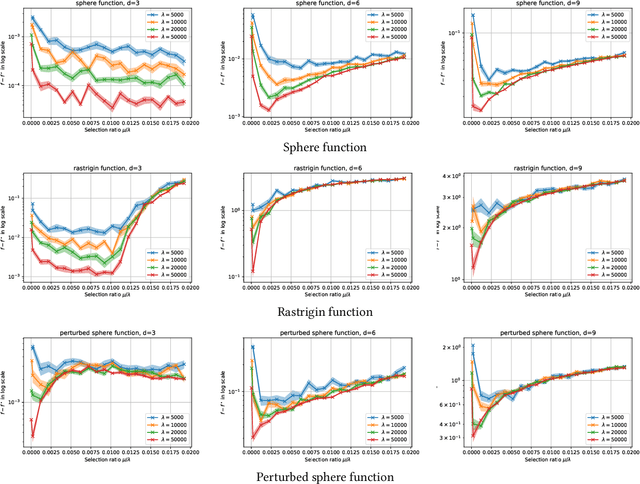
Parallel black box optimization consists in estimating the optimum of a function using $\lambda$ parallel evaluations of $f$. Averaging the $\mu$ best individuals among the $\lambda$ evaluations is known to provide better estimates of the optimum of a function than just picking up the best. In continuous domains, this averaging is typically just based on (possibly weighted) arithmetic means. Previous theoretical results were based on quadratic objective functions. In this paper, we extend the results to a wide class of functions, containing three times continuously differentiable functions with unique optimum. We prove formal rate of convergences and show they are indeed better than pure random search asymptotically in $\lambda$. We validate our theoretical findings with experiments on some standard black box functions.