 Add to Chrome
 Add to Firefox
 Add to Edge
Redirected, Not Removed: Task-Dependent Stereotyping Reveals the Limits of LLM Alignments
Apr 03, 2026
How biased is a language model? The answer depends on how you ask. A model that refuses to choose between castes for a leadership role will, in a fill-in-the-blank task, reliably associate upper castes with purity and lower castes with lack of hygiene. Single-task benchmarks miss this because they capture only one slice of a model's bias profile. We introduce a hierarchical taxonomy covering 9 bias types, including under-studied axes like caste, linguistic, and geographic bias, operationalized through 7 evaluation tasks that span explicit decision-making to implicit association. Auditing 7 commercial and open-weight LLMs with \textasciitilde45K prompts, we find three systematic patterns. First, bias is task-dependent: models counter stereotypes on explicit probes but reproduce them on implicit ones, with Stereotype Score divergences up to 0.43 between task types for the same model and identity groups. Second, safety alignment is asymmetric: models refuse to assign negative traits to marginalized groups, but freely associate positive traits with privileged ones. Third, under-studied bias axes show the strongest stereotyping across all models, suggesting alignment effort tracks benchmark coverage rather than harm severity. These results demonstrate that single-benchmark audits systematically mischaracterize LLM bias and that current alignment practices mask representational harm rather than mitigating it.

SocioEval: A Template-Based Framework for Evaluating Socioeconomic Status Bias in Foundation Models
Apr 03, 2026As Large Language Models (LLMs) increasingly power decision-making systems across critical domains, understanding and mitigating their biases becomes essential for responsible AI deployment. Although bias assessment frameworks have proliferated for attributes such as race and gender, socioeconomic status bias remains significantly underexplored despite its widespread implications in the real world. We introduce SocioEval, a template-based framework for systematically evaluating socioeconomic bias in foundation models through decision-making tasks. Our hierarchical framework encompasses 8 themes and 18 topics, generating 240 prompts across 6 class-pair combinations. We evaluated 13 frontier LLMs on 3,120 responses using a rigorous three-stage annotation protocol, revealing substantial variation in bias rates (0.42\%-33.75\%). Our findings demonstrate that bias manifests differently across themes lifestyle judgments show 10$\times$ higher bias than education-related decisions and that deployment safeguards effectively prevent explicit discrimination but show brittleness to domain-specific stereotypes. SocioEval provides a scalable, extensible foundation for auditing class-based bias in language models.
Leveraging LSTM and GAN for Modern Malware Detection
May 07, 2024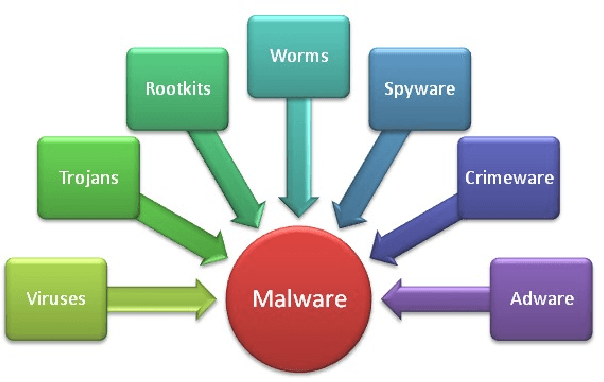
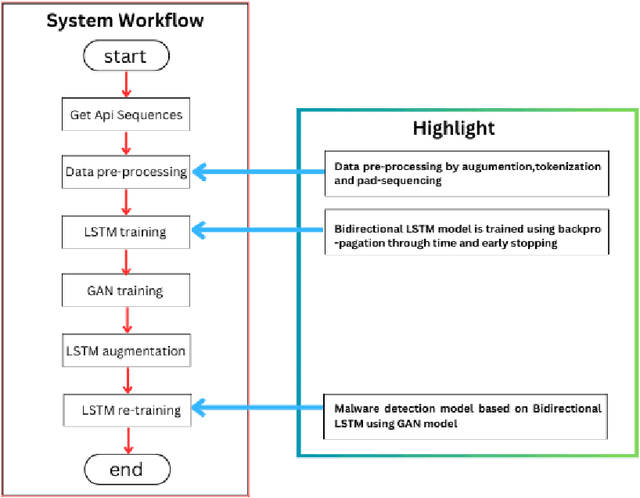
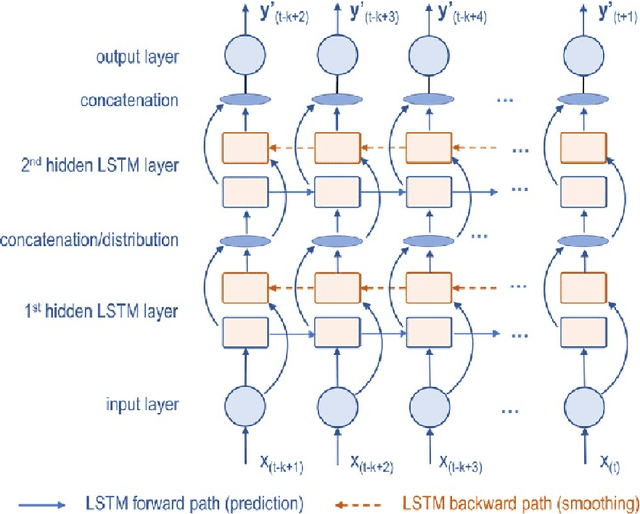
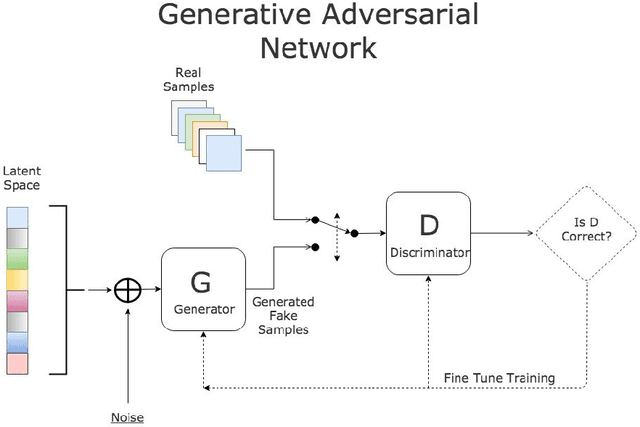
The malware booming is a cyberspace equal to the effect of climate change to ecosystems in terms of danger. In the case of significant investments in cybersecurity technologies and staff training, the global community has become locked up in the eternal war with cyber security threats. The multi-form and changing faces of malware are continuously pushing the boundaries of the cybersecurity practitioners employ various approaches like detection and mitigate in coping with this issue. Some old mannerisms like signature-based detection and behavioral analysis are slow to adapt to the speedy evolution of malware types. Consequently, this paper proposes the utilization of the Deep Learning Model, LSTM networks, and GANs to amplify malware detection accuracy and speed. A fast-growing, state-of-the-art technology that leverages raw bytestream-based data and deep learning architectures, the AI technology provides better accuracy and performance than the traditional methods. Integration of LSTM and GAN model is the technique that is used for the synthetic generation of data, leading to the expansion of the training datasets, and as a result, the detection accuracy is improved. The paper uses the VirusShare dataset which has more than one million unique samples of the malware as the training and evaluation set for the presented models. Through thorough data preparation including tokenization, augmentation, as well as model training, the LSTM and GAN models convey the better performance in the tasks compared to straight classifiers. The research outcomes come out with 98% accuracy that shows the efficiency of deep learning plays a decisive role in proactive cybersecurity defense. Aside from that, the paper studies the output of ensemble learning and model fusion methods as a way to reduce biases and lift model complexity.