 Add to Chrome
 Add to Firefox
 Add to Edge
Security and Privacy in Agentic AI: Grand Challenges and Future Directions
Jul 07, 2026
We present key challenges and future research directions in the security and privacy of agentic AI, based on a horizon-scanning exercise that brought together thirty leading international experts from academia, industry, and government to engage in focused discussions and collaborative exercises on the emerging risks associated with the growing agency of AI.

From Gradient Clipping to Structural Refinement: Improving DPSGD for Medical Image Segmentation
Jun 19, 2026Medical image segmentation is widely used for disease detection but relies on sensitive data, raising privacy concerns as trained models can leak information. Differential privacy, typically implemented via Differential Private Stochastic Gradient Descent (DPSGD), provides a solution, though at the cost of reduced utility. Recent DPSGD variants, including Automatic clipping (Auto-S), Normalised SGD with perturbation (NSGD), and Per-sample adaptive clipping (PSAC), have shown promise in image classification, but their behavior in medical segmentation remains underexplored. We evaluate these methods across binary and multi-class tasks and analyze gradient alignment, showing that prior assumptions, particularly for PSAC, do not consistently hold. We further demonstrate that combining clipping strategies with morphological refinement improves segmentation quality under privacy constraints. Finally, we propose an adaptive DP-Morph variant that captures class-specific structures and enhances performance in multi-class settings.
Multi-Agent Cooperative Learning for Robust Vision-Language Alignment under OOD Concepts
Jan 11, 2026This paper introduces a novel Multi-Agent Cooperative Learning (MACL) framework to address cross-modal alignment collapse in vision-language models when handling out-of-distribution (OOD) concepts. Four core agents, including image, text, name, and coordination agents, collaboratively mitigate modality imbalance through structured message passing. The proposed framework enables multi-agent feature space name learning, incorporates a context exchange enhanced few-shot learning algorithm, and adopts an adaptive dynamic balancing mechanism to regulate inter-agent contributions. Experiments on the VISTA-Beyond dataset demonstrate that MACL significantly improves performance in both few-shot and zero-shot settings, achieving 1-5% precision gains across diverse visual domains.
Privacy-Preserving Generative Models: A Comprehensive Survey
Feb 05, 2025Despite the generative model's groundbreaking success, the need to study its implications for privacy and utility becomes more urgent. Although many studies have demonstrated the privacy threats brought by GANs, no existing survey has systematically categorized the privacy and utility perspectives of GANs and VAEs. In this article, we comprehensively study privacy-preserving generative models, articulating the novel taxonomies for both privacy and utility metrics by analyzing 100 research publications. Finally, we discuss the current challenges and future research directions that help new researchers gain insight into the underlying concepts.
SoK: On the Offensive Potential of AI
Dec 24, 2024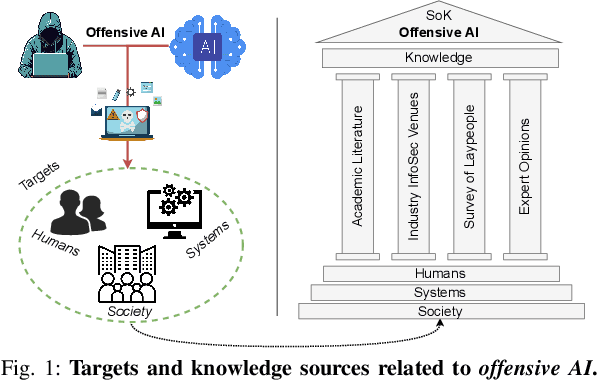
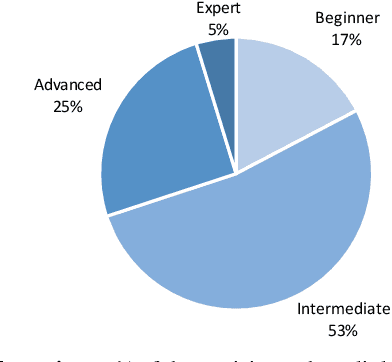
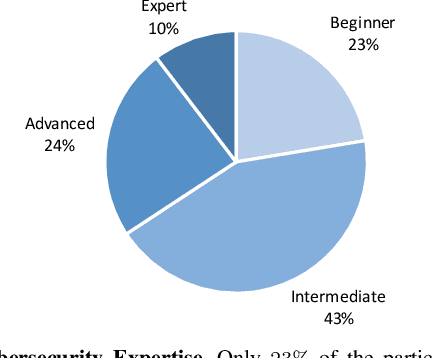
Our society increasingly benefits from Artificial Intelligence (AI). Unfortunately, more and more evidence shows that AI is also used for offensive purposes. Prior works have revealed various examples of use cases in which the deployment of AI can lead to violation of security and privacy objectives. No extant work, however, has been able to draw a holistic picture of the offensive potential of AI. In this SoK paper we seek to lay the ground for a systematic analysis of the heterogeneous capabilities of offensive AI. In particular we (i) account for AI risks to both humans and systems while (ii) consolidating and distilling knowledge from academic literature, expert opinions, industrial venues, as well as laymen -- all of which being valuable sources of information on offensive AI. To enable alignment of such diverse sources of knowledge, we devise a common set of criteria reflecting essential technological factors related to offensive AI. With the help of such criteria, we systematically analyze: 95 research papers; 38 InfoSec briefings (from, e.g., BlackHat); the responses of a user study (N=549) entailing individuals with diverse backgrounds and expertise; and the opinion of 12 experts. Our contributions not only reveal concerning ways (some of which overlooked by prior work) in which AI can be offensively used today, but also represent a foothold to address this threat in the years to come.
Privacy Policies Across the Ages: Content and Readability of Privacy Policies 1996--2021
Jan 21, 2022


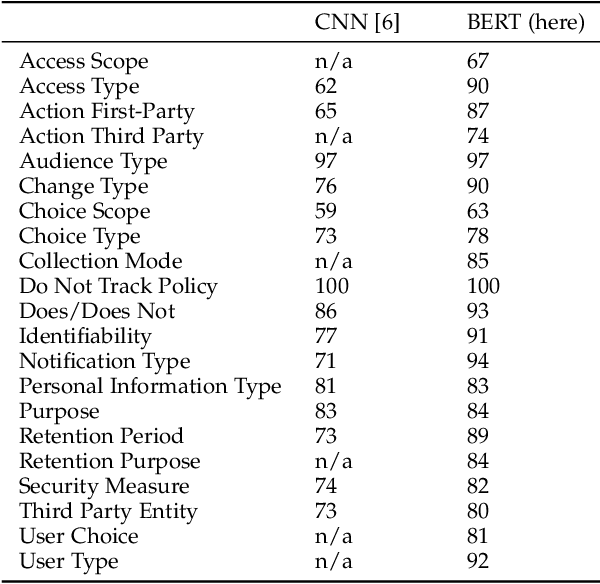
It is well-known that most users do not read privacy policies, but almost all users tick the box to agree with them. In this paper, we analyze the 25-year history of privacy policies using methods from transparency research, machine learning, and natural language processing. Specifically, we collect a large-scale longitudinal corpus of privacy policies from 1996 to 2021 and analyze the length and readability of privacy policies as well as their content in terms of the data practices they describe, the rights they grant to users, and the rights they reserve for their organizations. We pay particular attention to changes in response to recent privacy regulations such as the GDPR and CCPA. Our results show that policies are getting longer and harder to read, especially after new regulations take effect, and we find a range of concerning data practices. Our results allow us to speculate why privacy policies are rarely read and propose changes that would make privacy policies serve their readers instead of their writers.