 Add to Chrome
 Add to Firefox
 Add to Edge
Deep Leakage with Generative Flow Matching Denoiser
Jan 21, 2026
Federated Learning (FL) has emerged as a powerful paradigm for decentralized model training, yet it remains vulnerable to deep leakage (DL) attacks that reconstruct private client data from shared model updates. While prior DL methods have demonstrated varying levels of success, they often suffer from instability, limited fidelity, or poor robustness under realistic FL settings. We introduce a new DL attack that integrates a generative Flow Matching (FM) prior into the reconstruction process. By guiding optimization toward the distribution of realistic images (represented by a flow matching foundation model), our method enhances reconstruction fidelity without requiring knowledge of the private data. Extensive experiments on multiple datasets and target models demonstrate that our approach consistently outperforms state-of-the-art attacks across pixel-level, perceptual, and feature-based similarity metrics. Crucially, the method remains effective across different training epochs, larger client batch sizes, and under common defenses such as noise injection, clipping, and sparsification. Our findings call for the development of new defense strategies that explicitly account for adversaries equipped with powerful generative priors.

SpooFL: Spoofing Federated Learning
Jan 21, 2026Traditional defenses against Deep Leakage (DL) attacks in Federated Learning (FL) primarily focus on obfuscation, introducing noise, transformations or encryption to degrade an attacker's ability to reconstruct private data. While effective to some extent, these methods often still leak high-level information such as class distributions or feature representations, and are frequently broken by increasingly powerful denoising attacks. We propose a fundamentally different perspective on FL defense: framing it as a spoofing problem.We introduce SpooFL (Figure 1), a spoofing-based defense that deceives attackers into believing they have recovered the true training data, while actually providing convincing but entirely synthetic samples from an unrelated task. Unlike prior synthetic-data defenses that share classes or distributions with the private data and thus still leak semantic information, SpooFL uses a state-of-the-art generative model trained on an external dataset with no class overlap. As a result, attackers are misled into recovering plausible yet completely irrelevant samples, preventing meaningful data leakage while preserving FL training integrity. We implement the first example of such a spoofing defense, and evaluate our method against state-of-the-art DL defenses and demonstrate that it successfully misdirects attackers without compromising model performance significantly.
FEDLAD: Federated Evaluation of Deep Leakage Attacks and Defenses
Nov 05, 2024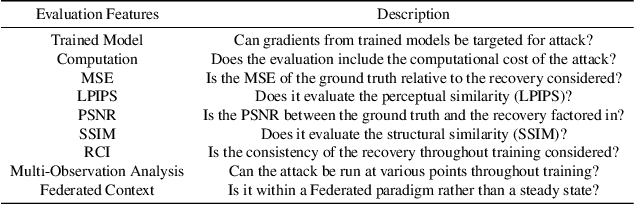
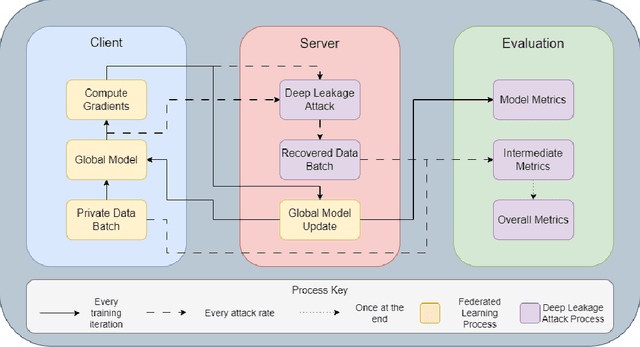
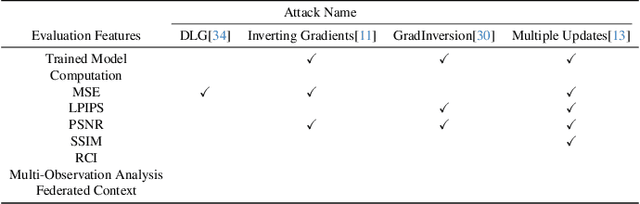
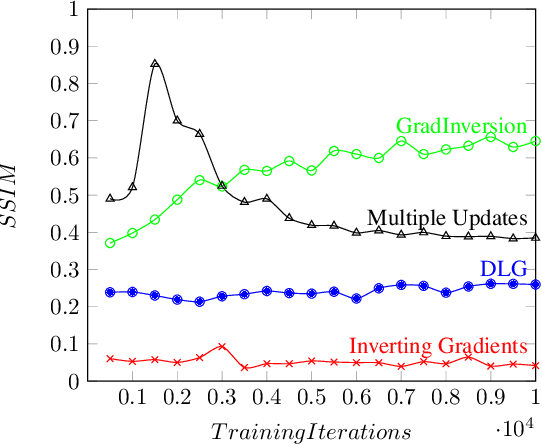
Federated Learning is a privacy preserving decentralized machine learning paradigm designed to collaboratively train models across multiple clients by exchanging gradients to the server and keeping private data local. Nevertheless, recent research has revealed that the security of Federated Learning is compromised, as private ground truth data can be recovered through a gradient inversion technique known as Deep Leakage. While these attacks are crafted with a focus on applications in Federated Learning, they generally are not evaluated in realistic scenarios. This paper introduces the FEDLAD Framework (Federated Evaluation of Deep Leakage Attacks and Defenses), a comprehensive benchmark for evaluating Deep Leakage attacks and defenses within a realistic Federated context. By implementing a unified benchmark that encompasses multiple state-of-the-art Deep Leakage techniques and various defense strategies, our framework facilitates the evaluation and comparison of the efficacy of these methods across different datasets and training states. This work highlights a crucial trade-off between privacy and model accuracy in Federated Learning and aims to advance the understanding of security challenges in decentralized machine learning systems, stimulate future research, and enhance reproducibility in evaluating Deep Leakage attacks and defenses.