 Add to Chrome
 Add to Firefox
 Add to Edge
Concurrent vertical and horizontal federated learning with fuzzy cognitive maps
Dec 17, 2024
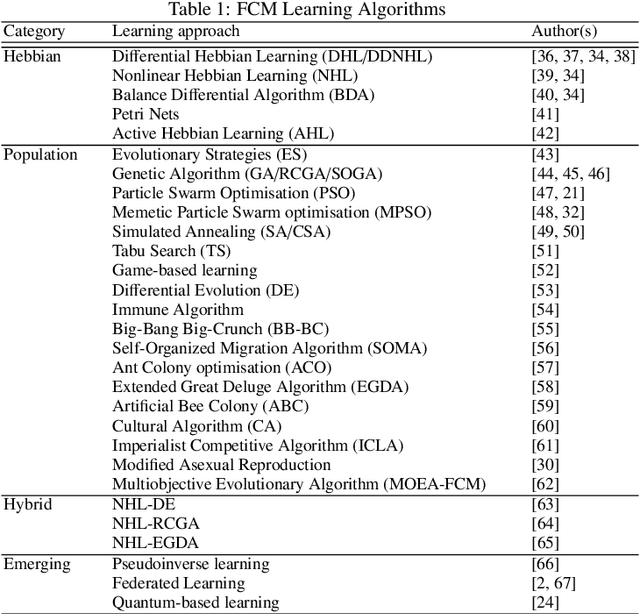
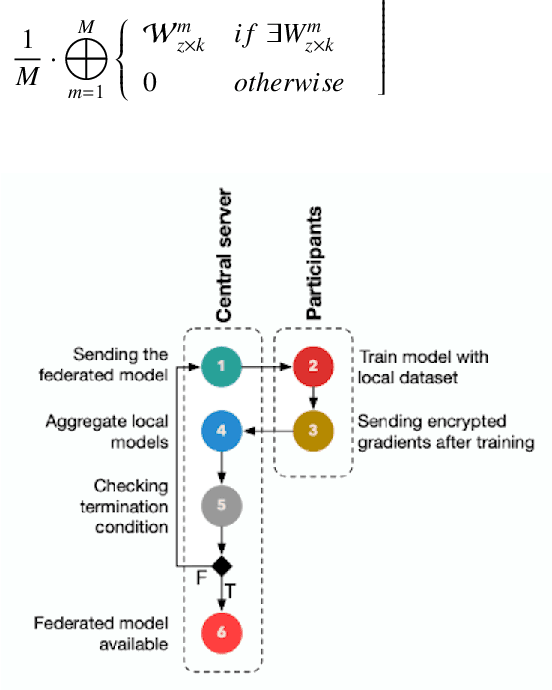

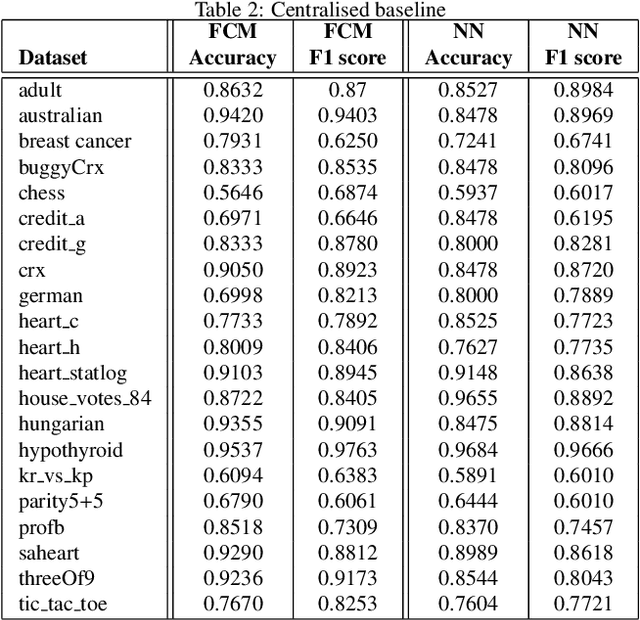
Data privacy is a major concern in industries such as healthcare or finance. The requirement to safeguard privacy is essential to prevent data breaches and misuse, which can have severe consequences for individuals and organisations. Federated learning is a distributed machine learning approach where multiple participants collaboratively train a model without compromising the privacy of their data. However, a significant challenge arises from the differences in feature spaces among participants, known as non-IID data. This research introduces a novel federated learning framework employing fuzzy cognitive maps, designed to comprehensively address the challenges posed by diverse data distributions and non-identically distributed features in federated settings. The proposal is tested through several experiments using four distinct federation strategies: constant-based, accuracy-based, AUC-based, and precision-based weights. The results demonstrate the effectiveness of the approach in achieving the desired learning outcomes while maintaining privacy and confidentiality standards.

Blind Federated Learning without initial model
Apr 24, 2024Federated learning is an emerging machine learning approach that allows the construction of a model between several participants who hold their own private data. This method is secure and privacy-preserving, suitable for training a machine learning model using sensitive data from different sources, such as hospitals. In this paper, the authors propose two innovative methodologies for Particle Swarm Optimisation-based federated learning of Fuzzy Cognitive Maps in a privacy-preserving way. In addition, one relevant contribution this research includes is the lack of an initial model in the federated learning process, making it effectively blind. This proposal is tested with several open datasets, improving both accuracy and precision.
Benchmarking federated strategies in Peer-to-Peer Federated learning for biomedical data
Feb 15, 2024The increasing requirements for data protection and privacy has attracted a huge research interest on distributed artificial intelligence and specifically on federated learning, an emerging machine learning approach that allows the construction of a model between several participants who hold their own private data. In the initial proposal of federated learning the architecture was centralised and the aggregation was done with federated averaging, meaning that a central server will orchestrate the federation using the most straightforward averaging strategy. This research is focused on testing different federated strategies in a peer-to-peer environment. The authors propose various aggregation strategies for federated learning, including weighted averaging aggregation, using different factors and strategies based on participant contribution. The strategies are tested with varying data sizes to identify the most robust ones. This research tests the strategies with several biomedical datasets and the results of the experiments show that the accuracy-based weighted average outperforms the classical federated averaging method.
A chaotic maps-based privacy-preserving distributed deep learning for incomplete and Non-IID datasets
Feb 15, 2024Federated Learning is a machine learning approach that enables the training of a deep learning model among several participants with sensitive data that wish to share their own knowledge without compromising the privacy of their data. In this research, the authors employ a secured Federated Learning method with an additional layer of privacy and proposes a method for addressing the non-IID challenge. Moreover, differential privacy is compared with chaotic-based encryption as layer of privacy. The experimental approach assesses the performance of the federated deep learning model with differential privacy using both IID and non-IID data. In each experiment, the Federated Learning process improves the average performance metrics of the deep neural network, even in the case of non-IID data.
A privacy-preserving, distributed and cooperative FCM-based learning approach for Cancer Research
Feb 15, 2024Distributed Artificial Intelligence is attracting interest day by day. In this paper, the authors introduce an innovative methodology for distributed learning of Particle Swarm Optimization-based Fuzzy Cognitive Maps in a privacy-preserving way. The authors design a training scheme for collaborative FCM learning that offers data privacy compliant with the current regulation. This method is applied to a cancer detection problem, proving that the performance of the model is improved by the Federated Learning process, and obtaining similar results to the ones that can be found in the literature.