 Add to Chrome
 Add to Firefox
 Add to Edge
Latent Space Guided Scenario Sampling for Multimodal Segmentation Under Missing Modalities
May 19, 2026
Multimodal semantic segmentation benefits remote sensing analysis by combining complementary information from different sensor modalities. In real-world remote sensing applications, one or more modalities may be unavailable due to sensor failures, adverse atmospheric conditions, or data acquisition problems. Even with pretrained multimodal representations and existing fine-tuning or adaptation strategies, performance may remain limited because all modality availability scenarios are typically treated as equally informative during training. In this paper, we propose a novel training strategy that learns a scenario sampling distribution directly from the pretrained latent space. Instead of relying on uniform random modality dropout, the proposed method guides fine-tuning toward more informative modality availability scenarios. More specifically, we quantify the effect of each scenario independently based on the distortion it induces in the shared latent representation. We then capture scenario relations using a radial basis function kernel and derive refined scenario scores through a regularized kernel smoothing. These scores are then converted into a probability distribution during scenario sampling for fine-tuning. We evaluate this strategy on three remote sensing image sets, namely DSTL, Potsdam, and Hunan, using CBC-SLP, CBC, and CMX backbones. The experimental results with different image sets and backbones show that our method outperforms standard fine-tuning and LoRA-based adaptation. These findings suggest that the pretrained latent representation can serve as an effective basis for sampling during missing modality fine-tuning. Code is available at https://github.com/iremulku/Latent-Space-Guided-Scenario-Sampling

Near-Infrared and Low-Rank Adaptation of Vision Transformers in Remote Sensing
May 28, 2024
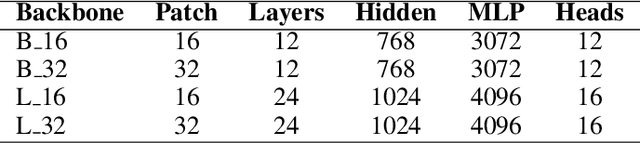
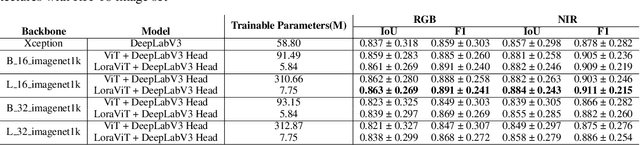
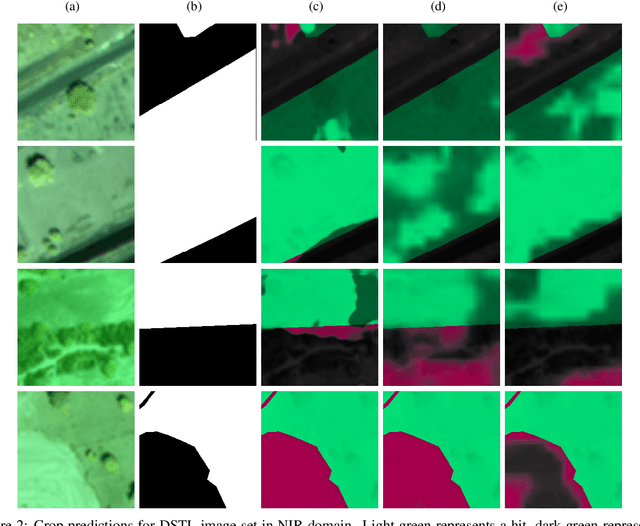
Plant health can be monitored dynamically using multispectral sensors that measure Near-Infrared reflectance (NIR). Despite this potential, obtaining and annotating high-resolution NIR images poses a significant challenge for training deep neural networks. Typically, large networks pre-trained on the RGB domain are utilized to fine-tune infrared images. This practice introduces a domain shift issue because of the differing visual traits between RGB and NIR images.As an alternative to fine-tuning, a method called low-rank adaptation (LoRA) enables more efficient training by optimizing rank-decomposition matrices while keeping the original network weights frozen. However, existing parameter-efficient adaptation strategies for remote sensing images focus on RGB images and overlook domain shift issues in the NIR domain. Therefore, this study investigates the potential benefits of using vision transformer (ViT) backbones pre-trained in the RGB domain, with low-rank adaptation for downstream tasks in the NIR domain. Extensive experiments demonstrate that employing LoRA with pre-trained ViT backbones yields the best performance for downstream tasks applied to NIR images.
A Survey on Deep Learning-based Architectures for Semantic Segmentation on 2D images
Dec 21, 2019
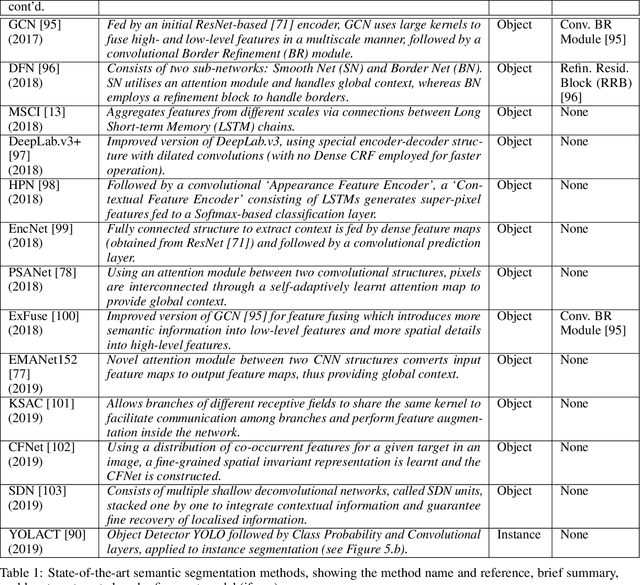
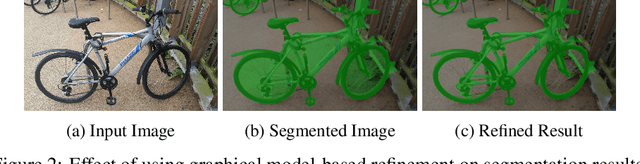
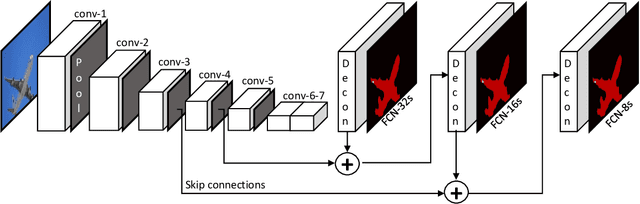
Semantic segmentation is the pixel-wise labelling of an image. Since the problem is defined at the pixel level, determining image class labels only is not acceptable, but localising them at the original image pixel resolution is necessary. Boosted by the extraordinary ability of convolutional neural networks (CNN) in creating semantic, high level and hierarchical image features; excessive numbers of deep learning-based 2D semantic segmentation approaches have been proposed within the last decade. In this survey, we mainly focus on the recent scientific developments in semantic segmentation, specifically on deep learning-based methods using 2D images. We started with an analysis of the public image sets and leaderboards for 2D semantic segmantation, with an overview of the techniques employed in performance evaluation. In examining the evolution of the field, we chronologically categorised the approaches into three main periods, namely pre-and early deep learning era, the fully convolutional era, and the post-FCN era. We technically analysed the solutions put forward in terms of solving the fundamental problems of the field, such as fine-grained localisation and scale invariance. Before drawing our conclusions, we present a table of methods from all mentioned eras, with a brief summary of each approach that explains their contribution to the field. We conclude the survey by discussing the current challenges of the field and to what extent they have been solved.