 Add to Chrome
 Add to Firefox
 Add to Edge
Tree Meets Transformer: A Hybrid Architecture for Scalable Power Allocation in Cell-Free Networks
Dec 27, 2025
Power allocation remains a fundamental challenge in wireless communication networks, particularly under dynamic user loads and large-scale deployments. While Transformerbased models have demonstrated strong performance, their computational cost scales poorly with the number of users. In this work, we propose a novel hybrid Tree-Transformer architecture that achieves scalable per-user power allocation. Our model compresses user features via a binary tree into a global root representation, applies a Transformer encoder solely to this root, and decodes per-user uplink and downlink powers through a shared decoder. This design achieves logarithmic depth and linear total complexity, enabling efficient inference across large and variable user sets without retraining or architectural changes. We evaluate our model on the max-min fairness problem in cellfree massive MIMO systems and demonstrate that it achieves near-optimal performance while significantly reducing inference time compared to full-attention baselines.

Linear Attention for Joint Power Optimization and User-Centric Clustering in Cell-Free Networks
Dec 19, 2025Optimal AP clustering and power allocation are critical in user-centric cell-free massive MIMO systems. Existing deep learning models lack flexibility to handle dynamic network configurations. Furthermore, many approaches overlook pilot contamination and suffer from high computational complexity. In this paper, we propose a lightweight transformer model that overcomes these limitations by jointly predicting AP clusters and powers solely from spatial coordinates of user devices and AP. Our model is architecture-agnostic to users load, handles both clustering and power allocation without channel estimation overhead, and eliminates pilot contamination by assigning users to AP within a pilot reuse constraint. We also incorporate a customized linear attention mechanism to capture user-AP interactions efficiently and enable linear scalability with respect to the number of users. Numerical results confirm the model's effectiveness in maximizing the minimum spectral efficiency and providing near-optimal performance while ensuring adaptability and scalability in dynamic scenarios.
Transformer-Based Power Optimization for Max-Min Fairness in Cell-Free Massive MIMO
Mar 05, 2025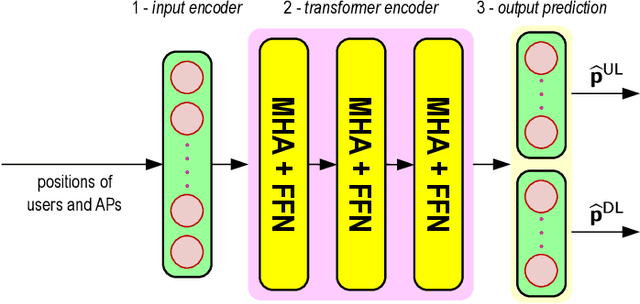


Power allocation is an important task in wireless communication networks. Classical optimization algorithms and deep learning methods, while effective in small and static scenarios, become either computationally demanding or unsuitable for large and dynamic networks with varying user loads. This letter explores the potential of transformer-based deep learning models to address these challenges. We propose a transformer neural network to jointly predict optimal uplink and downlink power using only user and access point positions. The max-min fairness problem in cell-free massive multiple input multiple output systems is considered. Numerical results show that the trained model provides near-optimal performance and adapts to varying numbers of users and access points without retraining, additional processing, or updating its neural network architecture. This demonstrates the effectiveness of the proposed model in achieving robust and flexible power allocation for dynamic networks.