 Add to Chrome
 Add to Firefox
 Add to Edge
AdaCubic: An Adaptive Cubic Regularization Optimizer for Deep Learning
Apr 10, 2026
A novel regularization technique, AdaCubic, is proposed that adapts the weight of the cubic term. The heart of AdaCubic is an auxiliary optimization problem with cubic constraints that dynamically adjusts the weight of the cubic term in Newton's cubic regularized method. We use Hutchinson's method to approximate the Hessian matrix, thereby reducing computational cost. We demonstrate that AdaCubic inherits the cubically regularized Newton method's local convergence guarantees. Our experiments in Computer Vision, Natural Language Processing, and Signal Processing tasks demonstrate that AdaCubic outperforms or competes with several widely used optimizers. Unlike other adaptive algorithms that require hyperparameter fine-tuning, AdaCubic is evaluated with a fixed set of hyperparameters, rendering it a highly attractive optimizer in settings where fine-tuning is infeasible. This makes AdaCubic an attractive option for researchers and practitioners alike. To our knowledge, AdaCubic is the first optimizer to leverage cubic regularization in scalable deep learning applications.

Camera Model Identification Using Audio and Visual Content from Videos
Jun 25, 2024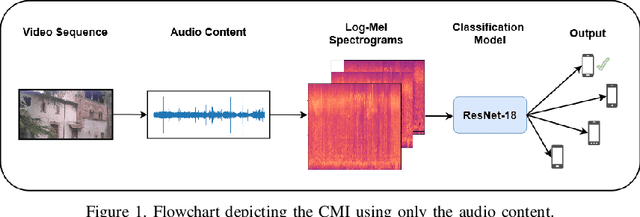
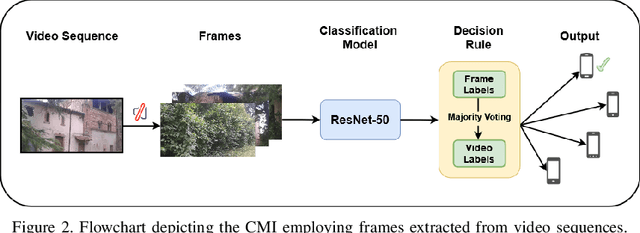
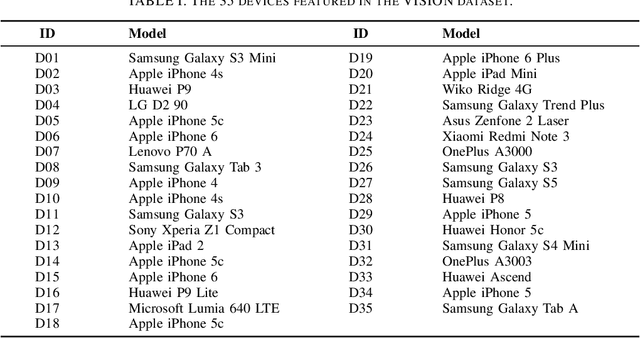
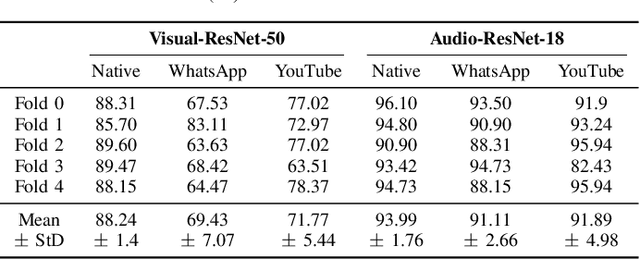
The identification of device brands and models plays a pivotal role in the realm of multimedia forensic applications. This paper presents a framework capable of identifying devices using audio, visual content, or a fusion of them. The fusion of visual and audio content occurs later by applying two fundamental fusion rules: the product and the sum. The device identification problem is tackled as a classification one by leveraging Convolutional Neural Networks. Experimental evaluation illustrates that the proposed framework exhibits promising classification performance when independently using audio or visual content. Furthermore, although the fusion results don't consistently surpass both individual modalities, they demonstrate promising potential for enhancing classification performance. Future research could refine the fusion process to improve classification performance in both modalities consistently. Finally, a statistical significance test is performed for a more in-depth study of the classification results.