 Add to Chrome
 Add to Firefox
 Add to Edge
A green solvent screening tool for emerging materials via uncertainty aware, transformer enhanced transfer learning
Jun 11, 2026
Accurate prediction of solubility remains a central challenge across materials science and sustainable chemistry. In particular due to emerging technologies like organic and hybrid photovoltaics, batteries, and catalysis, solvent usage is expected to increase significantly within the coming years. Therefore, substituting solvents with greener alternatives is vital. This is where machine learning can have substantial impact. However, the limited data on critical parameters of solubility significantly constraints machine learning efficacy. In this work, we transfer a pre-trained foundational model on QM9 targets to our application with minimal data requirements. Additionally, the pipeline integrates uncertainty quantification, allowing the user to gauge the confidence of the predictions. As baseline, we succeed in predicting the Hansen solubility parameters and Dielectric Constant for which extensive databases exist. Importantly, we achieve high model performance on additional targets, such as Gutmann Donor and Acceptor numbers, where the available data is extremely limited. Overall, we augment data on solubility descriptors by orders of magnitude with high quality predictions. For effective dissemination, we deploy easy-to-use, easily integrateable with high throughput labs, customizable tool for ranking and screening possible solvent substitutes. Finally, we rediscovered known green solvent alternatives and proposed new candidates proving its relevance for finding eco-friendly solvents.

AUGUR, A flexible and efficient optimization algorithm for identification of optimal adsorption sites
Sep 24, 2024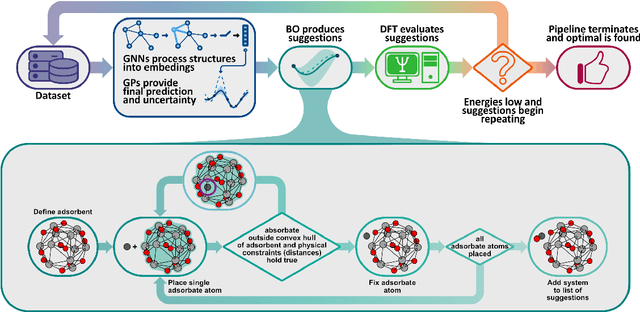

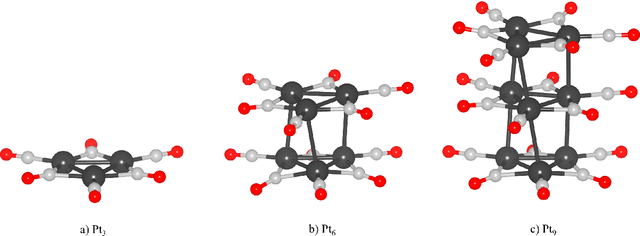
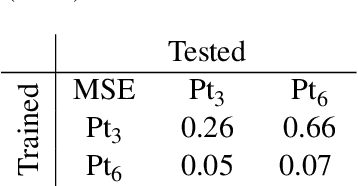
In this paper, we propose a novel flexible optimization pipeline for determining the optimal adsorption sites, named AUGUR (Aware of Uncertainty Graph Unit Regression). Our model combines graph neural networks and Gaussian processes to create a flexible, efficient, symmetry-aware, translation, and rotation-invariant predictor with inbuilt uncertainty quantification. This predictor is then used as a surrogate for a data-efficient Bayesian Optimization scheme to determine the optimal adsorption positions. This pipeline determines the optimal position of large and complicated clusters with far fewer iterations than current state-of-the-art approaches. Further, it does not rely on hand-crafted features and can be seamlessly employed on any molecule without any alterations. Additionally, the pooling properties of graphs allow for the processing of molecules of different sizes by the same model. This allows the energy prediction of computationally demanding systems by a model trained on comparatively smaller and less expensive ones
Machine-Learning-Optimized Perovskite Nanoplatelet Synthesis
Oct 18, 2022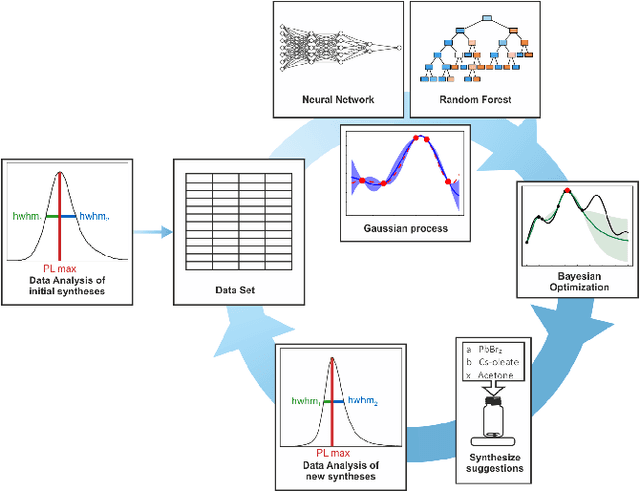

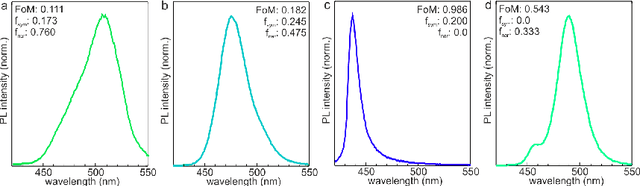
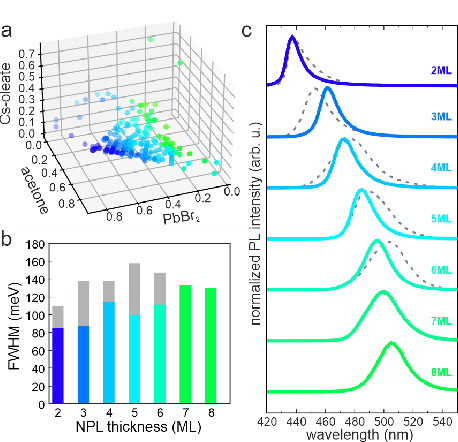
With the demand for renewable energy and efficient devices rapidly increasing, a need arises to find and optimize novel (nano)materials. This can be an extremely tedious process, often relying significantly on trial and error. Machine learning has emerged recently as a powerful alternative; however, most approaches require a substantial amount of data points, i.e., syntheses. Here, we merge three machine-learning models with Bayesian Optimization and are able to dramatically improve the quality of CsPbBr3 nanoplatelets (NPLs) using only approximately 200 total syntheses. The algorithm can predict the resulting PL emission maxima of the NPL dispersions based on the precursor ratios, which lead to previously unobtainable 7 and 8 ML NPLs. Aided by heuristic knowledge, the algorithm should be easily applicable to other nanocrystal syntheses and significantly help to identify interesting compositions and rapidly improve their quality.