 Add to Chrome
 Add to Firefox
 Add to Edge
Instance-Aware Test-Time Segmentation for Continual Domain Shifts
Dec 09, 2025
Continual Test-Time Adaptation (CTTA) enables pre-trained models to adapt to continuously evolving domains. Existing methods have improved robustness but typically rely on fixed or batch-level thresholds, which cannot account for varying difficulty across classes and instances. This limitation is especially problematic in semantic segmentation, where each image requires dense, multi-class predictions. We propose an approach that adaptively adjusts pseudo labels to reflect the confidence distribution within each image and dynamically balances learning toward classes most affected by domain shifts. This fine-grained, class- and instance-aware adaptation produces more reliable supervision and mitigates error accumulation throughout continual adaptation. Extensive experiments across eight CTTA and TTA scenarios, including synthetic-to-real and long-term shifts, show that our method consistently outperforms state-of-the-art techniques, setting a new standard for semantic segmentation under evolving conditions.

Question-Aware Gaussian Experts for Audio-Visual Question Answering
Mar 07, 2025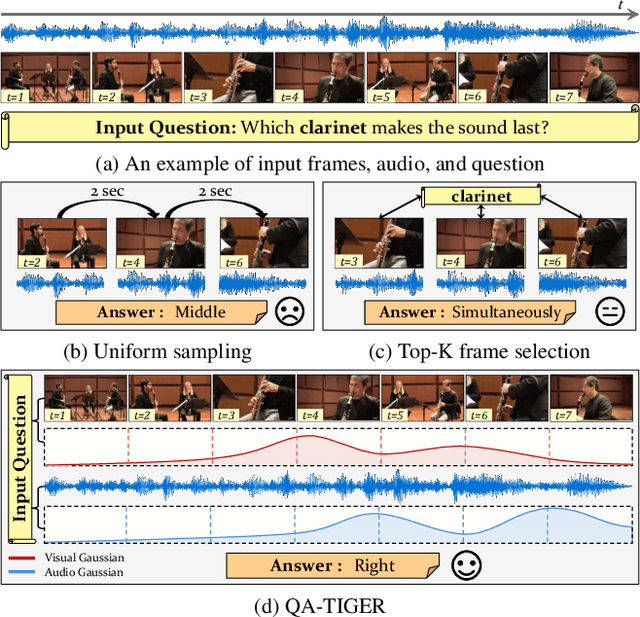

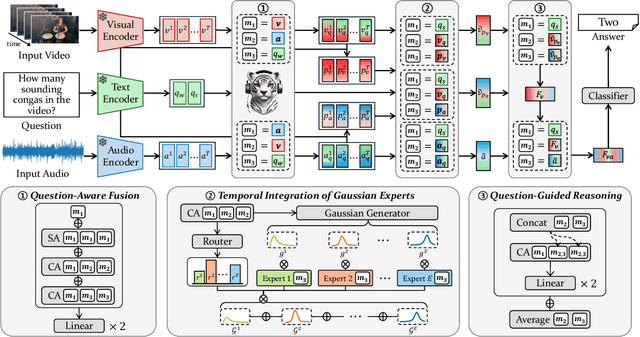
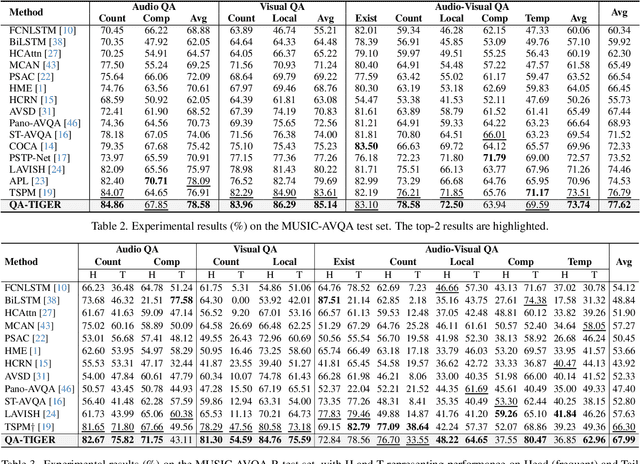
Audio-Visual Question Answering (AVQA) requires not only question-based multimodal reasoning but also precise temporal grounding to capture subtle dynamics for accurate prediction. However, existing methods mainly use question information implicitly, limiting focus on question-specific details. Furthermore, most studies rely on uniform frame sampling, which can miss key question-relevant frames. Although recent Top-K frame selection methods aim to address this, their discrete nature still overlooks fine-grained temporal details. This paper proposes QA-TIGER, a novel framework that explicitly incorporates question information and models continuous temporal dynamics. Our key idea is to use Gaussian-based modeling to adaptively focus on both consecutive and non-consecutive frames based on the question, while explicitly injecting question information and applying progressive refinement. We leverage a Mixture of Experts (MoE) to flexibly implement multiple Gaussian models, activating temporal experts specifically tailored to the question. Extensive experiments on multiple AVQA benchmarks show that QA-TIGER consistently achieves state-of-the-art performance. Code is available at https://aim-skku.github.io/QA-TIGER/