 Add to Chrome
 Add to Firefox
 Add to Edge
Task-Agnostic Noisy Label Detection via Standardized Loss Aggregation
May 11, 2026
Noisy labels are common in large-scale medical imaging datasets due to inter-observer variability and ambiguous cases. We propose a statistically grounded and task-agnostic framework, Standardized Loss Aggregation (SLA), for detecting noisy labels at the sample level. SLA quantifies label reliability by aggregating standardized fold-level validation losses across repeated cross-validation runs. This formulation generalizes discrete hard-counting schemes into a continuous estimator that captures both the frequency and magnitude of performance deviations, yielding interpretable and statistically stable noisiness scores. Experiments on a public fundus dataset demonstrate that SLA consistently outperforms the hard-counting baseline across all noise levels and converges substantially faster, especially under low noise ratios where subtle loss variations are informative. Samples with high SLA scores indicate potentially ambiguous or mislabeled cases, guiding efficient re-annotation and improving dataset reliability for any classification task.

Robust Asymmetric Loss for Multi-Label Long-Tailed Learning
Aug 10, 2023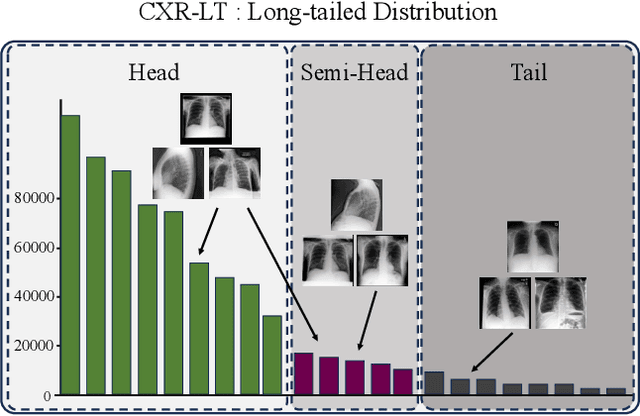
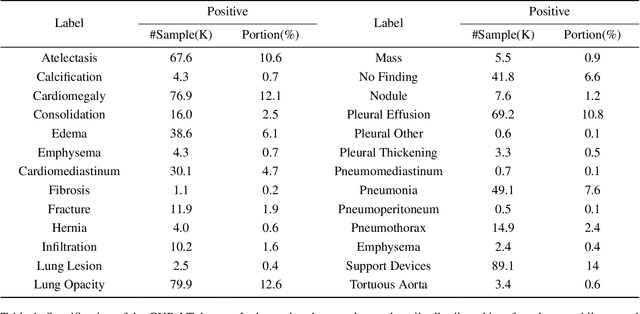
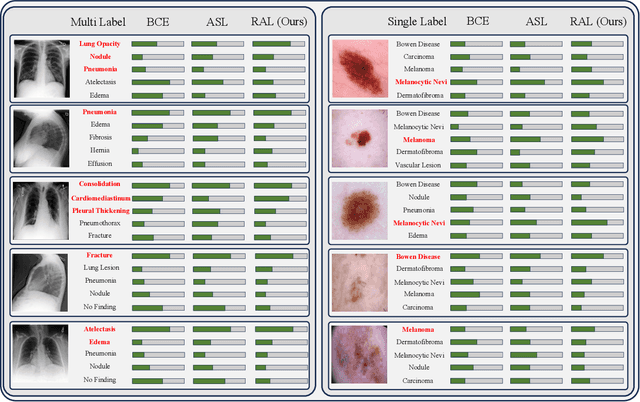
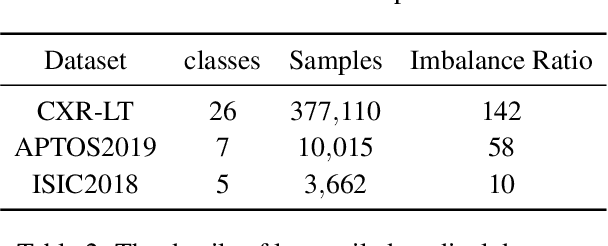
In real medical data, training samples typically show long-tailed distributions with multiple labels. Class distribution of the medical data has a long-tailed shape, in which the incidence of different diseases is quite varied, and at the same time, it is not unusual for images taken from symptomatic patients to be multi-label diseases. Therefore, in this paper, we concurrently address these two issues by putting forth a robust asymmetric loss on the polynomial function. Since our loss tackles both long-tailed and multi-label classification problems simultaneously, it leads to a complex design of the loss function with a large number of hyper-parameters. Although a model can be highly fine-tuned due to a large number of hyper-parameters, it is difficult to optimize all hyper-parameters at the same time, and there might be a risk of overfitting a model. Therefore, we regularize the loss function using the Hill loss approach, which is beneficial to be less sensitive against the numerous hyper-parameters so that it reduces the risk of overfitting the model. For this reason, the proposed loss is a generic method that can be applied to most medical image classification tasks and does not make the training process more time-consuming. We demonstrate that the proposed robust asymmetric loss performs favorably against the long-tailed with multi-label medical image classification in addition to the various long-tailed single-label datasets. Notably, our method achieves Top-5 results on the CXR-LT dataset of the ICCV CVAMD 2023 competition. We opensource our implementation of the robust asymmetric loss in the public repository: https://github.com/kalelpark/RAL.