 Add to Chrome
 Add to Firefox
 Add to Edge
A Human-Centred Architecture for Large Language Models-Cognitive Assistants in Manufacturing within Quality Management Systems
Mar 17, 2026
Large Language Models-Cognitive Assistants (LLM-CAs) can enhance Quality Management Systems (QMS) in manufacturing, fostering continuous process improvement and knowledge management. However, there is no human-centred software architecture focused on QMS that enables the integration of LLM-CAs into manufacturing in the current literature. This study addresses this gap by designing a component-based architecture considering requirement analysis and software development process. Validation was conducted via iterative expert focus groups. The proposed architecture ensures flexibility, scalability, modularity, and work augmentation within QMS. Moreover, it paves the way for its operationalization with industrial partners, showcasing its potential for advancing manufacturing processes.

Predicting Dynamic Stability of Power Grids using Graph Neural Networks
Aug 18, 2021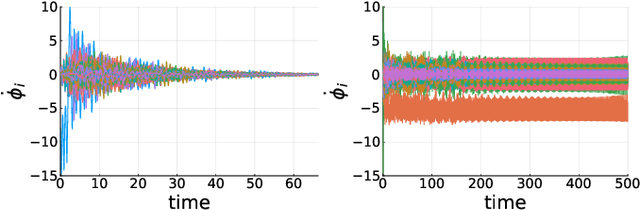
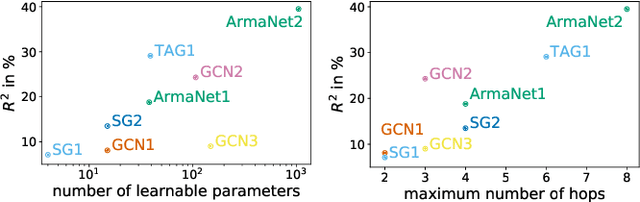
The prediction of dynamical stability of power grids becomes more important and challenging with increasing shares of renewable energy sources due to their decentralized structure, reduced inertia and volatility. We investigate the feasibility of applying graph neural networks (GNN) to predict dynamic stability of synchronisation in complex power grids using the single-node basin stability (SNBS) as a measure. To do so, we generate two synthetic datasets for grids with 20 and 100 nodes respectively and estimate SNBS using Monte-Carlo sampling. Those datasets are used to train and evaluate the performance of eight different GNN-models. All models use the full graph without simplifications as input and predict SNBS in a nodal-regression-setup. We show that SNBS can be predicted in general and the performance significantly changes using different GNN-models. Furthermore, we observe interesting transfer capabilities of our approach: GNN-models trained on smaller grids can directly be applied on larger grids without the need of retraining.