 Add to Chrome
 Add to Firefox
 Add to Edge
Can Graph Learning Learn Circuits?
Aug 09, 2026
Circuit localization is a mechanistic interpretability task whose goal is to identify a sparse subgraph of a transformer's computation graph sufficient to reproduce a particular behavior. Most established methods localize circuits independently for each model--task pair. We instead frame circuit localization as a graph machine learning problem in which the edges of a computation graph represent computational pathways, and graph neural networks (GNNs) model interactions among these pathways. We introduce Graph Circuit Learning (GCL), a supervised, amortized framework that trains a GNN across multiple model--task pairs and applies it to unseen cases. To provide sufficient data, we augment the InterpBench benchmark with additional cases derived from the TracrBench programs. Of the 14 evaluated GCL configurations, the highest scored a median edge AUROC of $0.902$ (interquartile interval $[0.861, 0.942]$) on the 16 original held-out InterpBench cases. This is close to the published InterpBench median of $0.910$ for EAP-IG while remaining below ACDC's $0.959$. Removing all message-passing edges reduces the median to $0.825$. We also adapt PGExplainer, a GNN explainability method, to circuit localization, obtaining a median edge AUROC of $0.858$ on the same cases. These preliminary results suggest that graph machine learning offers a natural and potentially powerful perspective on circuit localization, and we hope this perspective encourages closer exchange between the two communities.

The Role of Node Features in Graph Pooling
May 07, 2026Graph pooling is commonly applied in graph classification, yet its empirical gains over standard WL-1 expressive GNNs are often marginal or inconsistent. We study this gap by analysing the interaction between node features and graph topology and their effect on pooling objectives. Our analysis reveals that pooling operators require node features that are well-aligned with the graph's topology -- a condition often overlooked and not guaranteed in empirical networks. We formalise fundamental requirements for node features to enable effective pooling, and introduce a quantitative measure of feature quality. Our empirical evaluation shows that, when these requirements are satisfied, pooling can be beneficial and improve performance on appropriate datasets.
Weisfeiler and Leman Follow the Arrow of Time: Expressive Power of Message Passing in Temporal Event Graphs
May 30, 2025An important characteristic of temporal graphs is how the directed arrow of time influences their causal topology, i.e., which nodes can possibly influence each other causally via time-respecting paths. The resulting patterns are often neglected by temporal graph neural networks (TGNNs). To formally analyze the expressive power of TGNNs, we lack a generalization of graph isomorphism to temporal graphs that fully captures their causal topology. Addressing this gap, we introduce the notion of consistent event graph isomorphism, which utilizes a time-unfolded representation of time-respecting paths in temporal graphs. We compare this definition with existing notions of temporal graph isomorphisms. We illustrate and highlight the advantages of our approach and develop a temporal generalization of the Weisfeiler-Leman algorithm to heuristically distinguish non-isomorphic temporal graphs. Building on this theoretical foundation, we derive a novel message passing scheme for temporal graph neural networks that operates on the event graph representation of temporal graphs. An experimental evaluation shows that our approach performs well in a temporal graph classification experiment.
Insights from Network Science can advance Deep Graph Learning
Feb 03, 2025Deep graph learning and network science both analyze graphs but approach similar problems from different perspectives. Whereas network science focuses on models and measures that reveal the organizational principles of complex systems with explicit assumptions, deep graph learning focuses on flexible and generalizable models that learn patterns in graph data in an automated fashion. Despite these differences, both fields share the same goal: to better model and understand patterns in graph-structured data. Early efforts to integrate methods, models, and measures from network science and deep graph learning indicate significant untapped potential. In this position, we explore opportunities at their intersection. We discuss open challenges in deep graph learning, including data augmentation, improved evaluation practices, higher-order models, and pooling methods. Likewise, we highlight challenges in network science, including scaling to massive graphs, integrating continuous gradient-based optimization, and developing standardized benchmarks.
Hierarchical Graph Pooling Based on Minimum Description Length
Sep 16, 2024Graph pooling is an essential part of deep graph representation learning. We introduce MapEqPool, a principled pooling operator that takes the inherent hierarchical structure of real-world graphs into account. MapEqPool builds on the map equation, an information-theoretic objective function for community detection based on the minimum description length principle which naturally implements Occam's razor and balances between model complexity and fit. We demonstrate MapEqPool's competitive performance with an empirical comparison against various baselines across standard graph classification datasets.
Link Prediction with Untrained Message Passing Layers
Jun 24, 2024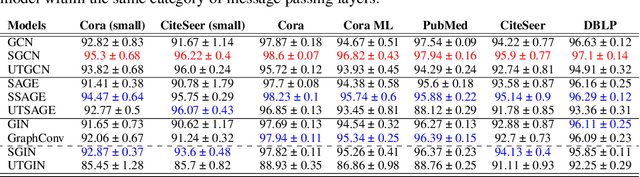
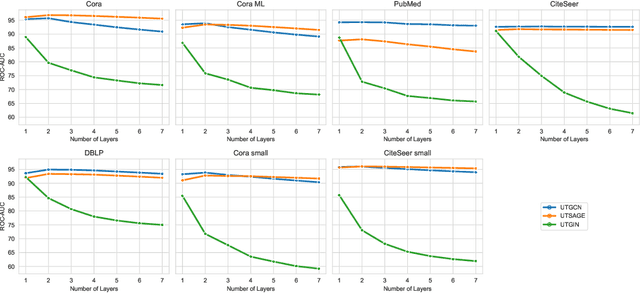

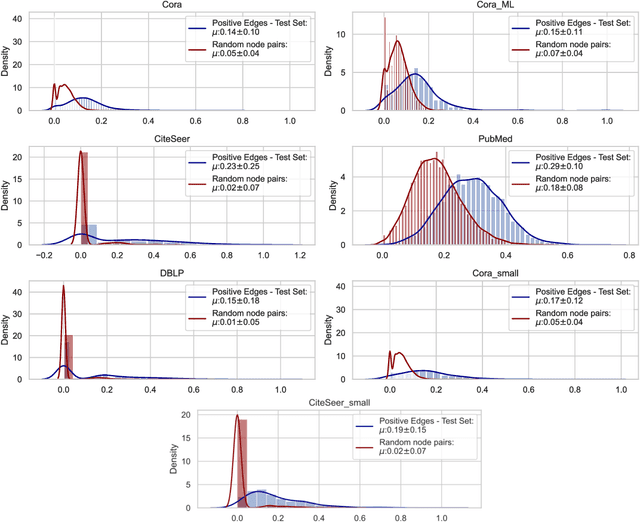
Message passing neural networks (MPNNs) operate on graphs by exchanging information between neigbouring nodes. MPNNs have been successfully applied to various node-, edge-, and graph-level tasks in areas like molecular science, computer vision, natural language processing, and combinatorial optimization. However, most MPNNs require training on large amounts of labeled data, which can be costly and time-consuming. In this work, we explore the use of various untrained message passing layers in graph neural networks, i.e. variants of popular message passing architecture where we remove all trainable parameters that are used to transform node features in the message passing step. Focusing on link prediction, we find that untrained message passing layers can lead to competitive and even superior performance compared to fully trained MPNNs, especially in the presence of high-dimensional features. We provide a theoretical analysis of untrained message passing by relating the inner products of features implicitly produced by untrained message passing layers to path-based topological node similarity measures. As such, untrained message passing architectures can be viewed as a highly efficient and interpretable approach to link prediction.
Inference of Sequential Patterns for Neural Message Passing in Temporal Graphs
Jun 24, 2024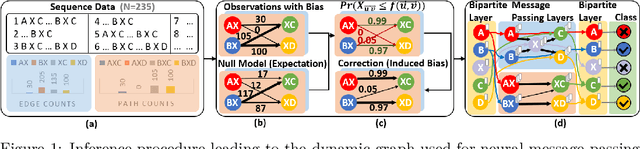
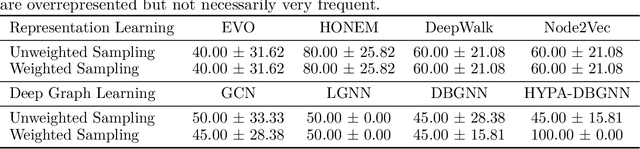

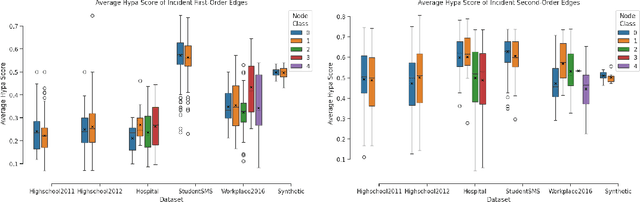
The modelling of temporal patterns in dynamic graphs is an important current research issue in the development of time-aware GNNs. Whether or not a specific sequence of events in a temporal graph constitutes a temporal pattern not only depends on the frequency of its occurrence. We consider whether it deviates from what is expected in a temporal graph where timestamps are randomly shuffled. While accounting for such a random baseline is important to model temporal patterns, it has mostly been ignored by current temporal graph neural networks. To address this issue we propose HYPA-DBGNN, a novel two-step approach that combines (i) the inference of anomalous sequential patterns in time series data on graphs based on a statistically principled null model, with (ii) a neural message passing approach that utilizes a higher-order De Bruijn graph whose edges capture overrepresented sequential patterns. Our method leverages hypergeometric graph ensembles to identify anomalous edges within both first- and higher-order De Bruijn graphs, which encode the temporal ordering of events. The model introduces an inductive bias that enhances model interpretability. We evaluate our approach for static node classification using benchmark datasets and a synthetic dataset that showcases its ability to incorporate the observed inductive bias regarding over- and under-represented temporal edges. We demonstrate the framework's effectiveness in detecting similar patterns within empirical datasets, resulting in superior performance compared to baseline methods in node classification tasks. To the best of our knowledge, our work is the first to introduce statistically informed GNNs that leverage temporal and causal sequence anomalies. HYPA-DBGNN represents a path for bridging the gap between statistical graph inference and neural graph representation learning, with potential applications to static GNNs.
From Link Prediction to Forecasting: Information Loss in Batch-based Temporal Graph Learning
Jun 07, 2024Dynamic link prediction is an important problem considered by many recent works proposing various approaches for learning temporal edge patterns. To assess their efficacy, models are evaluated on publicly available benchmark datasets involving continuous-time and discrete-time temporal graphs. However, as we show in this work, the suitability of common batch-oriented evaluation depends on the datasets' characteristics, which can cause two issues: First, for continuous-time temporal graphs, fixed-size batches create time windows with different durations, resulting in an inconsistent dynamic link prediction task. Second, for discrete-time temporal graphs, the sequence of batches can additionally introduce temporal dependencies that are not present in the data. In this work, we empirically show that this common evaluation approach leads to skewed model performance and hinders the fair comparison of methods. We mitigate this problem by reformulating dynamic link prediction as a link forecasting task that better accounts for temporal information present in the data. We provide implementations of our new evaluation method for commonly used graph learning frameworks.
The Self-Loop Paradox: Investigating the Impact of Self-Loops on Graph Neural Networks
Dec 04, 2023
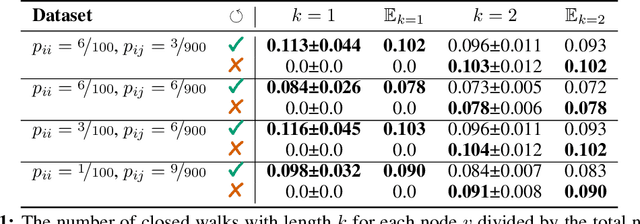
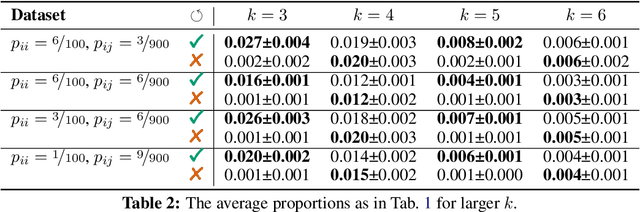

Many Graph Neural Networks (GNNs) add self-loops to a graph to include feature information about a node itself at each layer. However, if the GNN consists of more than one layer, this information can return to its origin via cycles in the graph topology. Intuition suggests that this "backflow" of information should be larger in graphs with self-loops compared to graphs without. In this work, we counter this intuition and show that for certain GNN architectures, the information a node gains from itself can be smaller in graphs with self-loops compared to the same graphs without. We adopt an analytical approach for the study of statistical graph ensembles with a given degree sequence and show that this phenomenon, which we call the self-loop paradox, can depend both on the number of GNN layers $k$ and whether $k$ is even or odd. We experimentally validate our theoretical findings in a synthetic node classification task and investigate its practical relevance in 23 real-world graphs.
Using Causality-Aware Graph Neural Networks to Predict Temporal Centralities in Dynamic Graphs
Oct 24, 2023Node centralities play a pivotal role in network science, social network analysis, and recommender systems. In temporal data, static path-based centralities like closeness or betweenness can give misleading results about the true importance of nodes in a temporal graph. To address this issue, temporal generalizations of betweenness and closeness have been defined that are based on the shortest time-respecting paths between pairs of nodes. However, a major issue of those generalizations is that the calculation of such paths is computationally expensive. Addressing this issue, we study the application of De Bruijn Graph Neural Networks (DBGNN), a causality-aware graph neural network architecture, to predict temporal path-based centralities in time series data. We experimentally evaluate our approach in 13 temporal graphs from biological and social systems and show that it considerably improves the prediction of both betweenness and closeness centrality compared to a static Graph Convolutional Neural Network.