 Add to Chrome
 Add to Firefox
 Add to Edge
Spatio-temporal probabilistic forecast using MMAF-guided learning
Mar 16, 2026
We employ stochastic feed-forward neural networks with Gaussian-distributed weights to determine a probabilistic forecast for spatio-temporal raster datasets. The networks are trained using MMAF-guided learning, a generalized Bayesian methodology in which the observed data are preprocessed using an embedding designed to produce a low-dimensional representation that captures their dependence and causal structure. The design of the embedding is theory-guided by the assumption that a spatio-temporal Ornstein-Uhlenbeck process with finite second-order moments generates the observed data. The trained networks, in inference mode, are then used to generate ensemble forecasts by applying different initial conditions at different horizons. Experiments conducted on both synthetic and real data demonstrate that our forecasts remain calibrated across multiple time horizons. Moreover, we show that on such data, simple feed-forward architectures can achieve performance comparable to, and in some cases better than, convolutional or diffusion deep learning architectures used in probabilistic forecasting tasks.

Mixed moving average field guided learning for spatio-temporal data
Jan 02, 2023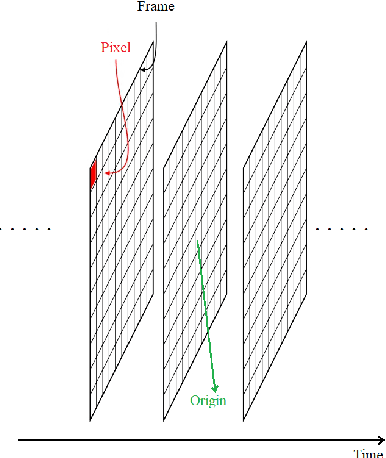
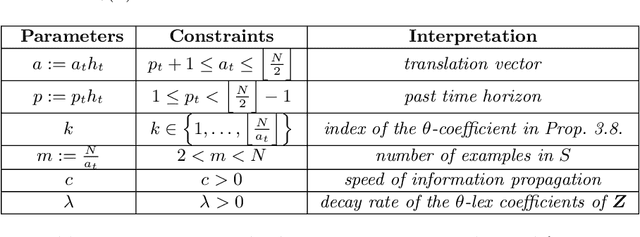
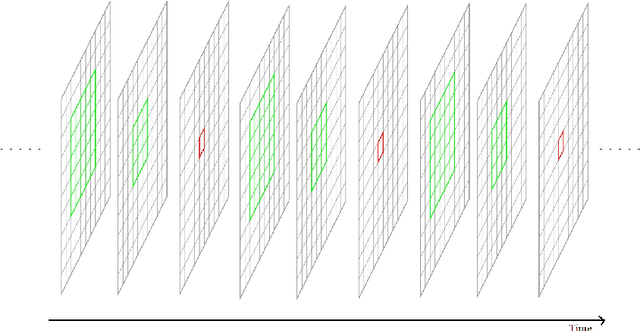
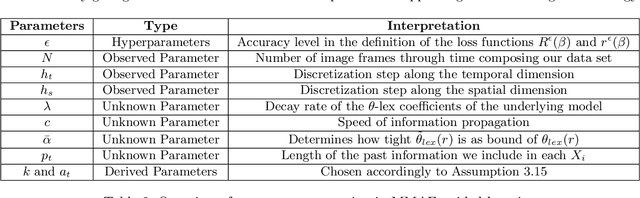
Influenced mixed moving average fields are a versatile modeling class for spatio-temporal data. However, their predictive distribution is not generally accessible. Under this modeling assumption, we define a novel theory-guided machine learning approach that employs a generalized Bayesian algorithm to make predictions. We employ a Lipschitz predictor, for example, a linear model or a feed-forward neural network, and determine a randomized estimator by minimizing a novel PAC Bayesian bound for data serially correlated along a spatial and temporal dimension. Performing causal future predictions is a highlight of our methodology as its potential application to data with short and long-range dependence. We conclude by showing the performance of the learning methodology in an example with linear predictors and simulated spatio-temporal data from an STOU process.