 Add to Chrome
 Add to Firefox
 Add to Edge
Pinching Antenna System-Assisted Hybrid AirComp-NOMA Uplink: Joint Precoding and Antenna Placement Optimization
Apr 14, 2026
This paper studies a pinching antenna system (PAS)-assisted hybrid uplink architecture that integrates over-the-air computation (AirComp) and non-orthogonal multiple access (NOMA) to simultaneously support distributed data aggregation and individual communication services. A base station with a dielectric waveguide hosting multiple pinching antennas receives signals from AirComp and NOMA users over shared time-frequency resources. To assess joint computation-communication performance, a hybrid metric combining the AirComp computation rate and the NOMA sum rate is proposed. Based on this metric, a joint optimization problem is formulated to maximize the hybrid rate by optimizing user transmit precoding, receive combining, and antenna deployment, subject to power, quality-of-service, and aggregation accuracy constraints. An alternating optimization framework is developed to solve the resulting non-convex problem. Numerical results show that the proposed design achieves significant performance gains over several benchmark schemes.

Secrecy Performance Analysis of Pinching-Antenna Systems Under Pinching-Position Uncertainty
Apr 14, 2026This paper investigates the secrecy performance of pinching-antenna systems (PAS) under practical pinching-position activation uncertainty. By dynamically selecting the radiation point along a dielectric waveguide, PAS enables low-cost spatial reconfigurability and enhanced secure transmission. Unlike existing studies that assume ideal activation control, we account for spatial inaccuracies caused by hardware limitations and environmental perturbations, which induce statistical dependence between the legitimate and eavesdropping channels. To capture this effect, a copula-based framework is employed to model the joint distribution of the corresponding signal-to-noise ratios (SNRs), and approximate expressions for the secrecy outage probability (SOP) are derived. Simulation results validate the theoretical findings and demonstrate that PAS retains robust secrecy performance compared with conventional fixed-antenna systems, even in the presence of activation uncertainty.
Terahertz User-Centric Clustering in the Presence of Beam Misalignment
Feb 19, 2024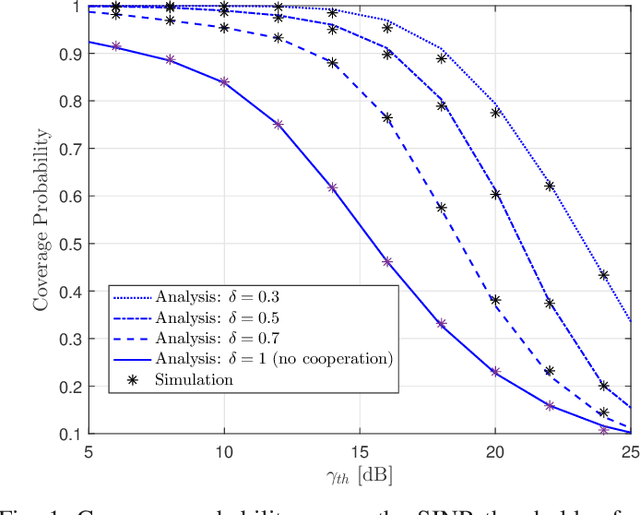
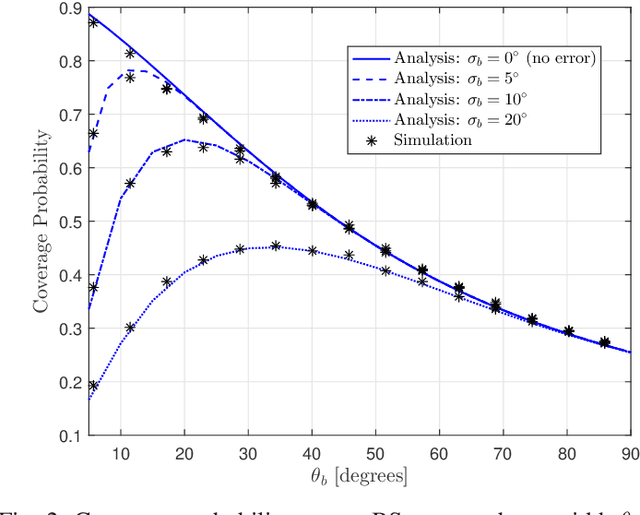
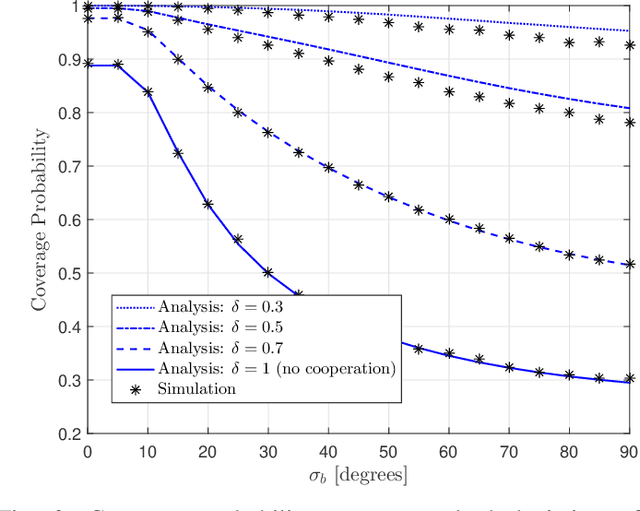
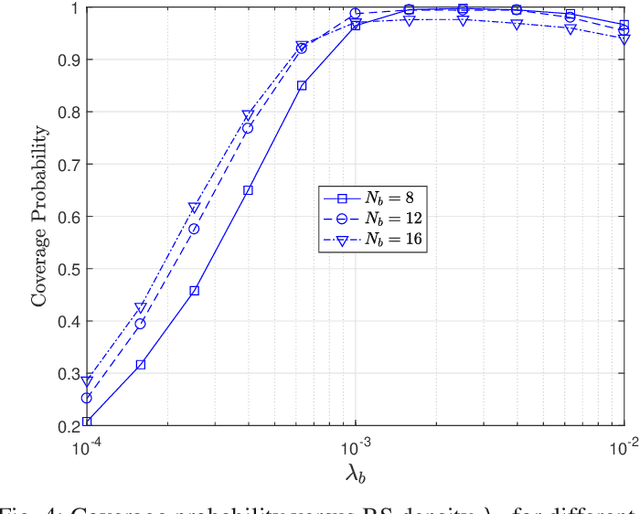
Beam misalignment is one of the main challenges for the design of reliable wireless systems in terahertz (THz) bands. This paper investigates how to apply user-centric base station (BS) clustering as a valuable add-on in THz networks. In particular, to reduce the impact of beam misalignment, a user-centric BS clustering design that provides multi-connectivity via BS cooperation is investigated. The coverage probability is derived by leveraging an accurate approximation of the aggregate interference distribution that captures the effect of beam misalignment and THz fading. The numerical results reveal the impact of beam misalignment with respect to crucial link parameters, such as the transmitter's beam width and the serving cluster size, demonstrating that user-centric BS clustering is a promising enabler of THz networks.