 Add to Chrome
 Add to Firefox
 Add to Edge
Goldilocks RL: Tuning Task Difficulty to Escape Sparse Rewards for Reasoning
Feb 16, 2026
Reinforcement learning has emerged as a powerful paradigm for unlocking reasoning capabilities in large language models. However, relying on sparse rewards makes this process highly sample-inefficient, as models must navigate vast search spaces with minimal feedback. While classic curriculum learning aims to mitigate this by ordering data based on complexity, the right ordering for a specific model is often unclear. To address this, we propose Goldilocks, a novel teacher-driven data sampling strategy that aims to predict each question's difficulty for the student model. The teacher model selects questions of appropriate difficulty for the student model, i.e., questions that are neither too easy nor too hard (Goldilocks principle), while training the student with GRPO. By leveraging the student's performance on seen samples, the teacher continuously adapts to the student's evolving abilities. On OpenMathReasoning dataset, Goldilocks data sampling improves the performance of models trained with standard GRPO under the same compute budget.

Multi-armed Bandits with Missing Outcome
Nov 08, 2024
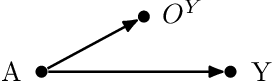
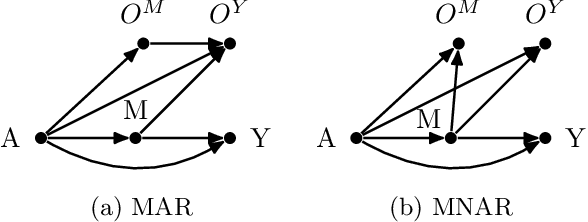
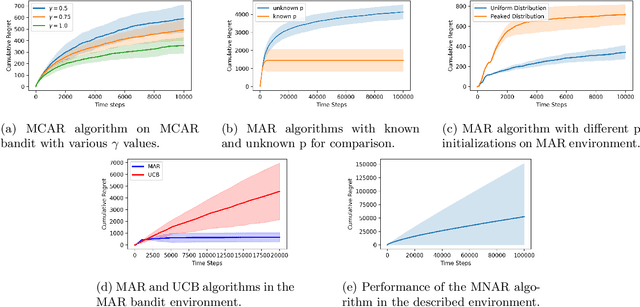
While significant progress has been made in designing algorithms that minimize regret in online decision-making, real-world scenarios often introduce additional complexities, perhaps the most challenging of which is missing outcomes. Overlooking this aspect or simply assuming random missingness invariably leads to biased estimates of the rewards and may result in linear regret. Despite the practical relevance of this challenge, no rigorous methodology currently exists for systematically handling missingness, especially when the missingness mechanism is not random. In this paper, we address this gap in the context of multi-armed bandits (MAB) with missing outcomes by analyzing the impact of different missingness mechanisms on achievable regret bounds. We introduce algorithms that account for missingness under both missing at random (MAR) and missing not at random (MNAR) models. Through both analytical and simulation studies, we demonstrate the drastic improvements in decision-making by accounting for missingness in these settings.