 Add to Chrome
 Add to Firefox
 Add to Edge
VAMAE: Vessel-Aware Masked Autoencoders for OCT Angiography
Apr 08, 2026
Optical coherence tomography angiography (OCTA) provides non-invasive visualization of retinal microvasculature, but learning robust representations remains challenging due to sparse vessel structures and strong topological constraints. Many existing self-supervised learning approaches, including masked autoencoders, are primarily designed for dense natural images and rely on uniform masking and pixel-level reconstruction, which may inadequately capture vascular geometry. We propose VAMAE, a vessel-aware masked autoencoding framework for self-supervised pretraining on OCTA images. The approach incorporates anatomically informed masking that emphasizes vessel-rich regions using vesselness and skeleton-based cues, encouraging the model to focus on vascular connectivity and branching patterns. In addition, the pretraining objective includes reconstructing multiple complementary targets, enabling the model to capture appearance, structural, and topological information. We evaluate the proposed pretraining strategy on the OCTA-500 benchmark for several vessel segmentation tasks under varying levels of supervision. The results indicate that vessel-aware masking and multi-target reconstruction provide consistent improvements over standard masked autoencoding baselines, particularly in limited-label settings, suggesting the potential of geometry-aware self-supervised learning for OCTA analysis.

SharpXR: Structure-Aware Denoising for Pediatric Chest X-Rays
Aug 11, 2025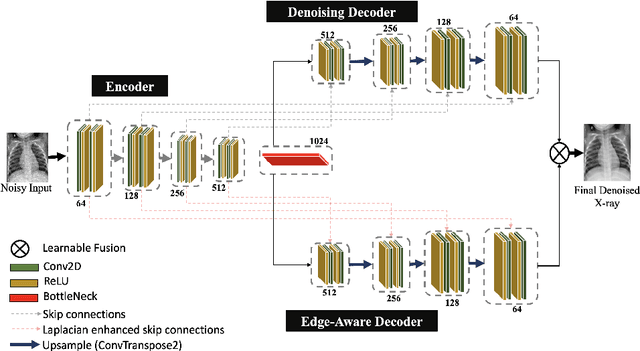
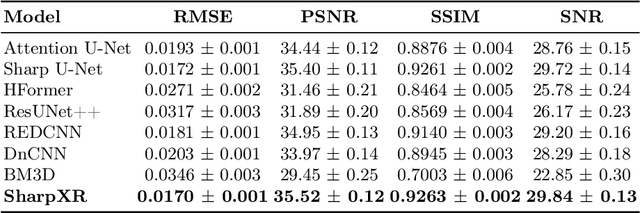
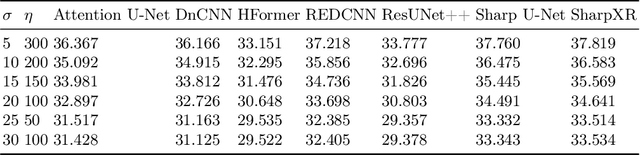
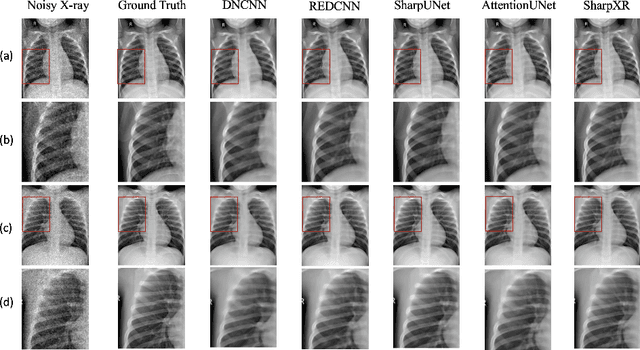
Pediatric chest X-ray imaging is essential for early diagnosis, particularly in low-resource settings where advanced imaging modalities are often inaccessible. Low-dose protocols reduce radiation exposure in children but introduce substantial noise that can obscure critical anatomical details. Conventional denoising methods often degrade fine details, compromising diagnostic accuracy. In this paper, we present SharpXR, a structure-aware dual-decoder U-Net designed to denoise low-dose pediatric X-rays while preserving diagnostically relevant features. SharpXR combines a Laplacian-guided edge-preserving decoder with a learnable fusion module that adaptively balances noise suppression and structural detail retention. To address the scarcity of paired training data, we simulate realistic Poisson-Gaussian noise on the Pediatric Pneumonia Chest X-ray dataset. SharpXR outperforms state-of-the-art baselines across all evaluation metrics while maintaining computational efficiency suitable for resource-constrained settings. SharpXR-denoised images improved downstream pneumonia classification accuracy from 88.8% to 92.5%, underscoring its diagnostic value in low-resource pediatric care.