 Add to Chrome
 Add to Firefox
 Add to Edge
The Wavefunction of Continuous-Time Recurrent Neural Networks
Feb 13, 2021
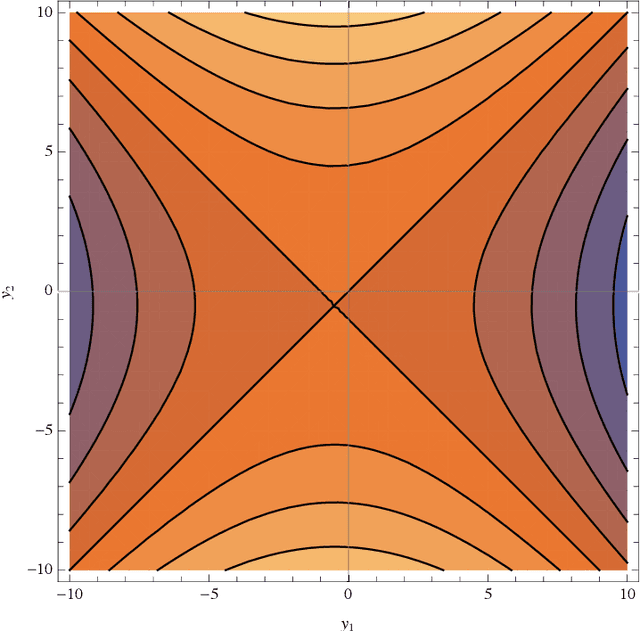
In this paper, we explore the possibility of deriving a quantum wavefunction for continuous-time recurrent neural network (CTRNN). We did this by first starting with a two-dimensional dynamical system that describes the classical dynamics of a continuous-time recurrent neural network, and then deriving a Hamiltonian. After this, we quantized this Hamiltonian on a Hilbert space $\mathbb{H} = L^2(\mathbb{R})$ using Weyl quantization. We then solved the Schrodinger equation which gave us the wavefunction in terms of Kummer's confluent hypergeometric function corresponding to the neural network structure. Upon applying spatial boundary conditions at infinity, we were able to derive conditions/restrictions on the weights and hyperparameters of the neural network, which could potentially give insights on the the nature of finding optimal weights of said neural networks.

On an Optimal Solution to the Film Scheduling and Showtime Staggering Problem
Nov 22, 2019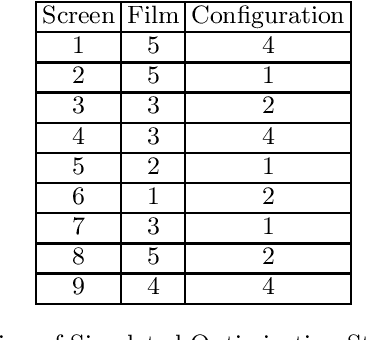
The scheduling of films is a major problem for the movie theatre exhibition business. The problem is two-fold: movie exhibitors ideally would like to schedule films to screens in their various locations to maximize attendance and revenue, but would also like to schedule these films such that neighbouring theatre locations play the same films at different times thus giving guests a multitude of showtime options. We refer to this latter problem as the showtime \emph{staggering} problem. We give an exact formulation of this scheduling problem using binary integer linear optimization, and provide a solved example as well. This work further shows that the optimal scheduling of films cannot be done across all theatre locations at once, but rather, must be done for each cluster of neighbouring locations.
Finding Common Characteristics Among NBA Playoff and Championship Teams: A Machine Learning Approach
Apr 03, 2017In this paper, we employ machine learning techniques to analyze seventeen seasons (1999-2000 to 2015-2016) of NBA regular season data from every team to determine the common characteristics among NBA playoff teams. Each team was characterized by 26 predictor variables and one binary response variable taking on a value of "TRUE" if a team had made the playoffs, and value of "FALSE" if a team had missed the playoffs. After fitting an initial classification tree to this problem, this tree was then pruned which decreased the test error rate. Further to this, a random forest of classification trees was grown which provided a very accurate model from which a variable importance plot was generated to determine which predictor variables had the greatest influence on the response variable. The result of this work was the conclusion that the most important factors in characterizing a team's playoff eligibility are a team's opponent number of assists per game, a team's opponent number of made two point shots per game, and a team's number of steals per game. This seems to suggest that defensive factors as opposed to offensive factors are the most important characteristics shared among NBA playoff teams. We then use neural networks to classify championship teams based on regular season data. From this, we show that the most important factor in a team not winning a championship is that team's opponent number of made three-point shots per game. This once again implies that defensive characteristics are of great importance in not only determining a team's playoff eligibility, but certainly, one can conclude that a lack of perimeter defense negatively impacts a team's championship chances in a given season. Further, it is shown that made two-point shots and defensive rebounding are by far the most important factor in a team's chances at winning a championship in a given season.