 Add to Chrome
 Add to Firefox
 Add to Edge
How Much Does Correctness Cost? Budgeted Placement of Strong Correctors in a Weak Multi-Agent Swarm
Jul 07, 2026
A cheap swarm of unreliable agents can be steered to a correct consensus by a few strong, expensive "oracle" correctors. We ask how much one must spend, and where to place the oracles. We model the swarm as a consensus on a graph in which each oracle pins one node toward the truth at a cost-coupled, concave strength, and measure quality by the coherence H(R)=tr M(R)^{-1}. Our first result is that H stays submodular (each added oracle helps less than the last) even when the oracles differ in strength, so a cost-benefit greedy comes within 1-1/e of the best placement at any budget. Inverting the budget gives the budget-correctness frontier B*(eps), the least spend that guarantees an eps-correct consensus: closed-form on the complete graph, and a minimal oracle count k* when oracles cost the same. Whether a budget then buys a few strong oracles or many medium onese curvature of the cost-quality law: diminishing returns favour spreadsharply increasion. Measured onthe Qwen3 ladder (0.6-32B), the law is concave for math verificatio convex foremergent code tracing, so the verdict is genuinely task-dependent.https://github.com/YehudaItkin/budgeted-oracle-placemen

Delayed Verification Destabilizes Multi-Agent LLM Belief: Instability Thresholds and Optimal Corrector Placement
Jun 25, 2026Multi-agent large language model (LLM) systems often rely on verifier and critic agents to suppress hallucinations, but verification is delayed. During this delay, false claims can propagate through the agent network. We model this process as delayed consensus on a graph with grounded corrector nodes. Spectral decomposition by the grounded Laplacian yields a closed-form stability threshold for the verification dose: correction that is too strong or too delayed can turn consensus into oscillation. The most unstable regime occurs when the communication and verification delays coincide; for delay two, the threshold is the inverse golden ratio. The same framework gives a supermodular placement objective and a greedy (1-1/e)-approximation rule for assigning a limited corrector budget to influential nodes. Experiments across five open models confirm the predicted dose-delay oscillations. By contrast, grounded factual answering makes truth an absorbing boundary and eliminates the effect, suggesting that the instability is specific to signed-belief tasks while grounded verification remains stabilizing
Quickest Detection of Hallucination Onset: Delay Bounds and Learned CUSUM Statistics
Jun 10, 2026Token-level hallucination detectors are evaluated as classifiers, by AUC over all tokens, yet a streaming monitor is judged by its reaction time: the number of tokens that pass between the onset of a hallucination and the alarm. We formulate hallucination onset detection as a quickest change detection problem. A first-order Markov model of the latent faithful/hallucinated state, validated on RAGTruth, places the task inside classical change-point theory and yields Lorden's lower bound on detection delay: about 1.3 tokens at a false-alarm rate of 0.01. We then show that a causal recurrent labeler acts as a CUSUM with a learned increment; at a matched false-alarm rate it detects in 11-13 tokens, against 31 for a linear per-token baseline, and a controlled decomposition attributes most of this advantage to a better per-token score rather than to temporal accumulation. An information-rate optimality theorem of Donsker-Varadhan type explains the remaining order-of-magnitude gap: the learned score realizes only 1/4.5 of the divergence the features carry, a deficit that recalibration cannot remove, with the remainder a finite-horizon effect. Classification metrics conceal this delay structure; sequential analysis makes it measurable
Majority Voting and the Condorcet's Jury Theorem
Feb 13, 2020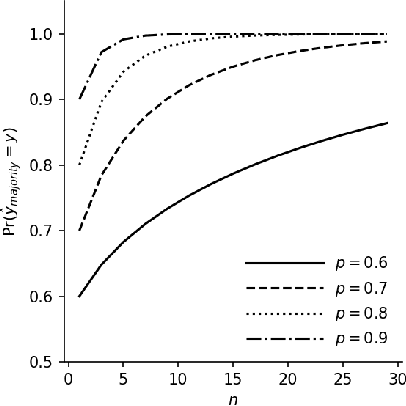
There is a striking relationship between a three hundred years old Political Science theorem named "Condorcet's jury theorem" (1785), which states that majorities are more likely to choose correctly when individual votes are often correct and independent, and a modern Machine Learning concept called "Strength of Weak Learnability" (1990), which describes a method for converting a weak learning algorithm into one that achieves arbitrarily high accuracy and stands in the basis of Ensemble Learning. Albeit the intuitive statement of Condorcet's theorem, we could not find a compact and simple rigorous mathematical proof of the theorem neither in classical handbooks of Machine Learning nor in published papers. By all means we do not claim to discover or reinvent a theory nor a result. We humbly want to offer a more publicly available simple derivation of the theorem. We will find joy in seeing more teachers of introduction-to-machine-learning courses use the proof we provide here as an exercise to explain the motivation of ensemble learning.