 Add to Chrome
 Add to Firefox
 Add to Edge
Learning solutions of parameterized stiff ODEs using Gaussian processes
Nov 08, 2025
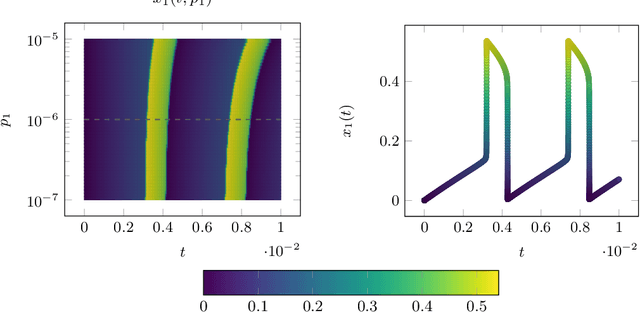

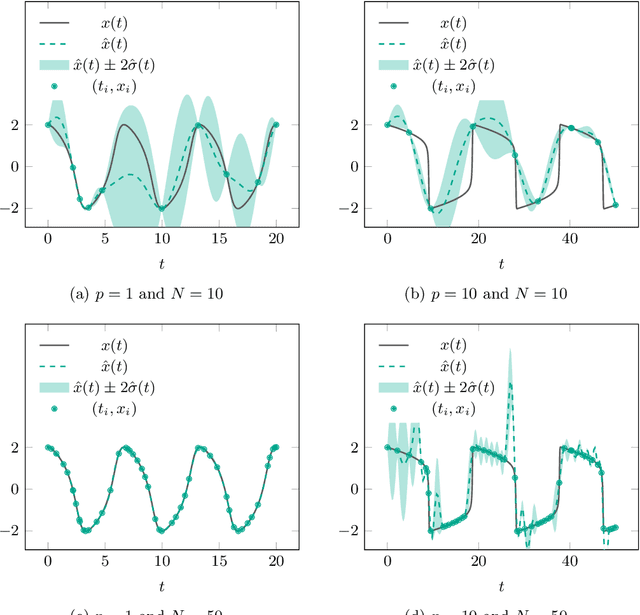
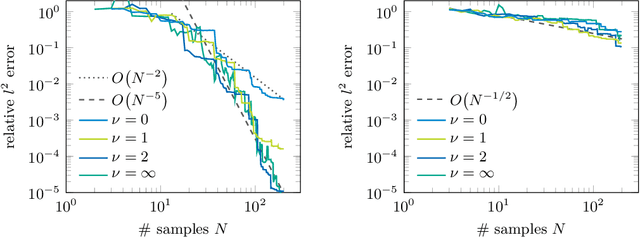
Stiff ordinary differential equations (ODEs) play an important role in many scientific and engineering applications. Often, the dependence of the solution of the ODE on additional parameters is of interest, e.g.\ when dealing with uncertainty quantification or design optimization. Directly studying this dependence can quickly become too computationally expensive, such that cheaper surrogate models approximating the solution are of interest. One popular class of surrogate models are Gaussian processes (GPs). They perform well when approximating stationary functions, functions which have a similar level of variation along any given parameter direction, however solutions to stiff ODEs are often characterized by a mixture of regions of rapid and slow variation along the time axis and when dealing with such nonstationary functions, GP performance frequently degrades drastically. We therefore aim to reparameterize stiff ODE solutions based on the available data, to make them appear more stationary and hence recover good GP performance. This approach comes with minimal computational overhead and requires no internal changes to the GP implementation, as it can be seen as a separate preprocessing step. We illustrate the achieved benefits using multiple examples.

Index-aware learning of circuits
Sep 02, 2023Electrical circuits are present in a variety of technologies, making their design an important part of computer aided engineering. The growing number of tunable parameters that affect the final design leads to a need for new approaches of quantifying their impact. Machine learning may play a key role in this regard, however current approaches often make suboptimal use of existing knowledge about the system at hand. In terms of circuits, their description via modified nodal analysis is well-understood. This particular formulation leads to systems of differential-algebraic equations (DAEs) which bring with them a number of peculiarities, e.g. hidden constraints that the solution needs to fulfill. We aim to use the recently introduced dissection concept for DAEs that can decouple a given system into ordinary differential equations, only depending on differential variables, and purely algebraic equations that describe the relations between differential and algebraic variables. The idea then is to only learn the differential variables and reconstruct the algebraic ones using the relations from the decoupling. This approach guarantees that the algebraic constraints are fulfilled up to the accuracy of the nonlinear system solver, which represents the main benefit highlighted in this article.