 Add to Chrome
 Add to Firefox
 Add to Edge
CLSGen: A Dual-Head Fine-Tuning Framework for Joint Probabilistic Classification and Verbalized Explanation
Apr 13, 2026
With the recent progress of Large Language Models (LLMs), there is a growing interest in applying these models to solve complex and challenging problems. Modern LLMs, capable of processing long contexts and generating verbalized explanations, offer significant potential in addressing real-world applications. However, a critical hurdle in deploying LLMs for practical decision-making is their inability to provide reliable, quantitative probabilities. While task-specific fine-tuning of LLMs using traditional discriminative objectives (similar to encoder-only models) can yield probability estimates, this often leads to catastrophic forgetting and linguistic collapse. Consequently, the model loses its ability to generate explanations, severely undermining its interpretability and usability. To address this challenge, we propose CLSGen, a novel LLM fine-tuning framework designed for binary classification tasks. The CLSGen framework encompasses a new model architecture, training methodology, and data construction strategy to enable robust probability estimation without sacrificing the model's inherent explanation-generation capabilities. Experimental results across multiple benchmark datasets demonstrate that models fine-tuned with CLSGen outperform existing baselines in classification metrics (AUROC and F1-score). Regarding explanation, the results showed strong alignment between predicted labels and generated justifications, as well as high readability.

Using tournaments to calculate AUROC for zero-shot classification with LLMs
Feb 20, 2025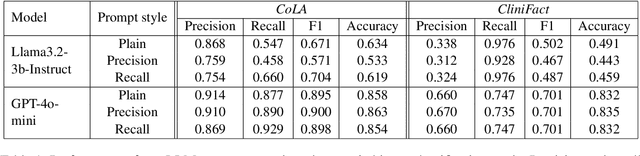
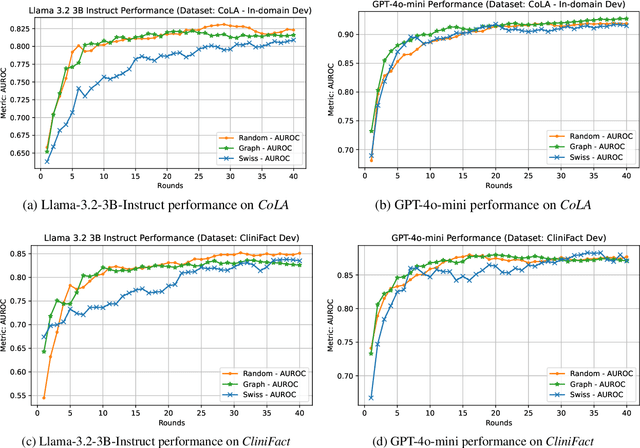
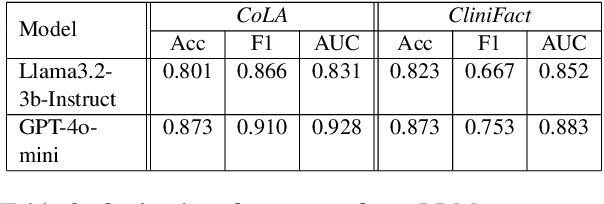
Large language models perform surprisingly well on many zero-shot classification tasks, but are difficult to fairly compare to supervised classifiers due to the lack of a modifiable decision boundary. In this work, we propose and evaluate a method that converts binary classification tasks into pairwise comparison tasks, obtaining relative rankings from LLMs. Repeated pairwise comparisons can be used to score instances using the Elo rating system (used in chess and other competitions), inducing a confidence ordering over instances in a dataset. We evaluate scheduling algorithms for their ability to minimize comparisons, and show that our proposed algorithm leads to improved classification performance, while also providing more information than traditional zero-shot classification.