 Add to Chrome
 Add to Firefox
 Add to Edge
A Real-World Evaluation of LLM Medication Safety Reviews in NHS Primary Care
Dec 24, 2025
Large language models (LLMs) often match or exceed clinician-level performance on medical benchmarks, yet very few are evaluated on real clinical data or examined beyond headline metrics. We present, to our knowledge, the first evaluation of an LLM-based medication safety review system on real NHS primary care data, with detailed characterisation of key failure behaviours across varying levels of clinical complexity. In a retrospective study using a population-scale EHR spanning 2,125,549 adults in NHS Cheshire and Merseyside, we strategically sampled patients to capture a broad range of clinical complexity and medication safety risk, yielding 277 patients after data-quality exclusions. An expert clinician reviewed these patients and graded system-identified issues and proposed interventions. Our primary LLM system showed strong performance in recognising when a clinical issue is present (sensitivity 100\% [95\% CI 98.2--100], specificity 83.1\% [95\% CI 72.7--90.1]), yet correctly identified all issues and interventions in only 46.9\% [95\% CI 41.1--52.8] of patients. Failure analysis reveals that, in this setting, the dominant failure mechanism is contextual reasoning rather than missing medication knowledge, with five primary patterns: overconfidence in uncertainty, applying standard guidelines without adjusting for patient context, misunderstanding how healthcare is delivered in practice, factual errors, and process blindness. These patterns persisted across patient complexity and demographic strata, and across a range of state-of-the-art models and configurations. We provide 45 detailed vignettes that comprehensively cover all identified failure cases. This work highlights shortcomings that must be addressed before LLM-based clinical AI can be safely deployed. It also begs larger-scale, prospective evaluations and deeper study of LLM behaviours in clinical contexts.

Improving Pre-trained Language Model Sensitivity via Mask Specific losses: A case study on Biomedical NER
Mar 28, 2024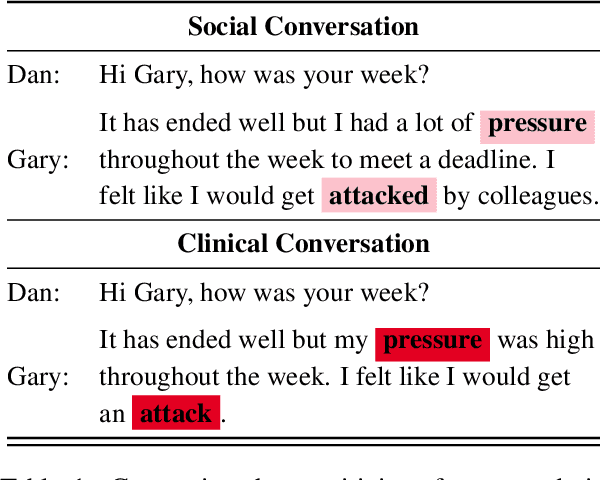

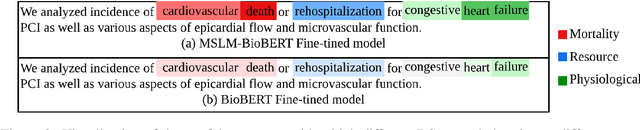
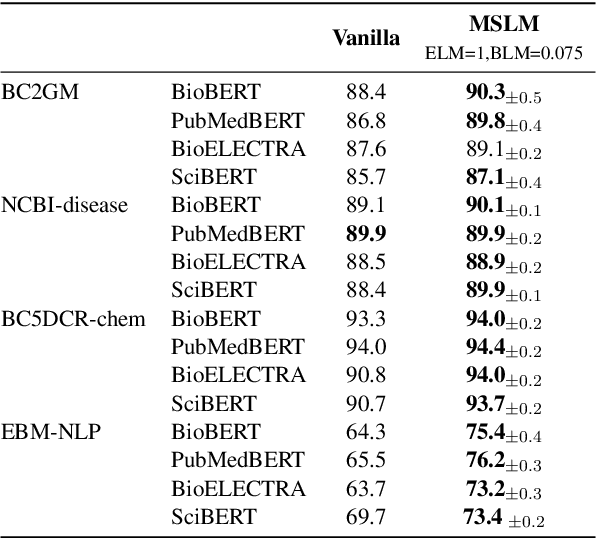
Adapting language models (LMs) to novel domains is often achieved through fine-tuning a pre-trained LM (PLM) on domain-specific data. Fine-tuning introduces new knowledge into an LM, enabling it to comprehend and efficiently perform a target domain task. Fine-tuning can however be inadvertently insensitive if it ignores the wide array of disparities (e.g in word meaning) between source and target domains. For instance, words such as chronic and pressure may be treated lightly in social conversations, however, clinically, these words are usually an expression of concern. To address insensitive fine-tuning, we propose Mask Specific Language Modeling (MSLM), an approach that efficiently acquires target domain knowledge by appropriately weighting the importance of domain-specific terms (DS-terms) during fine-tuning. MSLM jointly masks DS-terms and generic words, then learns mask-specific losses by ensuring LMs incur larger penalties for inaccurately predicting DS-terms compared to generic words. Results of our analysis show that MSLM improves LMs sensitivity and detection of DS-terms. We empirically show that an optimal masking rate not only depends on the LM, but also on the dataset and the length of sequences. Our proposed masking strategy outperforms advanced masking strategies such as span- and PMI-based masking.