 Add to Chrome
 Add to Firefox
 Add to Edge
LLMServingSim 2.0: A Unified Simulator for Heterogeneous and Disaggregated LLM Serving Infrastructure
Feb 26, 2026
Large language model (LLM) serving infrastructures are undergoing a shift toward heterogeneity and disaggregation. Modern deployments increasingly integrate diverse accelerators and near-memory processing technologies, introducing significant hardware heterogeneity, while system software increasingly separates computation, memory, and model components across distributed resources to improve scalability and efficiency. As a result, LLM serving performance is no longer determined by hardware or software choices in isolation, but by their runtime interaction through scheduling, data movement, and interconnect behavior. However, understanding these interactions remains challenging, as existing simulators lack the ability to jointly model heterogeneous hardware and disaggregated serving techniques within a unified, runtime-driven framework. This paper presents LLMServingSim 2.0, a unified system-level simulator designed to make runtime-driven hardware-software interactions in heterogeneous and disaggregated LLM serving infrastructures explicit and analyzable. LLMServingSim 2.0 embeds serving decisions and hardware behavior into a single runtime loop, enabling interaction-aware modeling of batching, routing, offloading, memory, and power. The simulator supports extensible integration of emerging accelerators and memory systems through profile-based modeling, while capturing dynamic serving behavior and system-level effects. We validate LLMServingSim 2.0 against real deployments, showing that it reproduces key performance, memory, and power metrics with an average error of 0.97%, while maintaining simulation times of around 10 minutes even for complex configurations. These results demonstrate that LLMServingSim 2.0 provides a practical bridge between hardware innovation and serving-system design, enabling systematic exploration and co-design for next-generation LLM serving infrastructures.

LLMServingSim2.0: A Unified Simulator for Heterogeneous Hardware and Serving Techniques in LLM Infrastructure
Nov 10, 2025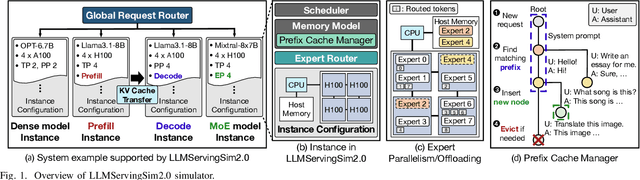
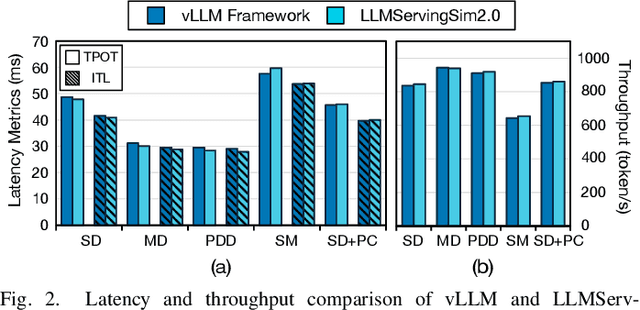
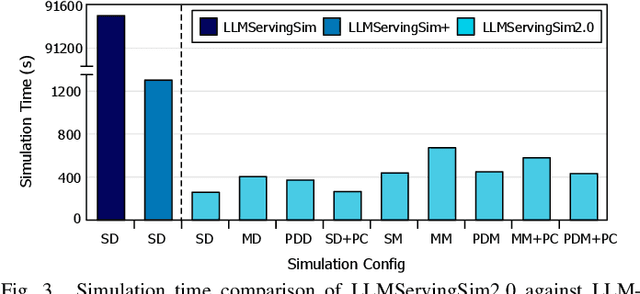
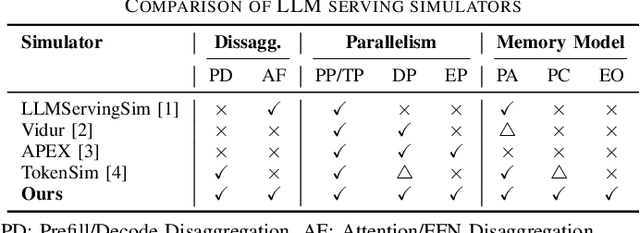
This paper introduces LLMServingSim2.0, a system simulator designed for exploring heterogeneous hardware in large-scale LLM serving systems. LLMServingSim2.0 addresses two key limitations of its predecessor: (1) integrating hardware models into system-level simulators is non-trivial due to the lack of a clear abstraction, and (2) existing simulators support only a narrow subset of serving techniques, leaving no infrastructure that captures the breadth of approaches in modern LLM serving. To overcome these issues, LLMServingSim2.0 adopts trace-driven performance modeling, accompanied by an operator-level latency profiler, enabling the integration of new accelerators with a single command. It further embeds up-to-date serving techniques while exposing flexible interfaces for request routing, cache management, and scheduling policies. In a TPU case study, our profiler requires 18.5x fewer LoC and outperforms the predecessor's hardware-simulator integration, demonstrating LLMServingSim2.0's low-effort hardware extensibility. Our experiments further show that LLMServingSim2.0 reproduces GPU-based LLM serving with 1.9% error, while maintaining practical simulation time, making it a comprehensive platform for both hardware developers and LLM service providers.
* 4 pages, 3 figures
Blind-Match: Efficient Homomorphic Encryption-Based 1:N Matching for Privacy-Preserving Biometric Identification
Aug 12, 2024We present Blind-Match, a novel biometric identification system that leverages homomorphic encryption (HE) for efficient and privacy-preserving 1:N matching. Blind-Match introduces a HE-optimized cosine similarity computation method, where the key idea is to divide the feature vector into smaller parts for processing rather than computing the entire vector at once. By optimizing the number of these parts, Blind-Match minimizes execution time while ensuring data privacy through HE. Blind-Match achieves superior performance compared to state-of-the-art methods across various biometric datasets. On the LFW face dataset, Blind-Match attains a 99.63% Rank-1 accuracy with a 128-dimensional feature vector, demonstrating its robustness in face recognition tasks. For fingerprint identification, Blind-Match achieves a remarkable 99.55% Rank-1 accuracy on the PolyU dataset, even with a compact 16-dimensional feature vector, significantly outperforming the state-of-the-art method, Blind-Touch, which achieves only 59.17%. Furthermore, Blind-Match showcases practical efficiency in large-scale biometric identification scenarios, such as Naver Cloud's FaceSign, by processing 6,144 biometric samples in 0.74 seconds using a 128-dimensional feature vector.
LLMServingSim: A HW/SW Co-Simulation Infrastructure for LLM Inference Serving at Scale
Aug 10, 2024Recently, there has been an extensive research effort in building efficient large language model (LLM) inference serving systems. These efforts not only include innovations in the algorithm and software domains but also constitute developments of various hardware acceleration techniques. Nevertheless, there is a lack of simulation infrastructure capable of accurately modeling versatile hardware-software behaviors in LLM serving systems without extensively extending the simulation time. This paper aims to develop an effective simulation tool, called LLMServingSim, to support future research in LLM serving systems. In designing LLMServingSim, we focus on two limitations of existing simulators: (1) they lack consideration of the dynamic workload variations of LLM inference serving due to its autoregressive nature, and (2) they incur repetitive simulations without leveraging algorithmic redundancies in LLMs. To address these limitations, LLMServingSim simulates the LLM serving in the granularity of iterations, leveraging the computation redundancies across decoder blocks and reusing the simulation results from previous iterations. Additionally, LLMServingSim provides a flexible framework that allows users to plug in any accelerator compiler-and-simulation stacks for exploring various system designs with heterogeneous processors. Our experiments demonstrate that LLMServingSim produces simulation results closely following the performance behaviors of real GPU-based LLM serving system with less than 14.7% error rate, while offering 91.5x faster simulation speed compared to existing accelerator simulators.